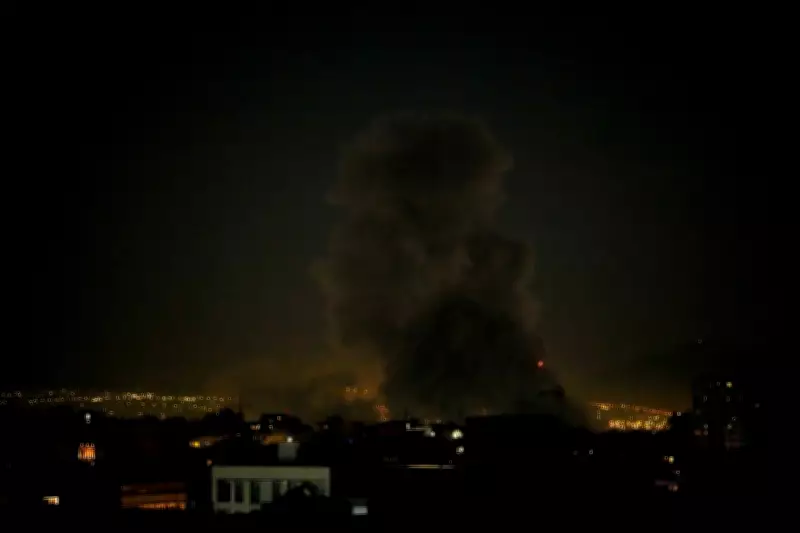
The Associated Press has made a significant editorial decision to refer to the escalating military confrontations between Iran, the United States, and Israel as the "Iran war." This updated terminology, announced on Monday, 2 March 2026, reflects the broadening scope and heightened intensity of a conflict that has increasingly centered on Iran, even as other regional actors become involved.
Rationale Behind the 'Iran War' Designation
The AP's classification stems from a series of aggressive military actions and retaliations that have unfolded. The United States and Israel initiated attacks on key Iranian military targets, resulting in the death of Supreme Leader Ayatollah Ali Khamenei and other senior government officials. In response, Iran launched missiles and drones at Israel and several Gulf Arab states that host U.S. armed forces, with remaining Iranian leaders vowing revenge for Khamenei's assassination.
These strikes and counterattacks indicate that the killing of Khamenei, coupled with U.S. President Donald Trump's public calls for the overthrow of the Islamic Republic, could precipitate a prolonged and widespread conflict engulfing the entire Middle East region.

Meeting the Definition of War
According to Merriam-Webster, war is defined as "a state of usually open and declared armed hostile conflict between states or nations" or "a state of hostility, conflict, or antagonism." Although none of the involved countries have formally declared war, the AP asserts that the attacks by the U.S. and Israel, combined with Iran's substantial retaliation, satisfy these criteria.
The decision by the Trump administration and Israeli leaders to execute these attacks, followed by significant destruction and casualties, provides sufficient grounds to label the actions and Iran's response as a war. Notably, President Trump himself has used the term "war" to describe the ongoing conflict.
The Importance of Accurate Terminology
Using precise language to describe military engagements between sovereign nations is crucial. In situations where a one-sided attack occurs without further escalation, or a conflict begins but does not intensify, indiscriminately applying the term "war" could dilute its significance. This, in turn, might lead to public desensitization, where people fail to grasp the gravity when a genuine war erupts.
Precedents for AP's Use of 'War'
The AP has previously issued guidance to use the word "war" in specific conflicts. For instance, in June 2025, following attacks on Iran by Israel and subsequent Iranian retaliation, the AP employed the term "war" to describe the hostilities, which lasted 12 days and significantly degraded Iran's air defenses, military leadership, and nuclear program through Israeli and American strikes.
Similarly, the AP began using "war" to characterize the conflicts between Russia and Ukraine and between Israel and Hamas shortly after fighting commenced in those cases. In making these determinations, editors evaluated factors such as casualty numbers, fighting intensity, the involvement of each party, and the terminology used by the countries themselves.
Stylistic Considerations and Future Guidance
The AP capitalizes the word "war" only when it forms part of a formal name, which does not currently exist for this conflict, hence the lowercase usage in "Iran war." Decisions regarding the application of the term are made in real time, with AP's news leaders and standards editors continuously monitoring developments to assess whether adjustments are necessary.
At this juncture, the level of fighting unequivocally constitutes the countries being at war, regardless of future developments. Even if hostilities were to cease imminently, the AP would maintain that the nations had been engaged in a war, underscoring the historical significance of the current escalation.