
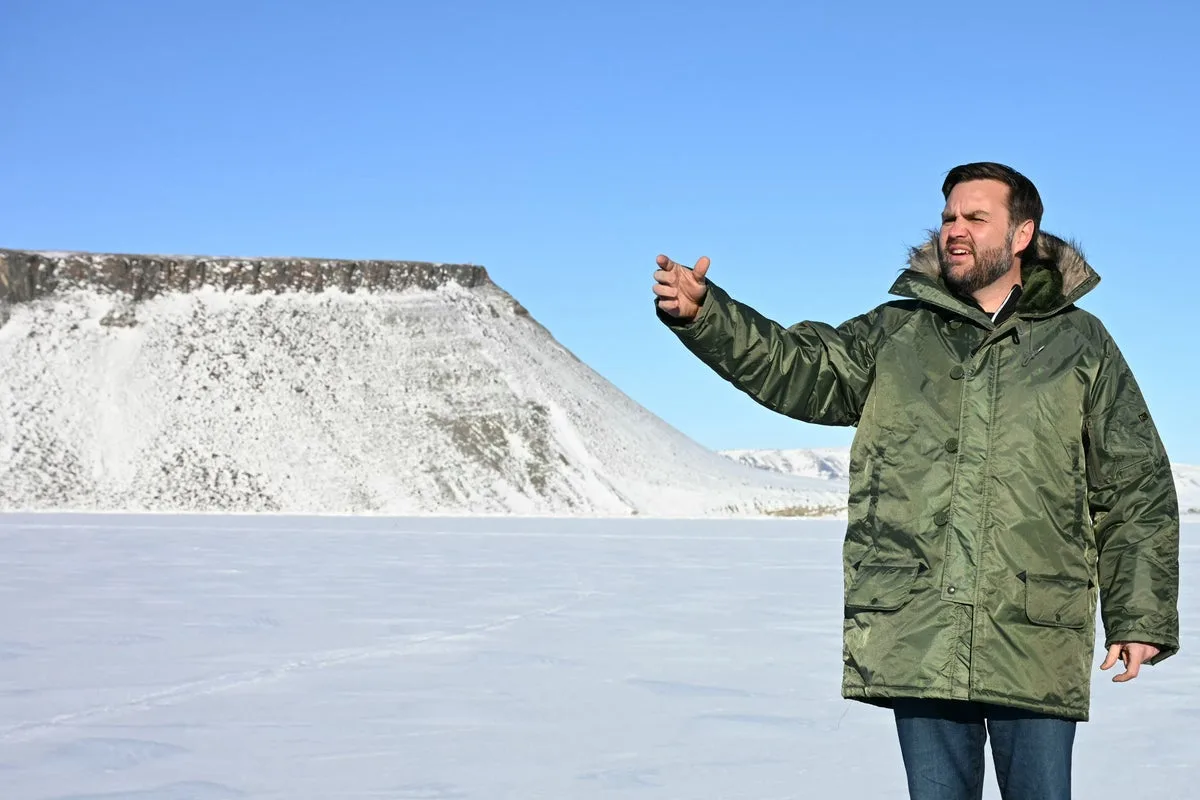
US President Donald Trump has repeatedly stated his desire for the United States to control Greenland, a self-governing territory of Denmark. The island, rich in rare earth minerals and strategically located in the Arctic, has become a focal point of international tension over trade and security. Trump has threatened to take the territory “the easy way or the hard way,” though both Denmark and Greenland’s government have rejected the idea. A summit at the White House is set to address the issue.
Greenland’s strategic importance dates back to World War II, when the US occupied it to prevent Nazi Germany from seizing the island and to protect North Atlantic shipping lanes. Today, the US operates Pituffik Space Base in northwestern Greenland, which supports missile warning and space surveillance for NATO. Greenland also guards the GIUK Gap, a key chokepoint for monitoring Russian naval movements in the North Atlantic.
Climate change is opening up the Arctic, creating potential new trade routes and reigniting competition with Russia and China. The Trump administration argues that Denmark has not done enough to secure the region, prompting European allies to bolster their defences. Denmark has announced major investments in Arctic naval vessels, drones, and satellite capabilities to strengthen its presence.
Greenland holds vast deposits of rare earth minerals essential for modern technology like smartphones and batteries. The US and other Western nations seek to reduce China’s dominance in this market. However, development is hampered by Greenland’s harsh climate and strict environmental regulations.
Despite US pressure, Greenland’s prime minister has stated that the island will not be owned or governed by Washington. Denmark’s Joint Arctic Command, headquartered in Nuuk, oversees surveillance and sovereignty enforcement, including the elite Sirius Dog Sled Patrol. China has also declared itself a “near-Arctic state” and plans a “Polar Silk Road,” adding to the geopolitical complexity.




