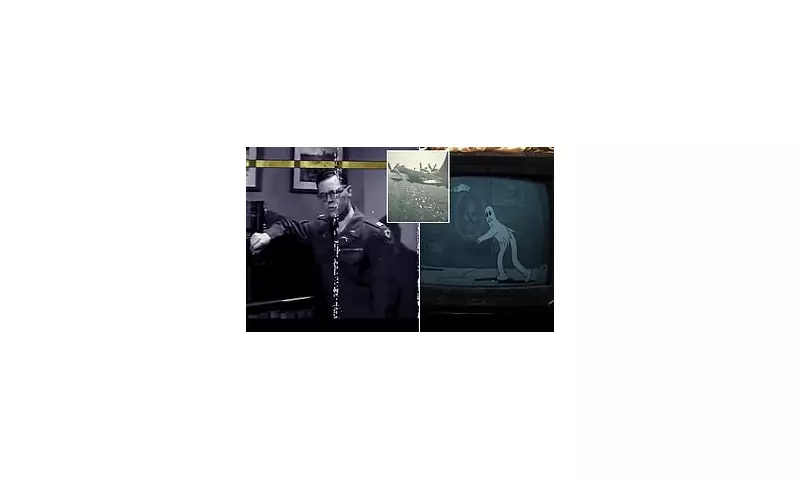
A clandestine United States military unit has unveiled a startling new recruitment film packed with unsettling imagery and hidden messages, marking their strongest pitch yet for new operatives.
The Chilling Visuals of Modern Warfare
The 4th Psychological Operations-Airborne, stationed at Fort Bragg in North Carolina, specializes in influence campaigns designed to shape how enemies think, react and communicate. Their latest video opens with a disturbing scene: a burning 1980s CRT television flickering to life with the dancing ghost from Fleischer Studios' 1930 cartoon 'Swing You Sinners!'
Within moments, the screen transitions to a dark forest where propaganda leaflets drift through trees, followed by soldiers standing anonymously among civilians as the words 'We are everywhere' flash ominously across the frame. The video then appears to rewind to a World War II-era bombing run, showing aircraft dropping pamphlets over crowds below.

A gravel-voiced narrator delivers the film's central message: 'There's another force applied in combat that we generally don't think of as a weapon of war. That weapon is words.' His warning echoes throughout: 'We are everywhere. Words are our weapon.'
Inside PSYOP's Demanding Recruitment Process
The video represents the Army's most ambitious attempt to attract recruits who can craft viral memes as confidently as they parachute from aircraft. It features numerous Easter eggs, including nods to conspiracy theories, the WWII 'Ghost Army' that deceived Nazi generals, and even a Pepe the Frog GIF dressed in a clown suit.
Soldiers aspiring to join this elite unit face an exceptionally demanding pathway. The process begins with a gruelling 10-day assessment evaluating physical fitness, mental resilience, critical thinking, communication skills and sustainability. Master Sergeant Mathews, the Noncommissioned Officer in Charge of the PSYOP Assessment and Selection course, explained they seek soldiers 'adept at conducting research to understand target audiences and use critical thinking to determine the best methods and arguments to influence.'
Candidates don't merely undergo physical challenges but also write reports, craft narratives, and present arguments simulating real-world PSYOP tasks. They undergo psychological evaluations to determine their suitability for these high-pressure roles.
The Art of Psychological Warfare
Successful candidates proceed to the 41-week Psychological Operations Qualification Course, studying human psychology, sociology and cultural dynamics to design effective influence strategies. They learn to identify and analyze groups for tailored messaging while crafting communications that align with mission objectives.
The 4th PSYOP conducts what they term 'influence activities to target psychological vulnerabilities and create or intensify fissures, confusion, and doubt in adversary organizations.' Their official website states: 'We use all available means of dissemination – from sensitive and high tech to low-tech, to no-tech, and methods from overt, to clandestine, to deception.'
The video concludes with the unit's lightning-bolt patch and a pulsing QR code directing viewers to goarmy.com/PSYOP, completing a recruitment pitch that blurs the lines between traditional warfare and modern psychological operations.