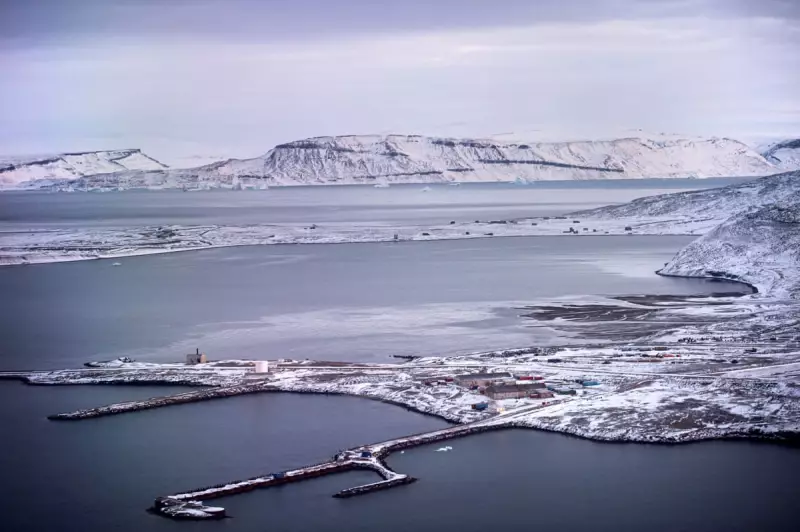
The remote, icy expanse of Greenland has served as a critical strategic outpost for the United States military for over eight decades. This history, marked by secret pacts, massive construction projects, and a chilling nuclear incident, underscores the island's enduring geopolitical importance far beyond its sparse population.
The Wartime Foundation: Securing the Atlantic
In April 1941, with Denmark under Nazi occupation, the United States moved decisively to prevent Germany from establishing a foothold in the Western Hemisphere. The US secured an agreement with the Danish minister in Washington to assume responsibility for defending Greenland. As reported at the time, intelligence suggested Germany was poised to seize southern Greenland for an airbase, with bombers and transports waiting in Norway.
The agreement was framed as an extension of the Monroe Doctrine. It allowed the US to establish landing fields and harbour facilities, creating a vital "hop" route for short-range American fighter planes travelling via Newfoundland and Iceland to Britain. American naval vessels gaining access to Greenland's waters could also provide unofficial protection for merchant shipping in the mid-Atlantic.

Cold War Expansion and the Thule Megabase
The strategic partnership was formalised in April 1951 with a new Danish-American defence agreement for Greenland, established under the nascent North Atlantic Treaty. This pact laid the groundwork for a significant military build-up. By November 1952, Danish sources announced plans for at least four major new US air force bases in Greenland, supplementing the three existing sites.
These new bases were designed to be hundreds of miles closer to the Soviet Union than the already formidable base at Thule (Pituffik), positioning them directly across the expected flight path of Soviet bombers targeting North America. The crown jewel of this network was Thule Air Base itself. Constructed in great secrecy beginning in 1951, the project was a monumental feat of logistics and engineering.
Building costs for Thule alone reached $500 million. Initial supplies were flown in over 4,000 kilometres, followed by a seaborne operation involving 50 transport ships and icebreakers during the brief 70-day window when the Melville Bay was navigable. The result was a highly mechanised, men-only town boasting one of the world's finest military airfields by 1956, complete with a three-kilometre runway.
Crisis on the Ice: The 1968 Nuclear Accident
The peril of stationing advanced weaponry in such a harsh environment was starkly revealed on 21 January 1968. An American B-52 bomber, carrying four unarmed hydrogen bombs, crashed on the ice near Thule. The aircraft broke through the ice, plunging its nuclear payload into the freezing waters.
The incident caused immediate diplomatic tension. The Danish Prime Minister, Hilmar Baunsgaard, demanded full information from Washington and forcefully reiterated Denmark's long-standing policy prohibiting nuclear weapons on its soil, a prohibition explicitly including Greenland. In response, US airmen embarked on a gruelling clean-up operation in March 1968, using shovels and axes to collect tons of radioactive snow and ice, which was sealed in containers for eventual removal.
This history, from its World War II origins through Cold War escalation to environmental crisis, illustrates how Greenland's frozen landscape became a permanent chessboard for global power dynamics. The bases, particularly Thule, remain active today, a testament to the island's unwavering strategic value.