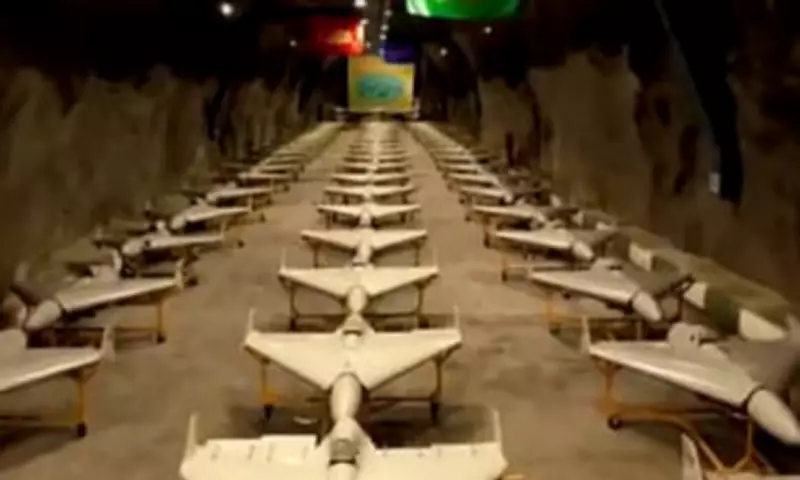
Iran has dramatically showcased a sprawling underground network of tunnels, packed with row after row of drones and rockets, amid escalating fears that the United States and its allies are rapidly depleting their expensive weaponry in the intensifying war against the regime.
Propaganda Footage Reveals Extensive Arsenal
Footage released by the Fars News Agency, which maintains close ties to Iran's Islamic Revolutionary Guard Corps, displayed long lines of missiles and Shahed drones within the subterranean complex. The video, set to a ticking clock soundtrack, employed dramatic drone cinematography to emphasise the sheer scale of Iran's inexpensive arsenal.
Stark Cost Disparity in Modern Warfare
Shahed drones are remarkably cheap to produce, costing merely tens of thousands of dollars and requiring minimal manufacturing time. This presents a sharp contrast to the sophisticated, high-cost weaponry favoured by the US and its allies. For instance, American-made Patriot missiles can range from $4 to $5 million each, with export prices often even higher. Meanwhile, THAAD missile batteries carry a price tag of approximately $13 million per unit.

Analysis conducted by Kirsty Grieco, a security expert at the Stimson Centre in Washington DC, revealed that the United Arab Emirates successfully intercepted 92% of the missiles and drones launched by Iran. Grieco estimates Iran spent between $11 million and $27 million on the 541 drones it launched at the UAE. In contrast, the cost to shoot down 506 of these drones, using interceptors averaging $500,000 to $1.5 million each, resulted in UAE defence expenditures soaring to between $253 million and $759 million. This indicates the UAE may have spent up to thirty times more on defence than Iran spent on its offensive operations.
Critical Shortages Loom for Gulf Defences
There are growing concerns that Gulf states could soon exhaust their anti-air defence systems. A source informed the Daily Mail that, at current depletion rates, supplies of interceptors might be depleted within just four days, noting they are being utilised at an unprecedented speed.
Conflict Escalates with Regional and Global Impact
The revelations come as explosions echoed in Iran's capital, Tehran, at dawn on Wednesday, marking the fifth day of conflict involving the United States and Israel. Israel has targeted Iranian leadership and security forces, while the Islamic Republic has retaliated with missile barrages and drone attacks on Israel and across the region. Israel's military confirmed its air defences were activated to intercept Iranian missiles, with explosions reported near Jerusalem.
Economic Shockwaves from the Strait of Hormuz
With Iran's strategic control over tanker movements through the Strait of Hormuz—a critical chokepoint through which about one-fifth of the world's oil is shipped—Brent crude prices have surged to over $82 per barrel. This represents an increase of more than 13% since the conflict's onset, reaching its highest level since July 2024. Global stock markets have suffered significant losses due to anxieties that soaring oil prices could stifle the world economy and erode corporate profits.
Diplomatic and Military Developments
The American Embassy in Saudi Arabia and the US Consulate in the United Arab Emirates faced drone attacks on Tuesday. In response, the US State Department authorised the evacuation of non-emergency government personnel from Saudi Arabia on Wednesday.
US Navy Admiral Brad Cooper, head of US Central Command, reported that Iran has launched more than 500 ballistic missiles and 2,000 drones to date. He described the initial American strikes as "nearly double the scale" of those at the start of the 2003 US-led invasion of Iraq. Cooper stated, "We've already struck nearly 2,000 targets, with more than 2,000 munitions. We have severely degraded Iran's air defences and destroyed hundreds of Iran's ballistic missiles, launchers and drones." He added, "In simple terms, we are focused on shooting all the things that can shoot at us."

Five days into a conflict that US President Donald Trump suggested could persist for a month or longer, nearly 800 people have been killed in Iran, including individuals Trump mentioned as potential future leaders. Israel confirmed on Wednesday it was executing a series of strikes across Tehran aimed at Iranian security forces, following an attack the previous day on a building linked to the clerical panel responsible for selecting Iran's next supreme leader in Qom.