

France Announces Nuclear Arsenal Expansion Amid Global Security Concerns
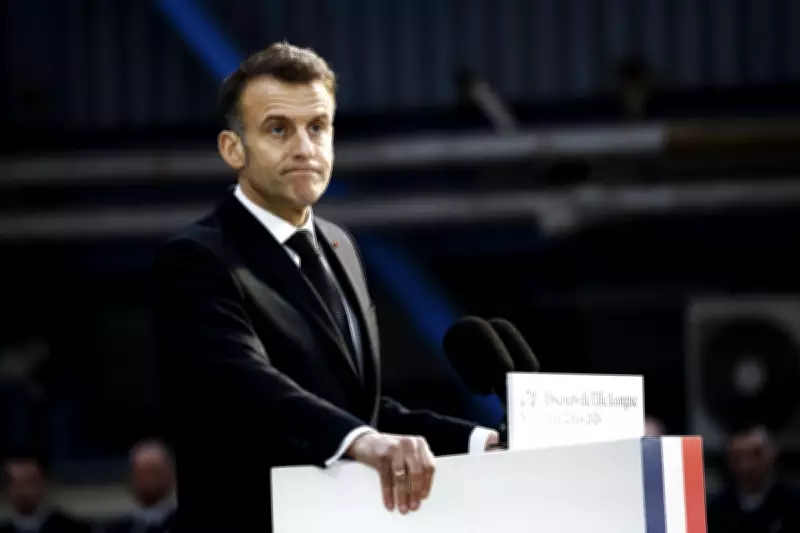
French President Emmanuel Macron has declared that France will increase its number of nuclear warheads, marking the first expansion of the country's arsenal since at least 1992. The announcement was made during a significant address at the Ile Longue naval base on France's Atlantic coast, home to the nation's ballistic missile submarines.
Macron's Warning of a 'Hardening' World
President Macron delivered a stark warning about the current global security landscape, describing a world that is "hardening" and becoming increasingly dangerous. He emphasized that Europe must take greater responsibility for its own security in this evolving environment.
"I have decided to increase the numbers of warheads of our arsenal," Macron stated firmly. "My responsibility is to ensure that our deterrence maintains – and will maintain in the future – its assured destructive power."

The French leader articulated a philosophical justification for the move with the statement: "To be free, one needs to be feared."
New 'Forward Deterrence' Posture
Macron described France's new strategic approach as "forward deterrence," which will enable "the temporary deployment of elements of our strategic air forces to allied countries" across Europe. This represents a significant shift in France's nuclear posture and European security cooperation.
However, Macron was unequivocal about maintaining exclusive French control over nuclear decision-making. He ruled out any arrangement where German aircraft would carry French nuclear bombs, insisting that any decision to use France's nuclear weapons would remain solely in the hands of the French president.
"If we had to use our arsenal, no state, however powerful, could shield itself from it, and no state, however vast, would recover from it," Macron declared, emphasizing the devastating potential of France's nuclear capabilities.
European Security Cooperation
The announcement comes amid growing European concerns about Russia's ongoing war in Ukraine and questions about long-term United States security commitments under the traditional nuclear umbrella. Macron noted that recent shifts in US defense priorities and the emergence of new threats have encouraged Europe to take its destiny "more firmly into its own hands."
France has initiated talks on deterrence cooperation with multiple European nations, including Britain, Germany, Poland, the Netherlands, Belgium, Greece, Sweden, and Denmark. Under the proposed framework, some partner countries will be able to host French strategic air forces, while allies' conventional forces may participate in French nuclear exercises.
In a joint statement, Macron and German Chancellor Friedrich Merz confirmed that the two nations would deepen integration in deterrence starting this year, "including German conventional participation in French nuclear exercises and joint visits to strategic sites."
International Reactions and Concerns
The Netherlands clarified its position, stating it was engaged in strategic talks with France on nuclear deterrence as "a supplement to, and not a replacement for, NATO's collective defense and nuclear deterrence capabilities."
Polish Prime Minister Donald Tusk expressed support for the initiative, writing on social media that "we are arming up together with our friends so that our enemies will never dare to attack us."
However, the announcement drew immediate criticism from disarmament campaigners. The International Campaign to Abolish Nuclear Weapons warned that the move risks escalating tensions and undermining global non-proliferation efforts.
"These are indiscriminate weapons that are banned under the Treaty on the Prohibition of Nuclear Weapons," said the group's executive director, Melissa Parke. "This is not progress, it's a nuclear arms race that no one can afford."
Strategic Context and Justification
France currently maintains fewer than 300 nuclear warheads and stands as the only nuclear power within the European Union since Britain's departure from the bloc in 2020. Both France and Britain remain the only Western European countries with nuclear arsenals, while the United States and Russia possess far larger stockpiles numbering in the thousands of warheads each.

Macron cited multiple factors contributing to what he described as a more dangerous global environment, including Russia's war in Ukraine, China's rapid military build-up, and the expansion of arsenals by other regional powers. He noted that adversaries were becoming "bolder," alliances more uncertain, and nuclear risks higher than in previous decades.
The French president insisted that the expansion was not about entering into an arms race but rather ensuring that "no adversary" could contemplate a strike against France or its interests without facing unacceptable consequences. This strategic calculus reflects France's determination to maintain credible deterrence in an increasingly volatile international security landscape.





