

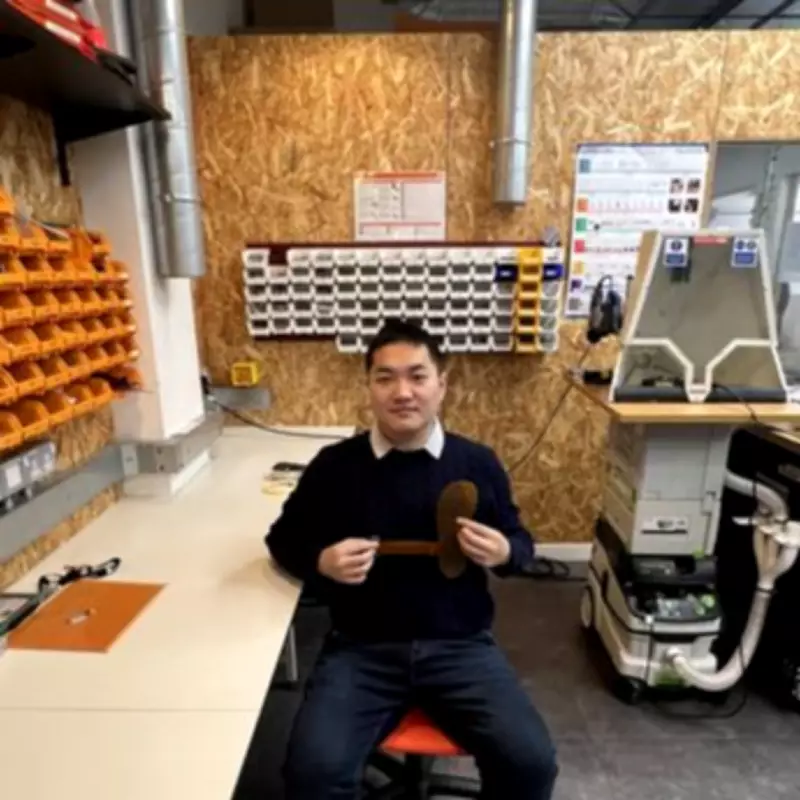
In a groundbreaking development for elderly care and mobility, a UK scientist has engineered an innovative smart shoe designed to prevent millions of older adults from experiencing dangerous falls. Dr Jiayang Li, an electrical engineering lecturer at the University of Bristol, invented the prototype after observing his 89-year-old mentor, Peter Langlois, struggling with balance issues.
Inspiration Behind the Invention
Dr Li was motivated to create the futuristic shoe when he noticed Mr Langlois, who remains actively involved in editing research papers at age 89, becoming unsteady on his feet. "His mind remains extremely sharp and his dedication is so inspiring," Dr Li explained. "One day I noticed he was unsteady on his feet and almost lost his balance. It got me thinking this is very risky and could have terrible consequences if it resulted in a fall, especially for people who live alone."
Advanced Sensor Technology
The smart shoe features an insole embedded with 253 minuscule sensors that provide laboratory-grade, real-time data on the wearer's gait patterns. This information can be conveniently viewed on tablets or mobile phones, making it accessible for everyday monitoring. The technology represents a significant advancement from previous hospital-based analysis methods by offering mobility and practicality.

"I realised we could apply similar techniques to monitor how well people are walking," said Dr Li, referencing his earlier work developing sensors for lung function assessment. "Mapping their leg gestures in detail could detect risk of falls, helping people like Peter stay safe whilst also keeping their independence at home."
Technical Specifications and Functionality
The device operates through a sophisticated microchip capable of simultaneously reading all 253 sensors embedded in the shoe sole. This system creates detailed images of the wearer's foot, pinpointing pressure areas and determining whether they're walking steadily or at risk of tumbling. Remarkably, the technology runs on just 100 microwatts of power, allowing it to operate for approximately three months before requiring recharging.
"The power of the microchip is just 100 microwatts so the device could run for around three months before it needs recharging," Dr Li elaborated. "To ensure the gadget is practical for everyday use, it operates on a low-voltage battery, meaning it could theoretically be powered by compact screen devices, such as a mobile phone or even a smartwatch."
Clinical Evaluation and Future Prospects
The prototype will be showcased to industry professionals this week at the Institute of Electrical and Electronics Engineers conference. Dr Li emphasized that the concept could be easily mass-produced, creating low-cost shoe soles that could transform older people's lives on a global scale.
"Fall prevention is a huge challenge for ageing populations, so the potential to anticipate and avoid that happening with our invention is really exciting," Dr Li stated. "Next, we'll conduct a formal clinical evaluation with a larger and more diverse group to validate how well it predicts fall risk, refine the analysis provided by the device it's connected to, and work with clinical and industry partners to translate it into a scalable product."
When Dr Li explained the concept to his mentor Peter Langlois, the elderly academic was deeply moved by the potential impact. "He was really touched and is pleased it might one day be manufactured and used to help so many people," Dr Li reported, highlighting the personal connection that drove this technological innovation forward.






