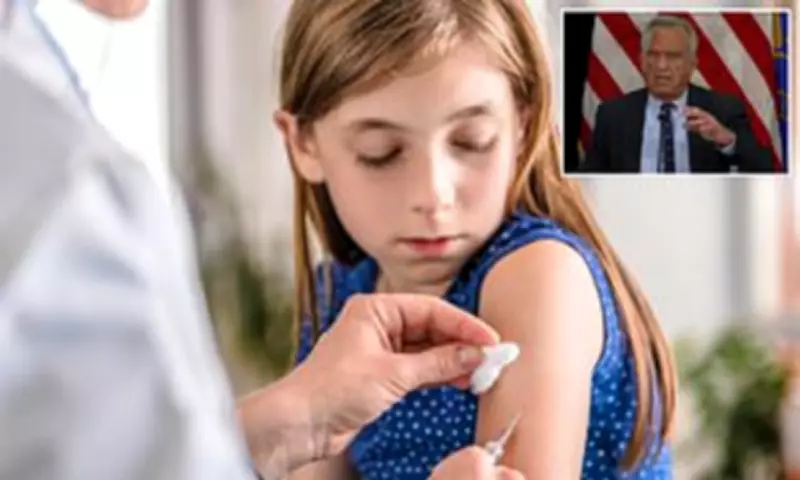
US States Challenge School Vaccine Mandates Amid Federal Policy Shift
A growing number of American states are actively pursuing the elimination or significant weakening of long-standing vaccine mandates for schoolchildren, with varying degrees of legislative success. This state-level campaign is unfolding concurrently with substantial federal policy changes, potentially setting the stage for a nationwide rollback of such public health requirements.
Federal Schedule Revision and State Legislative Momentum
Under the leadership of Secretary Robert F. Kennedy Jr., the Department of Health and Human Services has overseen a notable revision to the Centers for Disease Control and Prevention's childhood immunization schedule. The updated guidelines have reduced the number of routinely recommended vaccines from seventeen to eleven. Several key immunizations, including those for rotavirus, COVID-19, influenza, hepatitis A and B, and meningitis, have been reclassified. They are no longer universally recommended for all children but are instead placed into categories such as 'shared clinical decision-making' or are advised only for children deemed at high risk.
This federal adjustment forms one part of a dual-pronged strategy to reshape American vaccine policy. The other component is a coordinated, well-funded campaign at the state level, aimed at dismantling the school-entry vaccine mandates that have been foundational for decades. At least nine states have introduced legislation to eliminate or substantially weaken these requirements.

Idaho and Iowa are at the forefront, with measures advancing to remove mandates entirely. Iowa's HF 2171, which would eliminate all school vaccine requirements, has progressed through committee and awaits a full House vote. New Hampshire is advancing two targeted bills: HB 1811, amended to retain only the polio mandate, and HB 1719, which specifically targets the hepatitis B requirement.
The Coordinated Campaign Behind the Push
The effort to overturn state mandates is being spearheaded by the Medical Freedom Act Coalition, an umbrella organization comprising at least fifteen nonprofit groups. This coalition includes Children's Health Defense, the anti-vaccine nonprofit co-founded by RFK Jr., and various organizations created to support his 'Make America Healthy Again' initiative. While Kennedy states he is no longer involved with Children's Health Defense, his allies are leading this legislative charge.
Legislative momentum has accelerated significantly in 2025 and early 2026. Florida, following an announcement by Surgeon General Joseph Ladapo, is pursuing Senate Bill 1756 to expand personal belief exemptions while also initiating regulatory changes to drop requirements for hepatitis B and chickenpox vaccines. Arizona has a broad anti-mandate bill pending, though it faces a likely veto from the state's Democratic governor. West Virginia has introduced multiple bills to create religious exemptions and prohibit mandates outright.
These recent efforts build upon Idaho's 2025 Medical Freedom Act, which broadly prohibits discrimination based on vaccination status, creating legal conflicts with existing school mandates. Activists frequently cite the Trump Administration's perceived leniency on vaccines as evidence to argue that certain immunizations are not essential for all children, thereby justifying the elimination of school requirements.
Public Health Consequences and Waning Immunization Rates
The strategic impact of these changes creates a concerning cascade. Federal signals that a vaccine is less critical empower state legislators to propose ending school mandates, which in turn risks leading to lower immunization rates and a higher probability of preventable disease outbreaks. This impact is already tragically visible.

An ongoing measles outbreak in South Carolina has infected nearly one thousand people, predominantly children, with at least nineteen requiring hospitalization for severe complications like pneumonia and brain inflammation. Data reveals that 893 of these patients had not received both doses of the measles, mumps, and rubella (MMR) vaccine, which is 97 percent effective at preventing illness. In schools at the epicenter of the outbreak, student vaccination rates fell below 80 percent, far short of the CDC's 95 percent threshold needed to maintain herd immunity against this highly infectious disease.
National data corroborates a worrying trend. Vaccination coverage for kindergarteners declined during the 2024-2025 school year. Rates for all reported vaccines, including DTaP (92.1 percent), MMR (92.5 percent), and polio (92.5 percent), fell from the previous year's levels.
Broad Public Support for Vaccines Persists
Despite the legislative attacks and activist campaigns, vaccine requirements remain widely popular among the American public. Polling from the nonpartisan Kaiser Family Foundation indicates that nine in ten parents believe it is important for children to be vaccinated against measles, mumps, rubella, and polio.
This supportive attitude transcends political divisions. While 96 percent of Democrat parents support the MMR vaccine and 95 percent support the polio vaccine, a substantial 88 percent of Republican parents endorse the MMR vaccine and 86 percent support the polio vaccine. Even among parents identifying with the MAGA movement, 85 percent reported supporting the MMR shots and 82 percent endorsed the polio vaccine.
The Department of Health and Human Services has acknowledged inquiries regarding potential nationwide efforts to change vaccine requirements but has declined to provide specific answers. As state legislatures continue their debates, the tension between coordinated political activism, evolving federal policy, established public health science, and enduring public opinion defines a critical moment for American immunization strategy.