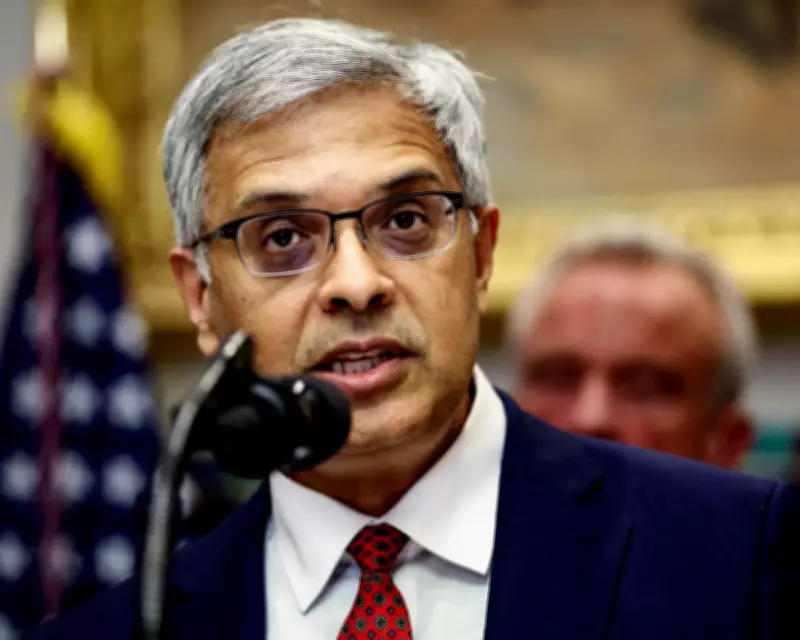
NIH Director Jay Bhattacharya Takes Helm as Acting CDC Head in Unprecedented Move
In a significant consolidation of power within United States health agencies, Jay Bhattacharya, the current director of the National Institutes of Health (NIH), has been appointed as the acting director of the Centers for Disease Control and Prevention (CDC). This announcement, made on Wednesday, marks Bhattacharya as the fourth leader to head the embattled CDC within a single year, raising eyebrows across the public health community.
The decision places Bhattacharya, a controversial health economist and close ally of Health and Human Services Secretary Robert F. Kennedy Jr., in control of two major federal health bodies simultaneously. Critics and observers express deep concern that this dual role could pave the way for sweeping changes to vaccine schedules and public health policies, aligning with Kennedy's longstanding scepticism towards vaccinations.
Concerns Over Agenda and Effectiveness
Experts warn that Bhattacharya's appointment may primarily serve to advance what they term "RFK Jr's agenda" on vaccines. Mallory Harris, an infectious disease researcher at the University of Maryland, noted the irony in Bhattacharya's new position. "Since becoming NIH director, he has been unusually involved in setting vaccine recommendations already," Harris said. "Now he is further consolidating his own power by taking on these roles simultaneously. It seems the one qualification for this job is rubber-stamping RFK Jr's agenda."

Staff within the NIH describe Bhattacharya as a largely hands-off leader, delegating most responsibilities to his principal deputy, Matthew Memoli, while focusing extensively on media appearances, earning him the nickname "Podcast Jay." Jenna Norton, an NIH program officer speaking personally, remarked, "He won't actually run the CDC. Just as he doesn't actually run NIH." This perception of ineffectiveness is echoed by Jeremy Berg, former director of the National Institute of General Medical Sciences, who stated, "Now, rather than largely ignoring the actual operations of one agency, he can largely ignore the actual operations of two."
Background and Controversial Stances
Bhattacharya rose to prominence during the Covid-19 pandemic for opposing preventive measures and advocating a "herd immunity" strategy, which the White House eventually adopted. He has been a vocal critic of officials like Anthony Fauci and Francis Collins, arguing that scientific funders should not be involved in health policy due to conflicts of interest. In a December 2021 post on Twitter/X, he wrote, "Bureaucrats who fund the careers of scientists should play no role whatsoever in setting pandemic policy," claiming such dual roles silence scientists.
Despite his criticisms, Bhattacharya's own leadership has overseen dramatic cuts to NIH research and staff, with similar reductions at the CDC under Kennedy's tenure. Berg, who initially offered advice to Bhattacharya, expressed disillusionment after the economist dismissed previous grants as "ideological boondoggles" in an email. "I moved from thinking: 'I need to help this poor guy because he's got a huge amount on his plate,' to: 'I don't think he's interested in knowing anything,'" Berg said.
Legal and Operational Implications
The appointment is temporary, with Bhattacharya able to serve as acting director for up to 210 days since the departure of the last Senate-confirmed director, Susan Monarez. Anne Joseph O'Connell, a professor at Stanford Law School, explained that after this period, he could no longer use the title but might still perform duties through delegation. Bhattacharya's Senate confirmation in March 2025 to lead the NIH qualifies him for this acting role, unlike previous officials considered by Kennedy.
Dorit Reiss, a professor of law at University of California Law San Francisco, highlighted the strategic nature of the appointment, saying, "They needed someone confirmed by the Senate who won't interfere." This move follows a 2023 law making the CDC director a Senate-confirmable position, though Monarez was fired after just four weeks last summer amid pressure from Kennedy to approve vaccine decisions.

Future Outlook and Expert Apprehensions
Looking ahead, experts fear Bhattacharya will use his new position to impose further restrictions on vaccinations and relitigate the CDC's role in the Covid-19 response. Berg noted Bhattacharya's obsession with the pandemic, expecting him to continue criticising former CDC director Rochelle Walensky, whom he accused of "politicized science."
Berg also offered a stark assessment of Bhattacharya's legacy, stating, "I think he's safely locked up the position of worst NIH director in history. The agency has lost people and is barely functioning." As Bhattacharya steps into this dual role, the public health community remains on high alert, wary of the potential shifts in policy that could emerge from this unprecedented consolidation of power at the top of US health agencies.