Manchester NHS Trust Creates Specialist Role for Cousin Couples
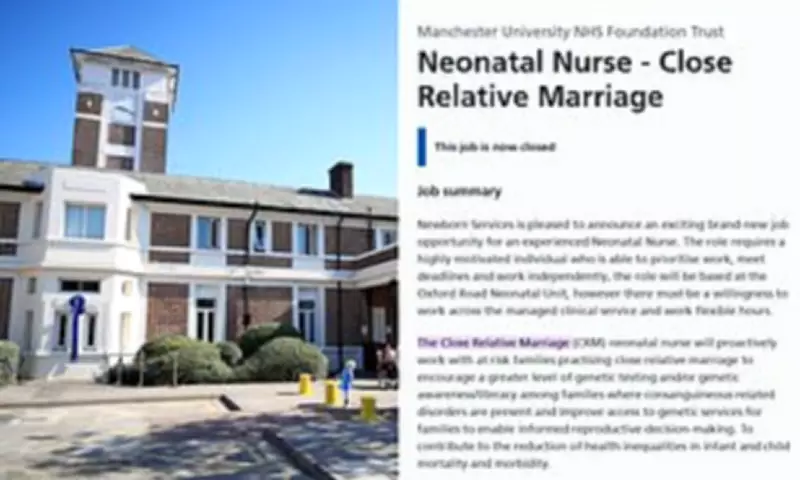
A major NHS Trust in Manchester recently advertised what it described as an "exciting new job opportunity" for a close-relative marriage nurse, specifically designed to support cousins who are having children together. The position, which has now closed for applications, was promoted earlier this year with the stated aim of enabling "informed reproductive decision making" within affected communities.
Role Details and Requirements
The Manchester Foundation Trust, one of England's largest NHS organisations, listed the Neonatal Nurse position as a fixed-term twelve-month contract. The successful applicant would receive an annual salary ranging from £37,338 to £44,962 for full-time work focused on ensuring "support and improve engagement with genetic services for affected families." The job description emphasised enabling parents to "make informed choices in a culturally sensitive empowering way."
The ideal candidate was described as fluent in Urdu and someone who "values diversity and difference," reflecting the specific communities where cousin marriage remains relatively common, particularly among those of Pakistani and Bangladeshi heritage in Britain.

NHS Guidance and Genetic Risk Assessment
Last month, new guidance from the health service emerged stating that concerns about congenital disease risks in cousin marriages are "exaggerated" and "unwarranted" on the grounds that "85 to 90 per cent of cousin couples do not have children" with genetic disorders. The national average rate for unaffected children stands at 98 per cent.
While acknowledging there are "risks to child health associated with close relative marriage," the guidance argues these should "be balanced against the potential benefits... from this marriage practice." The document further suggests that marrying a relative – fairly common in the Pakistani community – can offer "economic benefits" alongside "emotional and social connections" and "social capital."
Controversy and Criticism
Critics have accused the NHS of turning a blind eye to what they describe as an "indefensible cultural practice." Kellie-Jay Keen, leader of the Party of Women, described the phenomenon as "dangerous" and insisted it is "not part of our culture." The gender-critical activist told the Daily Mail: "The cost to the NHS and social care of this practice is enormous. Subjecting children to this risk unnecessarily is cruel."
Keen further argued: "The reason it continues is political cowardice. The government knows the harm, but it is unwilling to confront the cultural practices of certain communities for fear of being labelled 'racist' or 'Islamophobic.' So instead of protecting children, it chooses silence and appeasement."
Personal Testimonies and Community Perspectives
Aisha Ali-Khan, a child of first cousins, has previously spoken out about the dangers of promoting the benefits of close relative marriage. Ms Ali-Khan revealed: "My parents Mohammed and Barkat were first cousins. Four of their seven children were born with severe disabilities. Three have died – one of them my twin brother – and I am carer to my beloved older sister Tahira, who has a mental age of about eight."
The Women's Rights Activist acknowledged that in an ideal world "there wouldn't be cousins marrying and having children," but noted that talking to a qualified practitioner was ultimately better than getting advice from "some aunt down the street." She has previously condemned what she called the "highly dangerous stance" of citing potential benefits of cousin marriage.
Broader Context and Prevalence
The Manchester NHS Trust is one of multiple employers to have advertised roles akin to the close relative marriage nurse over the past eighteen months. Similar positions have been publicised at Frimley Health NHS Foundation Trust in Slough, alongside close relative midwifery and nursing posts in other parts of England including Bedfordshire Hospitals and GP practices in Bradford.

Marriages between cousins were once commonplace among Britain's upper echelons as a practice to strengthen alliances and keep wealth within families. Despite falling out of fashion in most communities, the practice remains relatively common among Travellers and in South Asian circles. As of May 2025, estimates suggest just one per cent of white British couples are first cousins.
Changing Trends and Research Findings
Experts first began tracking the prevalence of consanguinity in Bradford – home to one of the UK's largest Pakistani communities – in the late 2000s. The Born in Bradford study initially quizzed almost 12,500 pregnant women about their relationship with the father of their child, with a follow-up study involving another 2,400 women between 2016 and 2019.
The research found that cousin relationships are no longer a "majority" in Bradford's female Pakistani community amid rising awareness of birth defect risks. A decade ago, a Government-funded surveillance project found that 62 per cent of Pakistani heritage women were in consanguineous relationships. This figure has since dropped to 46 per cent according to researchers, with the decline attributed to higher educational attainment, stricter immigration rules, and changing family dynamics.