When we consider Britain's most important trees, we often look for towering height, immense girth, or great age. By these conventional measures, the willow seldom makes the list. Yet, in a profound ecological sense, it stands as one of our finest and most generous native species.
The Unrivalled Hub for Biodiversity
Willows often lack a dominant central trunk and rarely grow taller than seven metres, defying our classic image of a stately tree. However, their true pre-eminence lies in their incredible capacity to support life. More than 452 species of invertebrates depend on willows, a figure that surpasses even the mighty oak, which hosts 423 species. Furthermore, as highlighted in Jon Stokes's authoritative work, Trees of Britain and Ireland, these trees are also a haven for 160 different lichen species.
This generosity extends throughout the seasons, providing critical resources during times of scarcity. Their early blossom in March is a lifeline for emerging spring insects. Throughout the summer, the trees' association with 23 species of aphid creates a rich protein source, sustaining bird populations. In essence, a single willow is not just a tree; it is a complete, thriving ecosystem.

A Symbol of Nature's Tangled Relationships
If we shift our perspective from seeing nature as a catalogue of separate objects to viewing it as a complex web of relationships, the willow perfectly embodies this idea. Speaking of 'the willow' is itself an oversimplification. Britain is home to around 20 native species and a remarkable 70 hybrids, 20 of which spring from just three parent species. This botanical promiscuity is another facet of the willow's gift for generating abundance, though it complicates efforts to neatly categorise it.
A Personal Sanctuary in Derbyshire
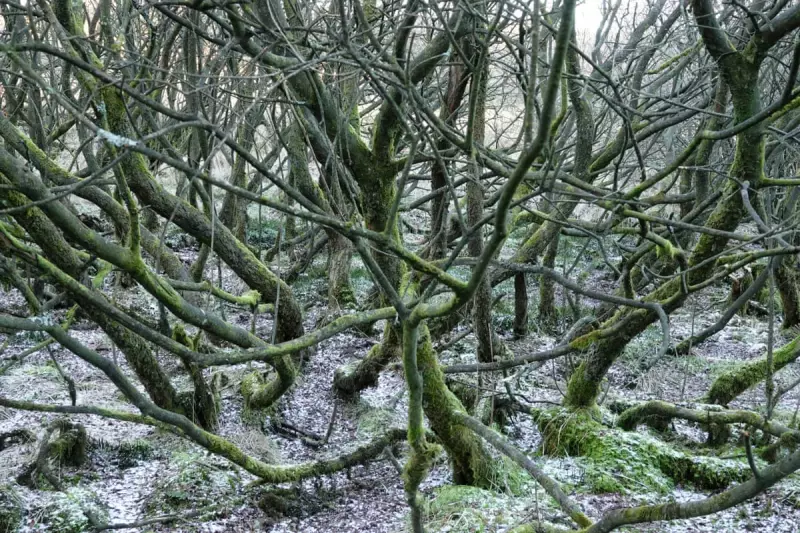
While pure stands of willow are uncommon, one such thicket near Buxton in Derbyshire holds a special place for the observer. This dense, gloomy grove is a sanctuary shared primarily with the local red deer, which come to wallow in its muddy hollows. Entering the thicket feels like stepping into a contained, cavernous space where progress is slow and deliberate.
Visitors must test the boggy black ground, constantly bowing under low branches or navigating around spherical thickets of outward-facing limbs. On a recent visit, the slow black trickle of water at its heart was edged with silver ice. The wind rattled the moss-laden branches, and from a patch of sludge, a woodcock burst forth—silent, dark, its wings brattling against the twigs before it plunged into the next willow entanglement.
The willow, in all its varied and hybrid forms, challenges our metrics for valuing nature. It may not win prizes for stature or antiquity, but as a cornerstone of biodiversity and a symbol of ecological interconnectedness, its contribution is unparalleled. It reminds us that a tree's true worth is measured not in timber, but in the life it sustains.