
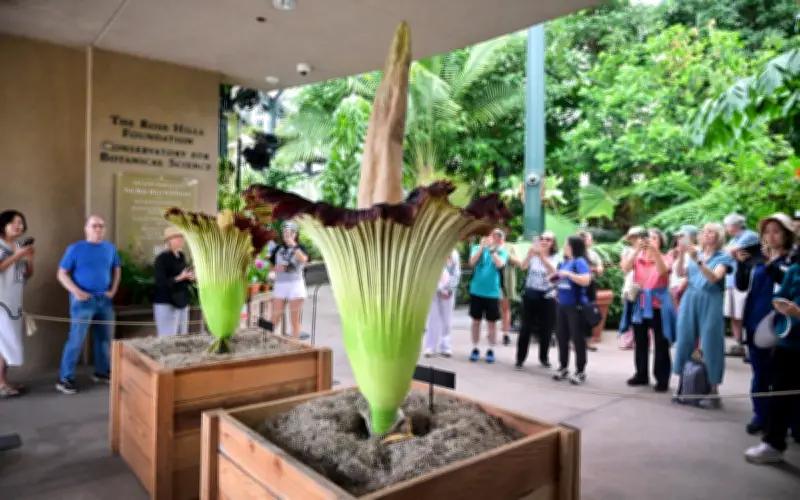
Two corpse flowers bloomed simultaneously at the Huntington Library, Art Museum, and Botanical Gardens in San Marino, California, drawing thousands of visitors eager to witness the rare and odorous event.
Massive Crowds and Limited Viewing Window
The two titan arums, named Odorysseus and Odora, attracted more than 7,000 people on Monday. Each bloom lasts only 24 to 48 hours, so staff alerted the public on Sunday afternoon when the towering plants began unfurling. The flowers reached their peak overnight before slowly closing the following day. Visitors still had the opportunity to see the spectacle on Monday.
"They were enchanted by it," said Brandon Tam, curator of the Huntington's orchid collection. "People who lined up for three hours in our line just to see the corpse flowers for just a few minutes."
Public Fascination and Inspiration
Tam noted that the event sparked curiosity and inspiration. "People were curious, people were inspired. People started to fall in love, if they haven't already been falling in love, with plants because of this poster child of a plant that has led people to better understand that plants have a life of their own."
The excitement was so intense that advance tickets sold out by late Monday morning. The corpse flowers will remain on display until early August.
Biology of the Corpse Flower
The titan arum, commonly called the corpse flower, is famous for its pungent odor resembling rotting flesh. This smell attracts carrion beetles and flesh flies, which pollinate the endangered plant. Native to western Sumatra, Indonesia, the corpse flower is not a single flower but a giant flowering structure composed of hundreds of tiny blooms. It can grow over 12 feet tall and, after its brief flowering ends, collapses before entering a dormant period that can last years.
Conservation Efforts at the Huntington
The Huntington has cultivated titan arums for more than 25 years. It currently holds over 43 mature specimens, many originating from a plant successfully pollinated in 2002. "In 2002, we pollinated a corpse flower, which produced hundreds of fruits and therefore hundreds of seeds that we would propagate," Tam said. The seedlings were shared with other botanical gardens in the US to help conserve the species, of which fewer than 1,000 are believed to remain in the wild.




