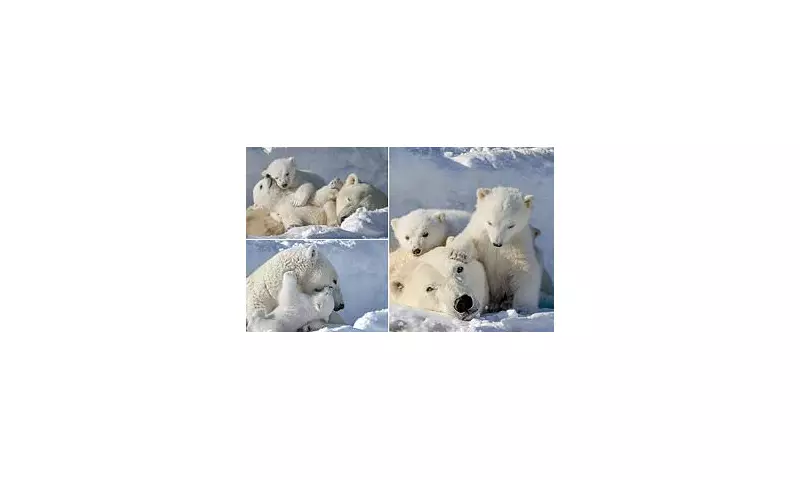
A heart-wrenching yet tender scene of a weary polar bear mother napping in the snow while her three-month-old cubs clamber over her has been captured by a dedicated photographer in northern Canada.
A Mother's Exhaustion in the Polar Bear Capital
The intimate moment was photographed by 70-year-old Phillip Chang during an 11-day expedition around Churchill, Manitoba. This remote area is globally renowned as the polar bear capital of the world, drawing visitors each autumn as bears congregate, waiting for the Hudson Bay to freeze so they can hunt seals on the newly formed sea ice.
Mr Chang, a semi-retired business owner from California, described the encounter. "This mother polar bear was travelling with her three cubs, which were about three months old," he said. "They were taking a short break during their journey to the sea, where the starving mother could hopefully catch a seal and feed herself."

He noted the stark contrast between the energetic and playful cubs and their utterly drained mother. "This moment, while it looks very cute, shows an exhausted and starving mother trying to fend for her cubs," he reflected.
A Population in Peril
The poignant image comes against a backdrop of serious concern for the species in this region. According to the World Wide Fund for Nature (WWF), there are an estimated 22,000 to 31,000 polar bears left in the wild globally.
However, data focused on the Western Hudson Bay population paints a grim picture. Charity Polar Bears International states that numbers there very likely decreased between 2011 and 2021. A 2021 aerial survey cited by the charity revealed the local bear population plummeted by 27% in just five years, from 842 bears to 618.
This sharp drop continues a declining trend observed over the last three decades but at an accelerated pace. The population has effectively halved since the 1980s, when approximately 1,200 bears roamed the area.
The Climate Change Link
The primary driver behind this decline is climate change, which is altering the freeze-thaw cycle of the Hudson Bay. The time bears are forced to stay onshore without access to their primary food source, seals, has increased as the bay takes longer to freeze.
Polar Bears International also notes there has been some migration to the Southern Hudson Bay region, where the population was likely stable from 2012 to 2021. Sixty per cent of the world's polar bears live within Canada, with others found in Alaska (USA), Russia, Greenland, and Norway's Svalbard archipelago.
Accurate global counts are challenging due to significant data gaps, particularly in the vast and infrastructure-poor Russian Arctic, where research is exceptionally difficult and costly.
For photographer Phillip Chang, enduring 11 days of extreme cold to witness this scene was profoundly moving. "I was thrilled to finally witness this moment and was deeply moved by the power and resilience of motherhood in such a harsh environment," he said. His photograph serves as a powerful, silent testament to the immense challenges polar bear families now face for survival.