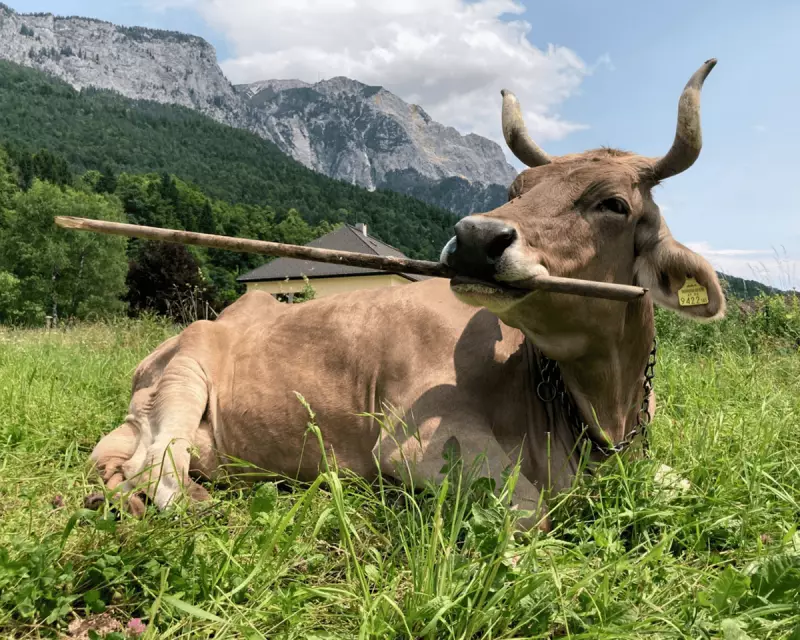
In a remarkable display of animal ingenuity, a brown Swiss cow named Veronika has been observed using a broom as a multi-purpose grooming tool, challenging long-held assumptions about human uniqueness. This behaviour, officially documented for the first time in cattle, involves Veronika picking up the broom with her tongue and deftly manoeuvring it to scratch hard-to-reach areas of her body.
Veronika's Deft Tool Manipulation
Researchers from the University of Veterinary Medicine in Austria detailed in the journal Current Biology how the 13-year-old pet cow employs the broom with surprising flexibility. She uses the blunt end for sensitive skin on her belly and the bristly end for thicker skin on her upper back and buttocks. This not only marks the inaugural record of tool use in cattle but also suggests cattle can utilise tools in a versatile, multi-purpose manner, akin to a Swiss army knife.
Farmers' Lack of Surprise
While the scientific community expressed astonishment, many dairy farmers remained unfazed. A farmer friend recounted similar anecdotes, such as a cow named Noisette using her tongue to unlock a pen door to steal feed or watch freed companions cause chaos. This perspective highlights that cows are often underestimated, with farmers recognising their quick learning, boredom, and mischievous tendencies as part of a rich behavioural tapestry.

Historical Context of Animal Tool Use
Tool use, defined as the deliberate manipulation of an object to achieve a goal, was once considered exclusively human. This notion began to crumble in the 1960s when Jane Goodall observed chimpanzees using twigs to extract termites. Since then, numerous examples have emerged, including sea otters using stones as hammers and anvils, chimpanzees crafting spears in Senegal, and New Caledonian crows fashioning hooks from plant stems.
Beyond Primates: Diverse Tool Users
The animal kingdom boasts a wide array of tool users, from polar bears allegedly using rocks to strike walruses to octopuses throwing shells and "firehawk" raptors spreading wildfires to flush out prey. Each discovery chips away at the pillars of human exceptionalism, such as tool use, complex communication, and cultural transmission.
Human Perception and Animal Intelligence
The surprise surrounding Veronika's actions reveals more about human biases than bovine capabilities. We consistently overlook the intelligence and similarities of non-human animals, preferring to maintain an illusion of superiority. As Louis Leakey remarked after Goodall's chimpanzee findings, we must redefine tools or accept chimpanzees as human. Similarly, Veronika's story urges us to abandon our high horses and acknowledge that cows, among other animals, possess remarkable and special traits without needing to be equated with humans.
This incident underscores the importance of observing animals with open eyes, as farmers and scientists alike recognise their complex inner lives. By embracing this perspective, we can foster greater appreciation for wildlife and move beyond outdated notions of human uniqueness.