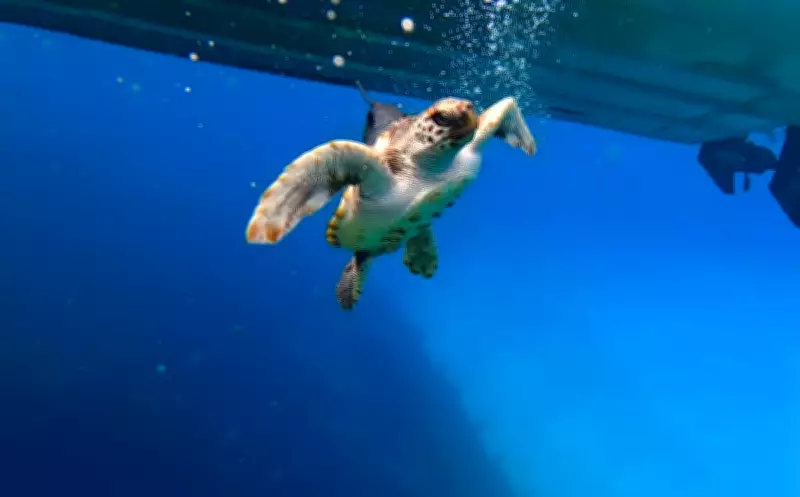
Loggerhead Turtle BB Released After Rehabilitation, Satellite Tagged in Climate Change Study
Bulwal Bilima, affectionately known as BB, has been satellite tagged and released into the waters off Lord Howe Island in New South Wales, Australia, following a ten-month stay at Taronga Wildlife Hospital. This event marks a significant milestone in conservation efforts, as the arrival of loggerhead turtles in New South Wales signals that these 'sentinels of climate change' are being pushed into unfamiliar habitats due to environmental shifts.
Rescue and Recovery of a Tiny Hatchling
When BB first arrived at Taronga Zoo in Sydney, the loggerhead hatchling was in a critical state: lethargic, severely constipated, and dehydrated. Weighing a mere 110 grams and no larger than a bar of soap, this tiny turtle, whose name means 'strong turtle' in the Aboriginal Dhurga language of the Yuin people, faced a daunting battle for survival. Found stranded in Booderee National Park in New South Wales last April—far south of typical hatching grounds—BB's recovery began with a diet of squid, sardines, and marine vitamins, gradually reviving the hatchling, whose sex remains undetermined until maturity.
Throughout the winter months, BB was kept in heated rehabilitation pools to maintain thermoregulation, as offshore waters were too cold. Finally, last month, the turtle was fitted with a satellite tracker and released from Lord Howe Island, located approximately 700 kilometers northeast of Sydney, into the strengthening East Australian Current.

A Warning Sign of Warming Seas
For conservationists, BB's rescue extends beyond saving a single life; it serves as a stark warning about the impacts of climate change. Warming seas are forcing marine species, including endangered loggerhead turtles, into new territories. The East Australian Current is intensifying, pushing warmer waters further south and bringing species once confined to Queensland into New South Wales—areas where they have rarely been recorded before.
Taronga's scientists are adapting to these shifts with a new strategy. By utilizing satellite trackers and innovative tagging techniques, they are monitoring the movements of both rehabilitated and wild turtles in real time. The objective is to predict future migration patterns and identify emerging corridors that may require protection in the coming years.
Loggerhead Turtles: Sentinels of Environmental Change
Loggerhead turtles, one of seven sea turtle species worldwide, are known for their longevity—living up to 80 years—and distinctive features, such as blocky heads, reddish-brown shells, and powerful jaws. They exhibit complex migratory patterns, often spending decades in open oceans before returning to their natal beaches to nest. However, their southward movement raises urgent conservation concerns.
Phoebe Meagher, a conservation officer involved in Taronga's turtle tagging project, emphasizes the significance of this shift. "We've got lots of turtles nesting down in New South Wales, which they never used to do, and so the question is, what does this mean for the conservation of the species? It's not about where the turtles live now, it's about where a turtle is going to live in the future," she explains.
Addressing Data Gaps and Future Challenges
Baseline data on marine turtles in New South Wales is scarce, complicating conservation efforts. Meagher notes that Commonwealth maps of biologically important areas for marine species had zero data points for marine turtles in the region. Taronga's tagging project aims to fill this gap, informing wildlife management and habitat protection strategies for the future.
Turtles are highly sensitive to environmental changes, often referred to as sentinels of climate change. Sand temperature plays a crucial role in determining hatchling sex—cooler sand produces males, while hotter sand yields females. As turtles move south, mismatches between ocean and sand temperatures could skew sex ratios or reduce survival rates. Additionally, intensifying currents may alter habitat suitability, increase disease risks, and bring turtles closer to human activities, exacerbating threats to already vulnerable species.

Human Impacts and Rehabilitation Efforts
Kimberly Vinette Herrin, a veterinary officer at Taronga who rehabilitated and released BB, has witnessed the consequences of human interactions firsthand. "We see a lot more impact from humans ... [such as] fishing lines, boat strikes, plastic ingestion," she says. Entanglement can lead to amputated flippers and embedded hooks, while changing migratory patterns expose turtles to unfamiliar pathogens.
Before BB's release, Herrin's team carefully monitored sea temperatures and foraging conditions around Lord Howe Island, a remote UNESCO-listed volcanic remnant near the East Australian Current. "We wanted to be careful about putting BB out in really cold temperatures that might not be so suitable," Herrin explains. "We always want it to be a little bit over 20°C, so they [turtles] have the best chance of doing well."
The Release and Tracking of BB
In mid-February, BB passed a final health check and was fitted with a small satellite tracker secured to its shell using epoxy and fibreglass. Herrin accompanied the team to Lord Howe Island for the release into the current. "It's like your child because you had it for a year. We can't keep it in captivity. It is the right thing to do. But you really hope that it's not just a morsel for something," she reflects.
Initially, BB's tracker pinged regularly for two days before going silent, causing concern. "I was horrified, absolutely horrified," Herrin admits. However, the tracker resumed signaling the next day, indicating that BB had traveled north before circling back, likely finding and entering the current.
Innovative Tagging Methods and Broader Implications
BB is one of approximately 21 turtles tracked by Taronga conservationists along the New South Wales coast, including 16 green turtles, three loggerheads, and two hawksbills. Tagging these southward-moving turtles in New South Wales's deeper, low-visibility waters has required new methods. Meagher highlights a key development: "If we find a turtle resting, they tend to tuck themselves under ledges. And if we can catch the resting turtles, it's actually a much less stressful capture because they're half asleep. Developing that method has been one of our biggest wins." For larger loggerheads, researchers use mesh nets secured to boats to lift them gently on board.
For Herrin, the most rewarding aspect of the rehabilitation process remains simple yet profound. "When they swim away and they don't look back, we know we've done OK, so that's the best thanks that we can get," she says. This release not only symbolizes hope for BB's future but also underscores the urgent need to address climate-driven changes affecting marine life worldwide.