In Gaza, a desperate rush for water trucks persists more than six months after the ceasefire between Israel and Hamas. Palestinians and humanitarian groups report that water shortages remain critical, with nearly 90% of the enclave's water infrastructure destroyed, including desalination plants and sewage treatment facilities, according to the United Nations.
Daily Struggle for Water
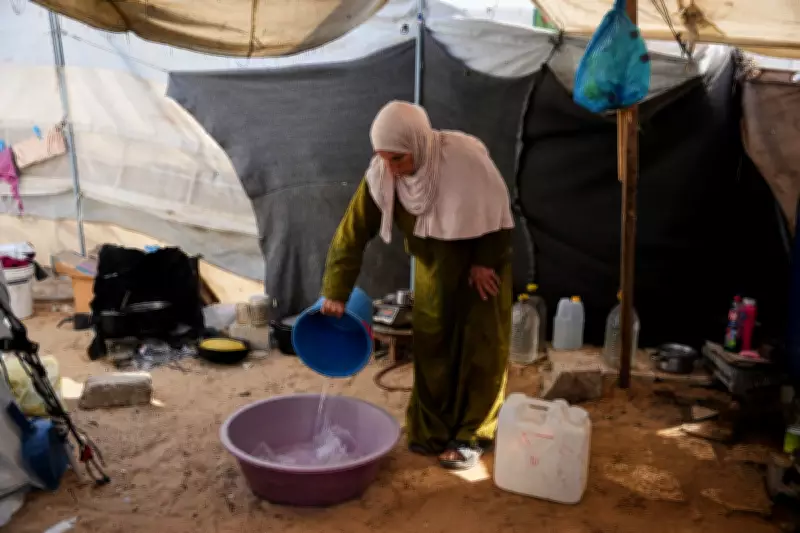
When water trucks arrive in their neighborhood, the Abu Daqqa family scrambles to hose what they can into dented plastic jerry cans marked with their name. Yehia Abu Daqqa rations it — one can per each of her children — pouring a little into a sippy cup for one of her daughters outside their tent in Muwasi, the sprawling tent camp where hundreds of thousands of displaced Palestinians now live. “The water truck arrives, and some 500 to 1,000 people throw themselves at it,” Abu Daqqa said. “They start fighting. It’s real suffering.”
Before the war, government providers and private companies distributed water via trucks and underground pipes. Wastewater was circulated to treatment facilities through underground pipes as well. The infrastructure is a top priority in Gaza's reconstruction plan, but progress has stalled as Israel demands Hamas completely disarm first.

Reliance on Delivered Water
The WASH Cluster, a United Nations-led network of nongovernmental organizations focused on water and sanitation, estimates that 80% of people in Gaza rely on water delivered by trucks to central distribution points. For Azmy Abu Lehya, that means on some days he walks more than 500 meters to his neighborhood's distribution point, sometimes getting water to lug back home through Muwasi, and other days he does not. “On two days, the water trucks come, and on the other two days, they don’t,” he said.
Israel has stated it no longer limits the import of water. COGAT, the military body that oversees humanitarian issues in Gaza, said it helped ensure pipelines can bring in enough for sanitation, sewage, drinking, and washing, and has not limited bottled water either. However, Palestinians say bottled water — much of which is delivered by private sector groups and sold in markets — is prohibitively expensive, with most of Gaza destroyed and its population unable to access jobs or steady incomes. Sharif Abu Helal, another Muwasi resident, does not even ask when he sees water bottles at his market because he knows he cannot afford it. “I am not ready to buy each person a bottle of water,” he said. “I have eight people. Is a gallon of water enough for them?”
Restrictions and Accusations
Many items used to clean and transport water — such as pipes, fuel, cement, and chemicals like chlorine — are among those Israel considers “dual use” and restricts out of concern they could be repurposed for weapons or missiles. Water restrictions and shortages have been a recurring issue throughout the war, with pipelines destroyed, water trucks hit by strikes, and spent munitions seeping into the groundwater aquifer used for wells.
In a report on water and sanitation this week, Doctors Without Borders (MSF) accused Israel of using water as a weapon of war, “systemically depriving” people in what it calls a “campaign of collective punishment.” Other groups, including Human Rights Watch, have lodged similar accusations. “While Gazans are deprived of water and sanitation, Israeli authorities are using aid as a tap, closing or opening slightly to allow only drops of aid to enter the Strip,” the report said. MSF, Gaza's second largest provider of water, said based on interviews conducted in late 2025 after the October ceasefire, Israel often blocked needed infrastructure like water pumps from entering Gaza, forcing them to salvage old or damaged parts to make desalination or water treatment equipment.

Water shortages have far-reaching consequences for Gaza’s 2.1 million people, fueling sewage overflows, sanitation failures, and the spread of waterborne and hygiene-related infections. “Israeli authorities know that without water life ends, yet they have deliberately and systematically obliterated water infrastructure in Gaza, while consistently blocking water-related supplies from entering,” said Claire San Filippo, MSF emergency manager. Though the report did not cover conditions today, the group called on Israel to allow in materials used for water and sanitation and noted that restrictions remain in place: “There are also not enough pipes available to create distribution networks,” the report said.
COGAT strenuously denied the allegations in the MSF report, calling them “a desperate attempt to regain legitimacy.” It stated that Israel allows more than 70,000 cubic meters of water — roughly 33.3 liters per person — in daily. Humanitarian agencies estimate people need at least 15 liters for cleaning, washing, drinking, and bathing daily.