Fly-tipping across England has reached its highest level in 14 years, with new data exposing the worst-affected areas and revealing the scale of a national epidemic driven by criminal gangs and rogue operators.
The Fly-Tipping Capitals of England
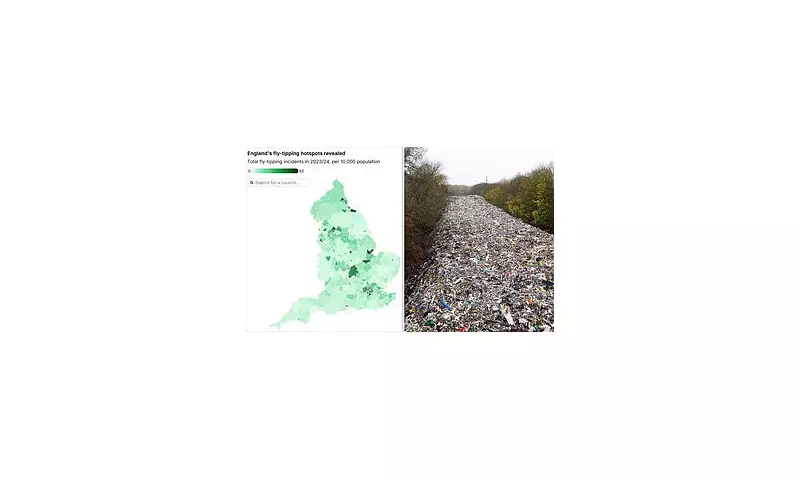
Official statistics from the Department for Environment, Food & Rural Affairs (Defra) for 2023/24 show a staggering 1.2 million incidents were recorded nationwide. This marks a 6% increase on the previous year, pushing the problem to a 14-year peak.
The City of London, with its small residential population but huge daily influx of visitors, recorded the highest rate of complaints. It saw 172 reports per 1,000 people. This figure is a shocking 860 times higher than the rate in Oadby and Wigston in Leicestershire, which had the cleanest streets with just 0.2 reports per 1,000.

Other London boroughs featured prominently in the top tier of offenders. Camden recorded 158 incidents per 1,000 people, Hackney had 127, and Westminster saw 121.
Organised Crime and a 'Low-Risk, High-Reward' Industry
The problem is no longer just about lazy homeowners. Experts warn that fly-tipping has become a lucrative enterprise for organised crime networks. Sarah Bradley, who works with the National Fly-Tipping Prevention Group, described it as a 'low-risk, high-reward industry'.
Criminal gangs and rogue builders often dump waste, ranging from household junk and broken appliances to hazardous materials like asbestos and chemical waste, in quiet locations before making a quick escape. In the worst cases, they leave behind dead animals and soiled nappies.
Gangs can charge up to £2,500 per lorry load to illegally dispose of rubbish, often reinvesting profits into other crimes like drug trafficking, fraud, and money laundering. Police have even dubbed waste crime 'the new narcotics' due to the vast profits involved.
Despite the potential for severe penalties—unlimited fines and up to five years in prison—the chance of prosecution remains vanishingly small. Last year, only 1,598 prosecutions were brought in England from over 1.15 million incidents, a prosecution rate of just 0.14%.
An Environmental and Economic Catastrophe
The scale of the crisis was starkly illustrated by the discovery of one of Britain's largest ever fly-tips in a field next to the A34 and River Cherwell in Oxfordshire. The 500ft-long, 20ft-high mountain of rubbish was branded an 'environmental catastrophe', with clean-up costs estimated at a staggering £25 million.
This incident highlighted the failure of authorities to act on warnings from locals. The blight affects more than just aesthetics; it attracts vermin, devalues property, and makes areas undesirable to live in. Gavin Lane, president of the Country Land and Business Association, stated that private landowners often bear the brunt, with some paying up to £100,000 to clear waste dumped on their land.
The total cost to the UK economy is estimated at £1 billion annually, though this is likely an underestimate as most incidents on private land go unreported.
Calls for Action and Political Promises
Critics argue that government responses have been inadequate. Sarah Bradley expressed her disillusionment, stating: 'It feels like a lot of talk to make it look like something is being done but we don’t see the action.' She highlighted that sentencing often fails to match the crime, with offenders in large-scale operations sometimes receiving fines lower than the initial fixed penalty notice.
The root cause is frequently identified as the landfill tax, introduced to encourage recycling but now seen as a driver for illegal dumping. Avoiding this tax—which now stands at £126 per tonne—is where criminals make their profit, undercutting legitimate waste operators.
In April, the government launched a crackdown promising to crush fly-tippers' vans and target cowboy waste operators. A Defra spokesperson said: 'We will not tolerate waste criminals and fly-tippers who blight our villages, communities and natural spaces going unpunished.'

Local authorities like Camden Council report increasing enforcement, issuing over 900 Fixed Penalty Notices last year and investing an extra £1 million in street cleaning. However, with rates soaring and organised crime entrenched, the battle to clean up England's streets and countryside appears to be an uphill struggle.