World's Largest Acidic Geyser Resumes Activity at Yellowstone
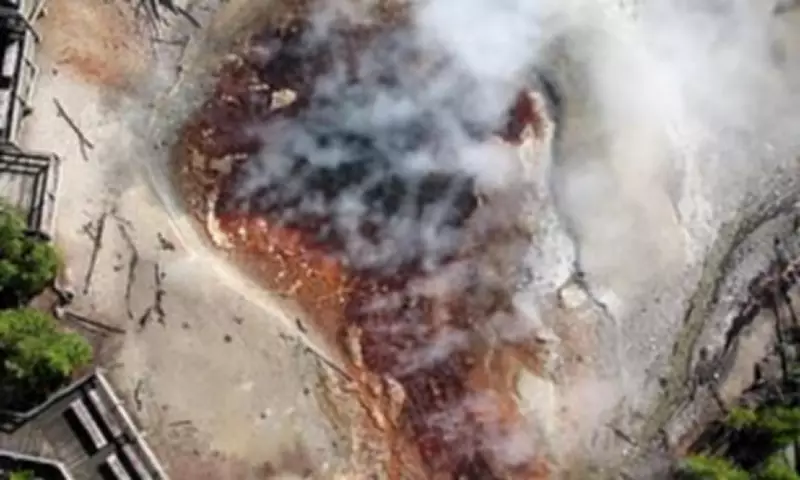
The Echinus Geyser, recognized as the largest acidic geyser on Earth, has dramatically reawakened at Yellowstone National Park after years of dormancy. Located within the Norris Geyser Basin, this remarkable geological feature spans approximately 660 feet (200 meters) in diameter and has begun erupting sporadically since February 7, marking its first activity since 2020.
A Return to Spectacular Displays
During its peak in the 1970s, Echinus Geyser would erupt for durations of up to 90 minutes, projecting hot acidic water as high as 75 feet (23 meters) into the air at intervals of roughly every hour. However, its eruptions became increasingly irregular over subsequent decades, with only one recorded in 2018, another in 2019, and two final eruptions in 2020 before falling completely silent.
The recent resurgence has seen eruptions lasting up to three minutes, with water heights reaching approximately 30 feet (9 meters). "For the first time since 2020, Echinus Geyser is erupting!" announced the US Geological Survey (USGS) via social media platform X. Mike Poland, Scientist-in-Charge at the Yellowstone Volcano Observatory, confirmed the activity, stating, "Echinus Geyser is the largest acidic geyser in the world, and it's been putting on a bit of a show in February."

Monitoring the Unusual Activity
Poland detailed that small temperature spikes detected at the beginning of February preceded the first proper eruption since December 2020. "This was followed by a few more eruptions... and then by the middle of the month, we started seeing very frequent eruptions that lasted until about February 24," he explained. While there have been additional temperature surges since, no further eruptions have occurred, leaving scientists to observe whether the activity will continue into March.
The renewed geyser activity coincides with recent scientific concerns regarding Yellowstone's underlying supervolcano. A study published in July revealed more than 86,000 "hidden earthquakes" detected between 2008 and 2022, with over half occurring in swarms—small clusters of interconnected tremors that sometimes precede volcanic events. Researchers identified these "chaotic" swarms moving along rough, young fault lines deep beneath the Yellowstone Caldera, likely caused by mineral-rich hot water forcing through rock fractures.
Understanding Acidic Geysers
Acidic geysers represent rare geological phenomena because acidic water typically degrades the rock formations that channel water toward the surface. The USGS notes that Echinus Geyser has avoided this breakdown because "the acid is not concentrated... rather, it's a bit like orange juice or vinegar." The acidity results from mixing between acidic gases and neutral waters, insufficient to erode the surrounding rock significantly.
Meanwhile, scientists continue to monitor broader volcanic activity at Yellowstone. Last March, researchers discovered a newly opened volcanic vent emitting steam at the Norris Geyser Basin, located at the base of a rhyolite lava flow. While the USGS maintains that the supervolcano likely won't erupt for another 100,000 years based on historical patterns, these discoveries underscore the dynamic nature of what appears to be a dormant volcano.
Supervolcano Context and Concerns
Yellowstone's supervolcano contains an immense magma reservoir capable of producing a category eight eruption over 100 times more powerful than the 1883 Krakatoa eruption. The volcano has experienced three major explosions at intervals of approximately 725,000 years, with the last occurring 631,000 years ago. Despite this timeline, Poland emphasized that currently "there is nothing really brewing right now... the magma chamber is nearly solid."
The geothermal processes that create Yellowstone's famous geysers, including Echinus, are driven by the same forces that generate seismic activity deep below the surface. As monitoring continues, scientists remain vigilant about both the spectacular surface displays and the complex geological systems beneath one of America's most iconic national parks.