England's New Recycling Rules Launch Amid Council Readiness Concerns
New regulations for household waste and recycling have officially come into force across England today, as an investigation reveals that approximately one in four local authorities remain unprepared to deliver the mandated service. The comprehensive changes aim to standardise waste collection practices nationwide, requiring households to separate their rubbish into a maximum of four distinct bins for collection.
Standardised Bin System Implementation
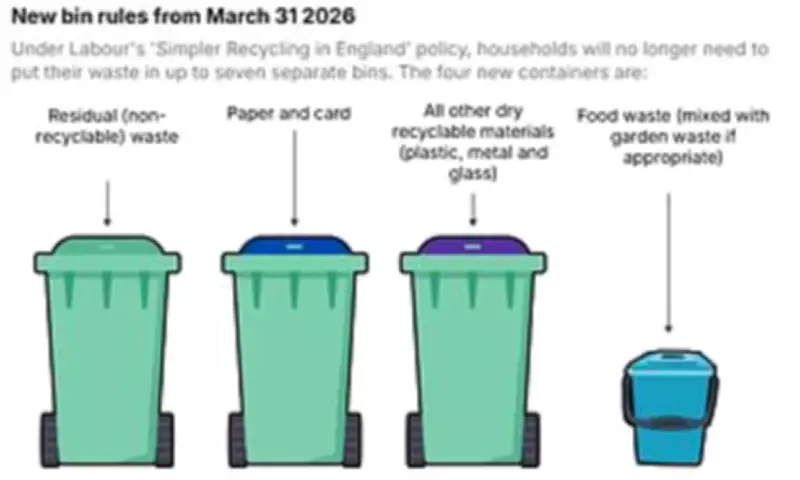
Under the new framework, which was first announced in 2024, households must now categorise their waste into specific streams. The default requirement involves four containers: one for food and garden waste; another for paper and cardboard; a third for dry recyclables including glass, metal, and plastics; and a final bin for general non-recyclable rubbish. In certain areas where paper and card can be collected alongside other dry recyclable materials, households may only need to use three bins instead.
The regulations also introduce mandatory weekly food waste collections, marking a significant shift from previous practices. Earlier legislation from 2021 defined recycling to include glass, plastic, food waste, paper, and card, leading some authorities to issue individual bins for each material type. The current changes seek to streamline this process while maintaining environmental benefits.

Council Readiness and Implementation Challenges
An investigation by BBC News, reissued today, found that 79 local authorities—representing one quarter of councils—did not expect to meet today's implementation deadline. Various factors have contributed to these delays, with some councils citing funding shortfalls and others pointing to difficulties in acquiring new specialist vehicles required for the updated collections.
Approximately half of English councils were not conducting weekly food waste collections prior to the new regulations, while some authorities have operated such services for over a decade. This disparity means that not every council needed to make substantial changes to comply with the new rules.
Among the councils missing the deadline, 57 expressed hope to launch their services by the end of this year, while more than a dozen could not provide even a rough start date. An additional 31 councils have established agreements allowing them to begin collections at a later date, often due to existing lengthy contracts that would be prohibitively expensive to alter immediately. These authorities are therefore not considered to have missed the official deadline.
Financial Implications and Government Support
The implementation delays persist despite the Department for Environment, Food and Rural Affairs (Defra) distributing more than £340 million in grants and providing targeted support to local authorities. Ministers are introducing these changes to eliminate what they describe as a 'postcode lottery' in bin collections, which has created confusion due to varying policies across different council areas.
However, the transition is proving costly for many local authorities. Investigations by the Daily Mail revealed that one council faces a £21 million implementation bill, another is spending £2.1 million on 15 new collection vehicles, and a third has allocated £350,000 merely to replace bin lids. The new default requirement for most households in England, effective from March 31, mandates four containers for residual waste, food waste (potentially mixed with garden waste), paper and card, and all other dry recyclable materials.
Criticism and Environmental Objectives
Critics including legal expert and self-proclaimed 'binfluencer' Gary Rycroft have raised concerns that additional bins on streets could obstruct pavements, particularly for parents with prams. The TaxPayers' Alliance warned that residents will be 'furious if their hard-earned cash is thrown away on costly new bins,' adding that while simplifying the waste collection system is welcome, 'attaching a huge price tag is a rubbish idea.'

The Government maintains that the changes provide councils with flexibility to deliver services appropriate for their communities, replacing the previous patchwork system where each authority independently decided on bin types and materials collected. Ministers insist the new rules will standardise sorting and collections nationwide, ensuring more high-quality recycled material can be processed domestically and utilized by manufacturers in new products.
Officials state that the regulations aim to reduce carbon emissions by decreasing the amount of rubbish burned and minimizing other environmental and social impacts of waste disposal. Circular economy minister Mary Creagh declared: 'We are ending the bin collections postcode lottery and making it easier for people to recycle wherever they live. Simplifying these rules will cut out carbon, clean up our streets, and help bring pride back into our communities.'
Broader Environmental Initiatives
These changes form part of wider Government efforts to promote a 'circular economy' in the UK, where resources remain in use longer, waste is reduced, and green growth is supported through infrastructure investment and job creation. The Government has also introduced an extended producer responsibility scheme, requiring packaging producers to pay fees covering recycling or waste management costs.
Additionally, plans are underway to launch a delayed deposit return scheme in 2027, where consumers will pay a small deposit when purchasing drinks in plastic bottles or metal cans, refundable upon returning empty containers to retailers. To assist local authorities facing area-specific delivery challenges, the Government has promised additional support including agreed transitional arrangements permitting later implementation dates.
Ministers note that more than £78 billion has been made available to councils in England this year, including funding for rolling out weekly food waste collections to all households, alongside the £340 million specifically allocated to support preparation for the new collections.
Industry Perspective on Policy Impact
Claire Shrewsbury, director of insights and innovation at climate action organisation Wrap, described the new rules as representing the 'biggest shakeup in recycling policy in England in 20 years.' She added: 'Now, wherever you are you'll have the same service at home, at work, and when out and about. We're a nation of recyclers, but most households put two or more items in the rubbish each week that could be recycled—because of confusion.'
Shrewsbury emphasized that simplifying recycling will help address this confusion, noting that if every household recycled one additional trigger spray weekly, enough energy would be saved to power every home in Birmingham for a year. Regarding food waste, she highlighted significant potential benefits: 'It's difficult to prevent all food waste and so recycling one kitchen caddy of unavoidable food waste could power your fridge for 18 hours, and a whole truck would keep that fridge cool for five years.'