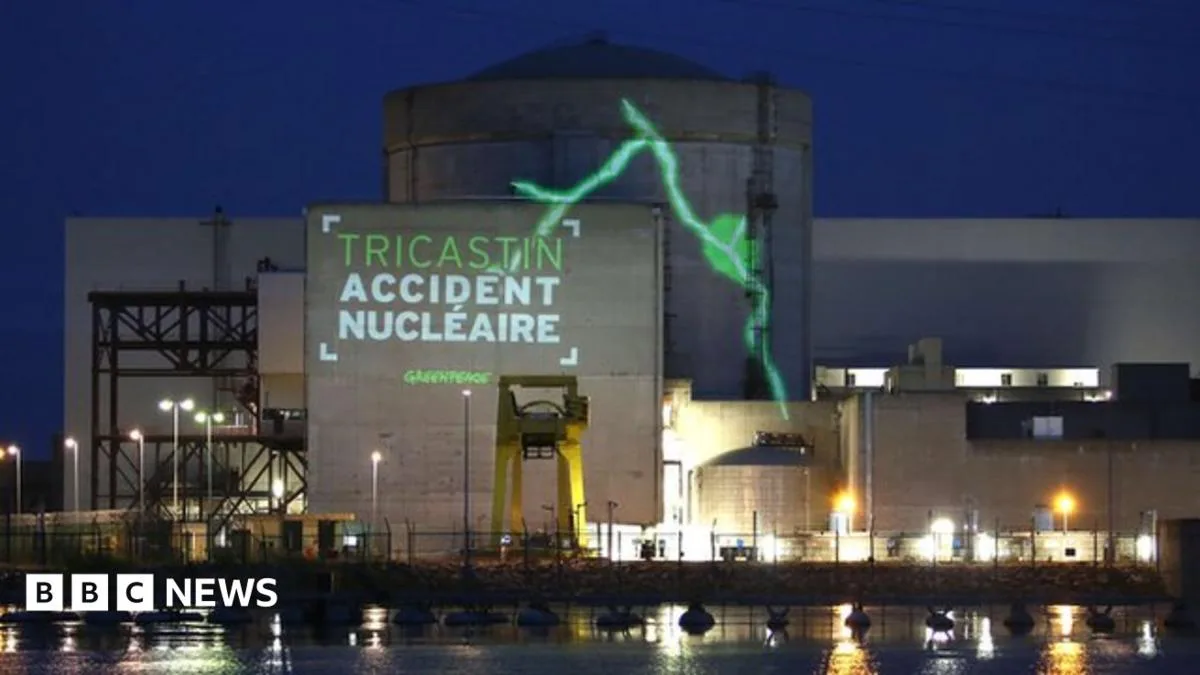
Greenpeace Activists Confront Macron at Nuclear Summit Over Russian Uranium Imports
Greenpeace Activists Confront Macron at Nuclear Summit

In a dramatic confrontation at a high-profile international gathering, French President Emmanuel Macron was accosted on stage by Greenpeace activists during a nuclear energy summit near Paris. The protesters, sharply dressed in black suits and ties, interrupted Macron and United Nations nuclear watchdog chief Rafael Grossi as they were greeting heads of state on Tuesday.

Protesters Challenge Macron Over Russian Uranium

The activists held banners bearing the Greenpeace logo with messages reading 'Nuclear Power = Energy Insecurity' and 'Nuclear power fuels Russia's war.' One protester shouted directly at Macron, demanding, 'Why are we still buying uranium from Russia?' The French president responded firmly, 'We produce nuclear power ourselves.'

This exchange highlights a significant contradiction in France's nuclear energy policy. While France maintains its own uranium enrichment capacity, the latest customs data from the French government reveals that the country continues to import enriched uranium for its power plants, including substantial quantities from Russia.

Global Nuclear Dependence on Russia

According to the World Nuclear Association, Russia's state nuclear company Rosatom accounted for approximately 44% of global uranium enrichment capacity in 2025. European nuclear power producers have faced considerable challenges in reducing their dependence on Russian supplies, even four years after Russia's invasion of Ukraine began.

Around fifteen Greenpeace activists also blocked arriving convoys outside the summit venue in Boulogne-Billancourt on the outskirts of Paris, according to statements from the environmental campaigning group.

Nuclear Summit Context and Criticism

France is hosting the second world nuclear energy summit, where global leaders are meeting to discuss and promote nuclear power as a clean energy solution. Greenpeace France issued a scathing critique of the event, calling it 'an anachronism, an event completely out of touch with reality.'

The group specifically referenced 'the tragic situations of the Russian aggression in Ukraine, the strikes on Iran, and the impacts of the worsening climate disruption' as reasons why such a summit is misguided.

European Leaders Defend Nuclear Energy

European Commission President Ursula von der Leyen delivered a strong defense of nuclear power at the summit's opening, declaring that Europe's turn away from civilian nuclear energy represented a 'strategic mistake.' She argued that the ongoing Middle East conflict had exposed the continent's fossil fuel 'vulnerability.'

'It was a strategic mistake for Europe to turn its back on a reliable, affordable source of low-emission power,' von der Leyen stated, speaking as the US-Israeli war with Iran entered its second week. 'For fossil fuels, we are completely dependent on expensive and volatile imports. They are putting us at a structural disadvantage to other regions.'

She emphasized that 'the current Middle East crisis gives a stark reminder of the vulnerability it creates,' while proposing that 'nuclear and renewables' together could 'become the joint guarantors of independence, security of supply, and competitiveness.'

Macron's Energy Sovereignty Argument

President Macron echoed similar themes, asserting that civilian nuclear power helps provide energy sovereignty. 'Nuclear power is key to reconciling both independence - and thus energy sovereignty - with decarbonisation, and thus carbon neutrality,' Macron told summit attendees.

He added a geopolitical warning: 'We can see it in our current geopolitical context: when we are too dependent on hydrocarbons, they can become a tool of pressure, or even of destabilisation.'

European Nuclear Decline and Investment

Von der Leyen highlighted the dramatic decline in Europe's nuclear energy production, noting that 'while in 1990, one-third of Europe's electricity came from nuclear, today it's only close to 15 percent.' To reverse this trend, she announced that the European Union would 'create a 200-million-euro ($230-million) guarantee to support investment in innovative nuclear technologies.'

Nuclear Energy's Resurgence

Nuclear energy experienced a significant crisis following the 2011 Fukushima disaster in Japan, which reinforced safety fears initially highlighted by the 1986 Chernobyl catastrophe. However, the growing international focus on energy sovereignty and the urgent search for clean energy solutions to combat global warming has reignited interest in atomic power.

According to the World Nuclear Association, nuclear power currently accounts for approximately nine percent of electricity produced worldwide, with some 440 reactors operating in around thirty countries. The Paris summit represents a concerted effort by nuclear advocates to position atomic energy as a crucial component of the global transition to cleaner power sources, despite the protests highlighting ongoing dependencies and geopolitical concerns.




