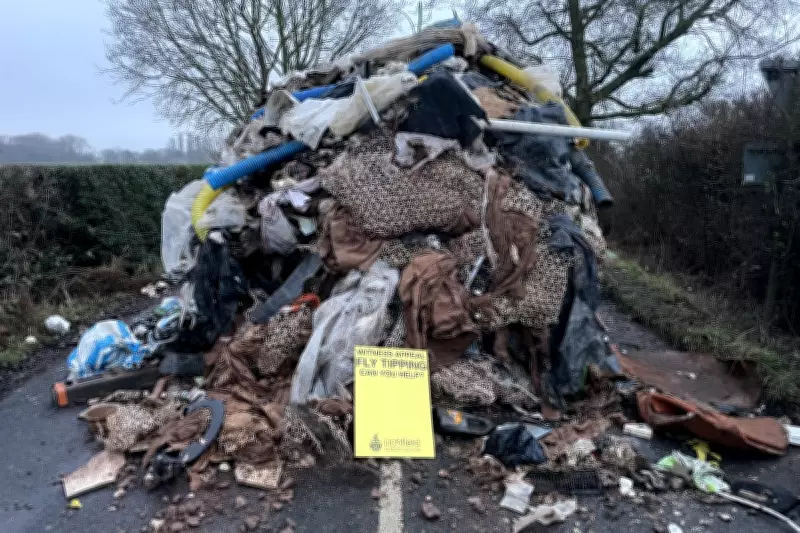
Fly-Tipping Incidents Soar to Record Levels Across England
Newly released official figures have exposed a dramatic escalation in fly-tipping across England, with cases surging by nearly 10% to reach unprecedented highs. Data from the Department for Environment, Food and Rural Affairs (Defra) confirms that local authorities recorded approximately 1.26 million incidents of illegal waste dumping during the 2024/2025 period.
A Steep Rise in Environmental Offences
This represents a significant 9% increase from the 1.15 million cases handled in the previous year, marking the highest level since revised recording methodologies were implemented in 2018/2019. The statistics specifically cover rubbish unlawfully discarded on public land, though private landowners nationwide are also bearing substantial clear-up costs from this pervasive issue.
Countryside organisations have issued stark warnings, highlighting that farmland is increasingly targeted by organised criminal networks. These groups dump waste that not only blights landscapes but also poses serious threats to wildlife, livestock, crops, and the broader environment. Farmers, despite being victims, are frequently left to foot the clean-up bills.

Breakdown of Waste and Locations
The council data provides a detailed breakdown of the fly-tipping epidemic. Nearly two-thirds of all incidents, precisely 62%, involved household waste. This category accounted for 777,000 cases in 2024/2025, up from 688,000 the year before. Household waste encompasses everything from standard black bags of daily rubbish to larger items like old furniture, carpets, and assorted clutter from loft and shed clearances.
In terms of location, fly-tipping most commonly occurs on pavements and roads, responsible for over a third of cases at 37%. Regarding scale, almost a third of incidents, 31%, involved waste equivalent to a small van load, while 27% were the size of a car boot or less. However, the most concerning trend involves larger-scale dumping.
There were 52,000 cases where the amount of rubbish was comparable to a tipper lorry load or more, an 11% rise from the previous year. These substantial incidents alone cost English councils a staggering £19.3 million to clear up last year. Additionally, the Environment Agency dealt with 98 incidents of large-scale illegal dumping during the same period.
Enforcement Actions and Government Response
While enforcement efforts have intensified, their effectiveness appears mixed. Councils took 572,000 enforcement actions in 2024/2025, an 8% increase, and issued 69,000 fixed penalty notices, up 9%. However, the total number of court fines dropped by 9% to 1,250, and the combined value of these fines decreased from £730,000 to £673,000, despite a slight rise in average fines.
In response to the crisis, Defra has published new guidance aimed at empowering local authorities. This includes measures to help councils seize and crush vehicles used for fly-tipping or repurpose them for clean-up operations, alongside advice on pursuing court cases. Councils are also being encouraged to publicly name and shame offenders on social media platforms.
Defra Minister Mary Creagh expressed strong condemnation, stating, "We are empowering local authorities to clamp down on waste cowboys and restore pride in our local areas. I share the public’s fury at seeing our streets, parks and fields used as dumping grounds." She warned fly-tippers that vehicles used for such crimes could end up on the scrapheap and highlighted government investments in technology and increased funding for the Environment Agency.
Calls for Stronger Measures and Industry Responsibility
The Liberal Democrats have advocated for serious waste crime to be prioritised by the National Crime Agency, suggesting it take over investigations from the Environment Agency in the most severe cases. Tim Farron, the party’s environment spokesman, criticised the current situation, noting that waste gangs have profited illegally while harming the environment and public health with impunity.

Gavin Lane, President of the Countryside, Land and Business Association (CLA), emphasised the severity of the problem in rural areas. "The countryside is increasingly being targeted by organised crime gangs – often violent – who know that rural areas are under-policed and resourced," he said. Lane called for penalties that better reflect the crime's severity and for vehicle seizure to be a default penalty.
Arooj Shah, chairwoman of the Local Government Association’s neighbourhoods committee, acknowledged councils' tireless efforts but pointed to inadequate penalties. "We continue to urge the Government to review sentencing guidelines for fly-tipping so that offenders are given bigger fines for more serious offences to act as a deterrent," she stated. Shah also urged manufacturers to contribute more by providing take-back services for items like sofas and mattresses to alleviate council clean-up costs.
The issue was further highlighted by recent footage from a London street, showing fly-tippers brazenly dumping rubbish from a tipper truck in broad daylight before speeding away upon noticing they were being filmed, underscoring the audacious nature of this growing environmental crime.