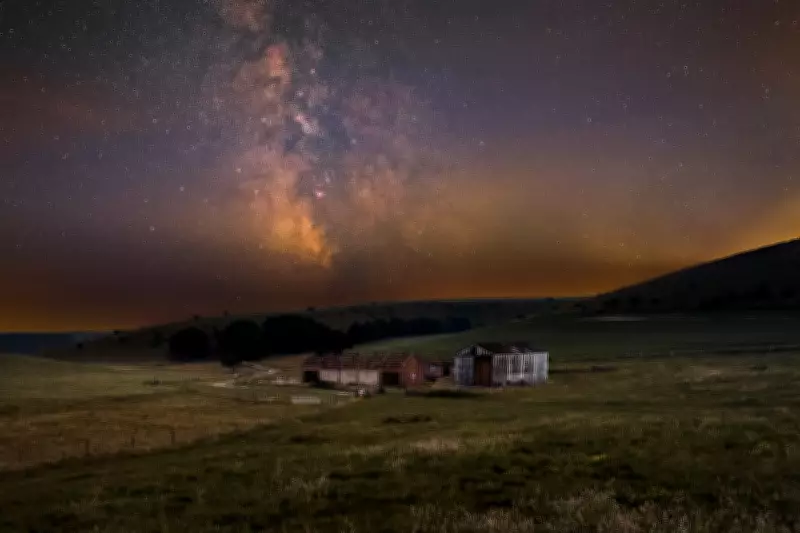
Milky Way Photo Triumphs in South Downs Dark Skies Competition
An "incredible" photograph of the Milky Way arching over the South Downs has been crowned the winner of the national park's annual astro-photography competition. The contest, which attracted more than 130 entries, was held to commemorate the 10th anniversary of the South Downs being designated an International Dark Sky Reserve.
Ancient Light Captures Celestial Beauty
The top prize was awarded to Brighton-based photographer Michael Harris for his image titled Ancient Light. The photograph masterfully captures the Milky Way galaxy shimmering above an abandoned barn in the Balsdean Valley near Brighton, East Sussex.
Judge Dan Oakley, a dark skies expert and astro-photographer, praised the winning entry, stating: "I think this is an incredible and realistic photo of what the South Downs Dark Skies experience is. It's beautifully framed."

Mr Harris elaborated on the historical significance of the location, noting: "The site has had a long history with Roman occupation, as a medieval hamlet, use as accommodation during the Second World War and for farming. All of which have long since come and gone in the time it has taken for the light from the Milky Way above to reach us, which is approximately 26,000 years."
Category Winners Showcase Night's Wonders
The competition featured several categories, each highlighting different aspects of the night sky. The Life At Night category was won by Richard Murray from Waterlooville for his photograph Snail Trail To The Stars, which depicts a snail beneath The Plough asterism.
Judge Elinor Newman, who organises the national park's Dark Skies Festival running until February 22, commented: "This really does encapsulate life at night, with the snail, flora and lichen. The image has incredible detail, captures a moment and takes me to another place. A very inspiring image."
Mr Murray described the challenging process behind his shot: "The shot took a lot of patience and a surprising amount of suspense, waiting for the exact moment when my tiny, mucus-powered model lifted both antennae toward the cosmos above. Eventually, the stars, the snail, and the timing all lined up and I got the shot I'd been hoping for."
Deep Space Category Reveals Cosmic Remnants
A new category, South Downs To Deep Space, was won by Nigel Stanbury from Haslemere, Surrey, for his photograph Jellyfish Nebula. This image captures a supernova remnant located an astonishing 5,000 light years away.
Judge Dan Oakley remarked on the image's striking appearance: "It looks like a jellyfish, but it's not, it's the remains of an exploding star. It looks straight out of Star Trek."
Mr Stanbury provided detailed insight into his photograph: "The image is of the so-called Jellyfish nebula located in the constellation of Gemini, the twins. It is the remains of a star larger than our sun, that exploded as a supernova many thousands of years ago, blowing off a cloud of gas that has been expanding ever since and glows as it collides with surrounding gas and dust. The image was taken over three nights, and needed 22 hours of exposure to bring out the colours and show the finer details of the faint structure. It has taken light 5,000 years to reach us so the image shows the object as it appeared 5,000 years ago."
The South Downs National Park's Dark Skies Festival continues to celebrate the region's exceptional night skies, with the competition winners showcasing the profound beauty and scientific wonder accessible from this protected reserve.