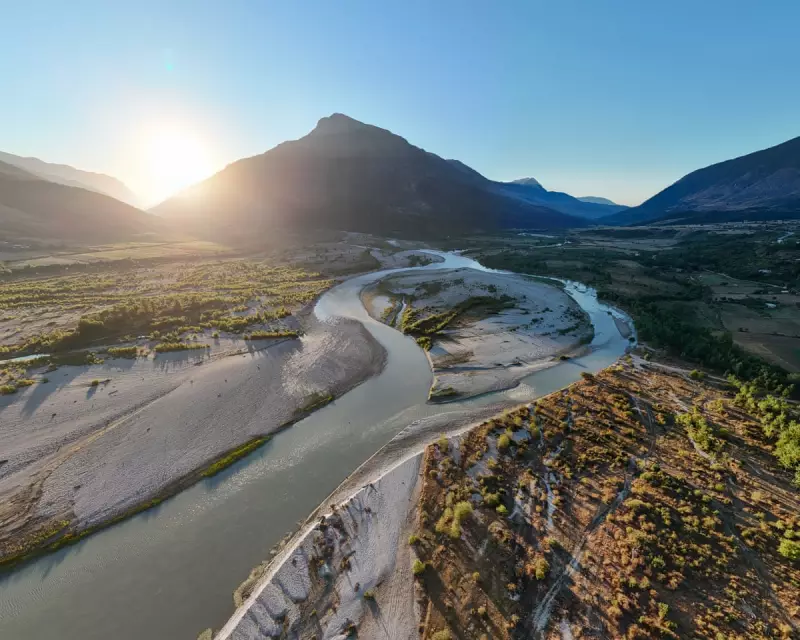
The Vjosa River flows from north-west Greece into south-west Albania, carving a graceful, meandering path across the southern Albanian landscape. This waterway, stretching 169 miles from its source, has recently been designated as Europe's first "wild river national park," a status achieved through the efforts of conservation charities EcoAlbania and Riverwatch. However, preserving its fragile ecosystem requires urgent action, including extensive tree planting, and volunteers are now being called upon to assist in this critical endeavour.
A Call to Action for Conservation
Our induction into the tree-planting initiative comes from Pietro, an Italian hydromorphologist overseeing a group of around twenty volunteers for the week. We gather in a makeshift nursery filled with spindly willow and poplar saplings, situated just above the Vjosa River. Pietro expertly extracts a young willow from the clay-rich soil, holding it up to demonstrate its delicate, earthy tendrils. "The trick is not to accidentally snick the stem or break the roots," he advises, emphasising the care needed for successful replanting. With this message in mind, we take up our hoes and head out in pairs to follow his instructions, ready to contribute to the river's preservation.
The Threat to Europe's Rivers
The volunteering week is the brainchild of EcoAlbania and the Austria-based Riverwatch, organisations that successfully persuaded the Albanian government to protect the Vjosa in 2023. This intervention was timely, as new research co-funded by Riverwatch reveals that Albania has lost 711 miles of "nearly natural" river stretches since 2018—proportionally more than any other Balkan country. On our first evening, Ulrich ("Uli") Eichelmann, Riverwatch's chief executive, presents a hard-hitting overview of the threats facing Europe's rivers. He reserves particular criticism for the thousands of dams obstructing once free-flowing waterways, blaming them for irreversible damage to fish stocks and freshwater ecosystems.

Uli asserts that the Vjosa, as one of the last wild rivers in the Balkans, has been spared a similar fate, but he warns that critical elements are still missing. "Although the river looks beautiful," he says, "there are critical things missing." High on his list are trees, many of which have been lost to fires, logging, road building, and aggressive grazing. This deforestation has led to high levels of erosion and an increased risk of flooding, underscoring the urgency of our replanting efforts.
Volunteers from Diverse Backgrounds
Buoyed by Uli's presentation, we approach our replanting tasks with redoubled efforts the next day. Our group includes a London-based book illustrator inspired by David Attenborough's Ocean documentary, a US geospatial analyst hoping to create an "Albania where Albanians might want to stay"—a reference to the country's 1.2 million emigrants overseas—and an Italian university student interested in eco-tourism, among others. Over lunch on the second day, I chat with Aida, a tour guide from Tirana who wants to better acquaint herself with the Vjosa region. She notes that visitors rarely come to this part of Albania, often driving straight through or making only quick visits to nearby historic towns like Gjirokastër. Looking out over the river's braided islets and rugged mountain backdrop, we agree that such oversight is a shame, given the region's rich cultural history, interesting gastronomic tradition, and abundance of natural attractions.
Challenges and Discoveries
That night, heavy rain begins, with torrents pouring down from thunderous skies. By the next morning, the planting zone is several feet underwater, temporarily suspending our activities. Instead, I join some volunteers on an impromptu sightseeing expedition, following Aida's recommendations. We head upstream, stopping first at the slow-food town of Përmet, then at the delightful Orthodox church of St Mary hidden in the hills, and finally hiking up the Langarica canyon despite the dreadful weather. The next day, with rain still falling hard, I opt for a soggy hike up the nearby Peshtura gorge to see a waterfall, now bursting from the hillside due to the rainfall. In the afternoon, I visit Gjirokastër, exploring its ethnographic museum and clifftop castle, which confirm its reputation as a must-see destination.

Balancing Tourism and Conservation
Later that night, I share my discoveries with Olsi Nika, executive director of EcoAlbania. While happy at my enthusiasm, he expresses concern about the park's future. As a conservationist and recent winner of the prestigious Goldman Environmental Prize, Olsi is not against tourism but worries about its potential impacts. Albania's coastline is already busy with package holidaymakers, and an airport is being built in the river's delta despite it being a protected area. He is anxious to see the government fulfil its management plan for the park, something it has been slow to do. "Tourism is like fire," he says. "You can prepare your soup with it, but it can also burn your house down."
A Historical Perspective
Olsi's words linger as I drive back towards Tirana, stopping at the archaeological site of Apollonia, an ancient Greek trading community later colonised by the Romans. According to Herodotus, Apollonia once sat on the Adriatic coast, but centuries of silt from the Vjosa have pushed it miles inland. Similarly, the river's route has altered over time, reminding us that change is constant in hydrology. Now, as a national park, the Vjosa faces new changes, with hopes that it will continue to flow untamed and unbroken, preserved for future generations.
The volunteering trip was funded by Patagonia, which supports EcoAlbania. EcoAlbania arranges hotel, food, and transport from Tirana to Tepelenë for about £700 for the week, with volunteers needing to arrange their own transport to Tirana. The next volunteering week is scheduled for 16-21 February, offering more opportunities to contribute to this vital conservation effort.