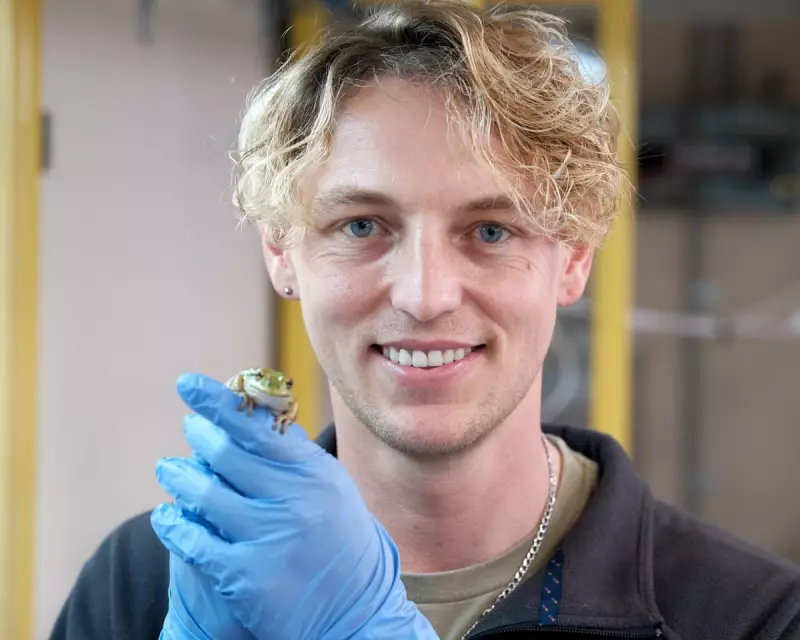
From a childhood spent chasing tadpoles in the Mojave desert to leading cutting-edge conservation research in Australia, Dr Anthony Waddle's journey is one of remarkable transformation. His current mission is nothing short of heroic: to save hundreds of frog species from a devastating fungal pandemic.
From Desert Dreams to a Deadly Fungal Threat
Anthony Waddle's fascination with amphibians began early. At just eight years old, he was captivated by tadpoles in a reservoir near Las Vegas, a moment he describes as "one of the perfect moments in my childhood". That childhood passion evolved into a career dedicated to conservation, culminating in a PhD from the University of Melbourne in 2022.
Today, the 35-year-old biologist is confronting one of the worst wildlife diseases in history. A deadly chytrid fungus has already driven 90 amphibian species to extinction and currently threatens over 500 more. This pathogen is almost always fatal, capable of rapidly decimating entire populations.

The stakes are incredibly high. Frogs and other amphibians are vital to global ecosystems, controlling insect populations that spread human diseases. Furthermore, their skin is a promising source for new, less addictive painkillers and compounds that could combat antibiotic resistance.
A Simple, Ingenious Solution: The Frog Sauna
During the pandemic, Waddle and a colleague began experimenting with a surprisingly simple concept to help frogs fight the fungus. They constructed miniature shelters using masonry bricks, which formed perfect frog-sized holes. These were stacked "like a Jenga tower" and covered with a greenhouse top, creating warm refuges.
The logic was sound. The chytrid fungus, much like human influenza, thrives in cooler conditions. By providing frogs with these warm "saunas," Waddle aimed to boost their body temperature and help their immune systems resist infection.
The experiment was a resounding success. Endangered green and golden bell frogs that spent winter in the saunas were significantly less likely to succumb to the fungus. Even more promising, they developed resistance, remaining protected when re-exposed to the pathogen later.
Beyond Saunas: Vaccination and Genetic Frontiers
While the saunas offer a lifeline, Waddle knew a more scalable solution was needed to protect the hundreds of species at risk. His work has since expanded into immunisation and the controversial field of synthetic biology.
One major project involves raising and vaccinating hundreds of green and golden bell frogs for release into the wild, an effort Waddle believes will be "the largest input of frogs in that population in a decade."
For species that cannot be vaccinated, like the critically endangered southern corroboree frog which no longer breeds naturally in the wild, his team is exploring gene replacement. They have begun creating transgenic frogs, introducing new genetic material to help the amphibians resist disease.
"We want to test it in as many Australian species as we can," Waddle explains with evident excitement. "If it works... it could be the solution, and we could share it around the world."
This approach is not without debate. While advocates see it as a tool to add genetic diversity and disease resistance, critics raise ethical concerns and warn of unintended ecological consequences. The International Union for Conservation of Nature's 2025 decision to permit synthetic biology for conservation opened the door for such research.
Waddle is a cautious advocate. "We can't just be willy-nilly slapping genes into frogs," he states, "but at the research level we should be investigating synthetic biology." He firmly believes these methods will soon be used in wild conservation projects.
A Ray of Hope for Global Amphibians
Australian herpetologist Dr Jodi Rowley has hailed Waddle's multifaceted work as "a ray of hope in amphibian conservation." With over 40% of amphibian species threatened globally, such innovative strategies are desperately needed.

For Waddle, the challenges are a source of driven anticipation, not dread. "Usually if I can't sleep, it's something exciting," he says. "I can't wait to see what happens in that experiment tomorrow... I'll be sitting in bed, [thinking] oh, we can do that experiment."
From the simple warmth of a brick sauna to the complex science of genetic editing, Anthony Waddle's work embodies a new, proactive era of conservation. It is a testament to how a childhood wonder, forged in a desert reservoir, can evolve into a global mission to preserve our planet's precious biodiversity.