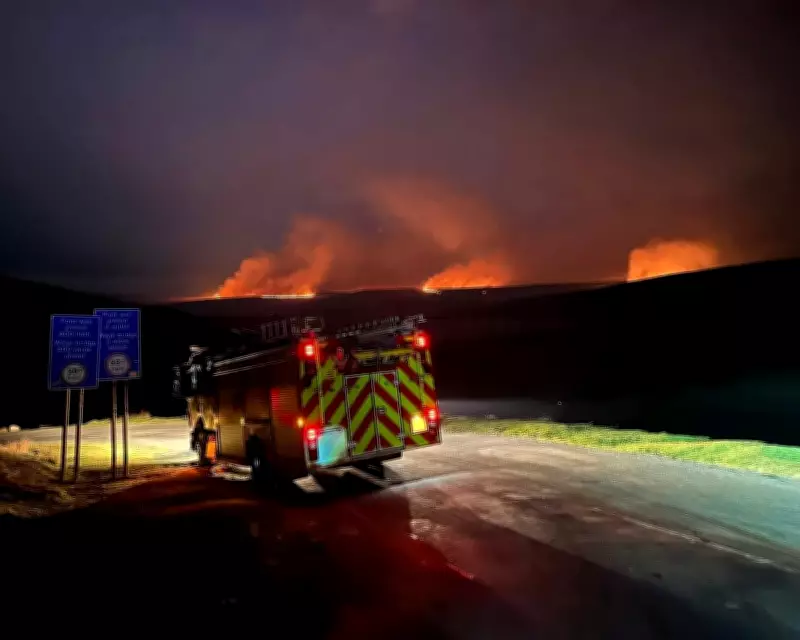
Firefighters are struggling to control wildfires raging through the scenic Elan valley in mid-Wales for a fifth day. The Mid and West Wales fire and rescue service has been working to extinguish fires in and around the Powys beauty spot since Sunday. It is not yet clear how much damage has been done to the valley, 80% of which is designated as sites of special scientific interest, raising fears for flora and fauna.
A helicopter had been deployed to tackle fires still burning fiercely near Claerwen dam and Teifi Pools, the fire and rescue service said, urging the public to stay away from the area. Hafod estate, a National Trust estate near Pontarfynach (Devil’s Bridge), has been closed until further notice.
Concerns for Wildlife and Ecosystem
Sorcha Lewis, a farmer focused on nature-friendly farming, published pictures on social media of the damage the fires had caused to the ffridd, the “mosaic ecosystem” of sloping areas lying between lowland pasture and open mountain grazing. “I was concerned for the trees … there was concern it may get into the wood but the fire service were monitoring that,” she wrote in a post. “In my past I have mapped the fires but never been in the brunt of one. Brian [Lewis’s husband] thinks it may be 40 years since there has been a fire here.”

Historical and Environmental Context
The Elan valley, sometimes known as the Welsh Lake District, is home to 70 sq miles (181 sq km) of dams and reservoirs, built by the Victorians to supply clean water to Birmingham. It is unclear how the fire started or grew so quickly.
In a statement, Natural Resources Wales said: “With conditions forecast to remain dry over the coming days, Wales is now entering an elevated risk period for wildfires. While teams will continue to work around the clock to protect people, nature and property, NRW is also reminding people of the devastating consequences lighting fires and using disposable BBQs can have on the environment.”
Additional Incidents and Record Wildfires
A large wildfire broke out at Waun Wen, near Merthyr Tydfil, on Wednesday night. Last year was the worst on record for wildfires in the UK, according to the Global Wildfire Information System. By November, wildfires had burned 47,026 hectares (116,204 acres) across the UK – the largest area in any year since monitoring began in 2012, and more than double the area burned in the record-breaking summer of 2022.
Separately, firefighters have entered a second day tackling a huge commercial waste blaze at an industrial site in Port Talbot.