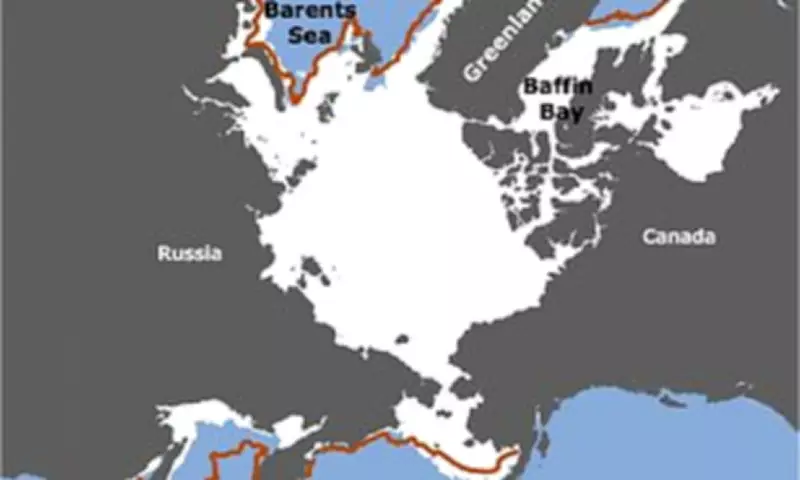
Arctic sea ice has reached a record low winter maximum following unusually warm temperatures in two critical regions, according to Japan's National Institute of Polar Research (NIPR). The annual peak extent—when ice coverage should be at its highest—was the smallest since satellite monitoring began in 1979.
Record Low Measurements
On March 13, 2026, ice covered just 5.31 million square miles (13.76 million square km), narrowly surpassing the previous low set in March 2025. That year, coverage had fallen six percent below the 1991–2010 average. Compared to 2025, the 2026 maximum was 11,580 square miles (30,000 square km) smaller.
Warmth Hinders Ice Formation
Researchers attribute the record low to elevated temperatures in the Sea of Okhotsk near Russia and Baffin Bay off northern Canada. These conditions prevented sea ice from expanding normally during the winter months. NIPR stated, "There are concerns that Arctic sea ice changes may reach a point of no return amid progressing global warming, potentially triggering a chain of impacts across the global climate system."

Strong southeasterly winds combined with warm water in the Sea of Okhotsk caused the ice extent to begin decreasing as early as February 19. Throughout the winter of 2025–2026, sea ice extent remained persistently low.
Satellite Data Confirms Trend
Data from the Japanese Space Agency's SHIZUKU satellite confirmed the record low. Comparisons with the 2010 average show the ice boundary was several miles further back, especially in the Sea of Okhotsk and Baffin Bay. January and February temperatures in these areas remained significantly above normal, severely hindering ice formation.
Historical Context and Future Projections
Previous studies suggest the first ice-free Arctic summer could occur as soon as 2027. Using 300 computer simulations, scientists predict an ice-free day is guaranteed within 9 to 20 years, regardless of emission reductions. Nine simulations indicated 2027 as a possible date.
However, research from the University of Exeter last year found that Arctic ice loss slowed from 2.9 million cubic km per decade (1979–2024) to 0.4 million cubic km per decade (2010–2024). Scientists caution this slowdown is temporary, likely lasting only 5 to 10 years, after which faster-than-average decline is expected.
Climate Implications
While melting sea ice does not directly raise sea levels, it plays a crucial role in regulating atmospheric and oceanic temperatures. Without reflective ice, the Arctic Ocean absorbs more solar energy, potentially destabilising global weather systems and causing sea levels to rise as warmer water expands. Dr. Céline Heuzé of the University of Gothenburg warned of "more extreme weather year-round," including cold spells in Italy and heatwaves and forest fires in Scandinavia.