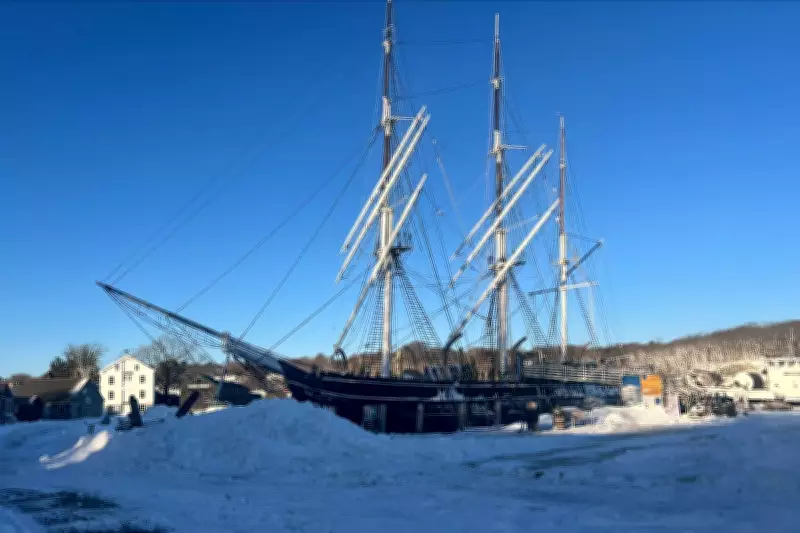
Clearing two feet of snow from a driveway presents a formidable challenge, but removing that same heavy accumulation from a 113-foot-long historic whaling ship docked in a river demands an entirely different level of effort and precision. Following a record-breaking snowstorm that blanketed the Northeast, shipyard workers at Connecticut's Mystic Seaport Museum embarked on a meticulous cleanup operation, limited exclusively to rubber and plastic shovels to safeguard their priceless wooden vessels.
Preserving History with Delicate Tools
Any metal implements, including standard snowblowers or metal shovels, were strictly prohibited during the operation to prevent damage to the decks of the Charles W. Morgan and other historic wooden boats in the museum's renowned collection. Shannon McKenzie, Vice President of Watercraft Operations and Preservation, explained the added complexity: "You've got to be cautious as you go. The added difficulty is, you've got to get it up and over all of the rails of the boat, which for the Morgan, it's 4 feet, 3 feet in places. So it's an onerous effort."
Mitigating Wear on Historic Materials
Scott Gifford, Shipyard Director at the museum, emphasised that crews are dedicated to mitigating wear and tear on the boats' historically accurate natural materials. This includes protecting the caulking in the Morgan's deck seams, which is made from pitch—a traditional combination of pine tar, linseed oils, and other "old-timey potions" that prevents leaks. A metal shovel could easily pull out this vital material, compromising the ship's integrity.

The Saltwater Preservation Process
Clearing the snow represents merely the initial step in the preservation process. Afterward, pure rock salt must be scattered across the decks to eliminate any residual snow and ice. Fresh water from melting snow poses a significant threat to the wooden structures. McKenzie elaborated: "The wooden boats definitely prefer to have salt water instead of fresh water. It sort of pickles them a little bit and it's much better for the wood. So we put salt on the decks so any fresh water that's melting from the snow gets the salt into it and doesn't contribute to rot on the boats."
Gifford noted that this method essentially duplicates how wooden ships were preserved generations ago, when vessels were regularly washed down with salt water. "This wasn't our idea," he stated. "This was out in the wooden boat world long before us."
Scope of the Maritime Museum's Collection
Mystic Seaport, recognised as the nation's largest maritime museum, houses three large ships, including the Charles W. Morgan—the last remaining wooden whaling ship from the 19th century American merchant fleet. Additionally, approximately a dozen mid-sized ships at the museum require snow clearance during every significant storm, making winter maintenance a recurring and labour-intensive task.
Extensive Cleanup Across the Property
The cleanup from this latest storm extended beyond the boats to encompass the entire 37-acre riverfront property, including parking lots and the historic seaport village with its cobblestone, slate, and gravel walkways, all of which must be shoveled by hand. This process has been repeated multiple times throughout the winter season. "It's trying our patience a little bit," McKenzie admitted with a laugh.
An enthusiastic team of about a dozen individuals commenced clearing the boats at 7 a.m., completing the task by lunchtime. They subsequently joined roughly seven other workers to assist in finishing the clearance of the sprawling grounds. Despite the arduous work, McKenzie reflected positively: "There's like piles and piles and piles of snow, but it's really beautiful. And it was a lovely day outside. It wasn't too cold. It was great. We had a great time."
Monitoring Stability During the Storm
Throughout the storm, workers maintained a vigilant watch over the boats. McKenzie highlighted the constant risk that accumulating snow could compromise their stability, particularly if it piled up unevenly on one side, posing a potential hazard to the historic structures.

Museum Operations and Future Forecasts
The museum anticipated reopening to staff with limited exhibits for visitors on Wednesday, with plans for the Charles W. Morgan to be ready for public viewing over the weekend. However, these plans remain contingent on the latest weather forecasts, which indicated the possibility of additional snowfall, potentially necessitating further rounds of this delicate and time-honoured preservation effort.