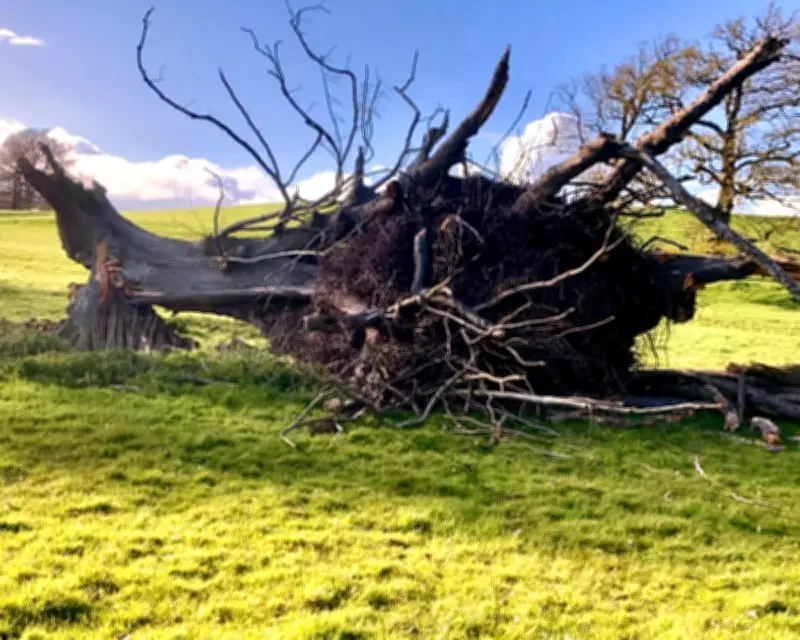
In the rolling countryside of The Marches, Shropshire, a centuries-old common lime tree recently met its dramatic end, transforming from a living landmark into a poignant absence that now redefines the very landscape it once dominated. The tree, estimated to be around 300 years old, stood as a silent witness to generations until Storm Dave brought it crashing down, its trunk snapping at the roots like a carrot and its branches splintering across the open field.
A Landscape Defined and Redefined
How swiftly something that has shaped a vista for hundreds of years can become the void that reshapes it entirely. This ancient tree, which had endured through years of trouble and change, now lies like a stranded shipwreck, its massive hulk of twigs resembling a stilled animal pelt. Just a day before its fall, the observer marvelled at its architecture of mostly dead wood yet vibrant life, pondering in tree-time how much longer it might persist as spring surged through the land and its timbers.
The Tree's History and Origins
This fallen giant is identified as a common lime, scientifically known as Tilia x europaea, a hybrid of the native small-leaved lime (T. cordata) and the large-leafed lime (T. platyphyllos). Likely of natural origins but possibly introduced, it became common through 17th- and 18th-century plantings, often referred to as the Dutch lime due to its prevalence in Dutch nurseries. These trees were extensively planted across Europe in parks, avenues, gardens, and streets, embodying the baroque style of the era.

Based on its condition, girth, height, browny-red leaf buds, and a thatch of epicormic twigs covering a third of its bulk—forming an ecosystem in itself—this individual tree could have been planted in the 18th or early 19th century. It stands as a Georgian survivor, part of a countryside idyll characterised by sweeping vistas and grand trees, such as those found at Llanforda and other estates around Oswestry.
Unearthing Historical Fragments
In the aftermath of the fall, a digging stick fashioned from the debris revealed intriguing artifacts buried in the duff of decayed wood and soil exposed by the broken trunk. Among the findings were a shard of stone, a hollow finger of wood, and a fragment of green glass—the corner of a flat-sided bottle. Holding this glass up to the sunlight revealed tiny bubbles of air trapped during its making, unseen since the tree was planted centuries ago.
This discovery sparks curiosity: was this bottle once filled with gin or laudanum, tossed into the planting hole as a libation by someone long forgotten? Such remnants offer a tangible connection to the past, echoing the lives that intersected with this tree over its long lifespan.
The Impact of Storm Dave
Storm Dave provided a swift and definitive answer to the question of the tree's longevity, declaring "none" as it toppled the ancient lime. This event underscores the fragility of even the most enduring natural features, reminding us of the powerful forces that can alter landscapes in an instant.
The fallen tree not only marks a loss but also creates a new focal point in the field, inviting reflection on the cycles of growth and decay that define our environment. Its story is a testament to the resilience and transience of nature, captured in moments of both standing grandeur and fallen repose.