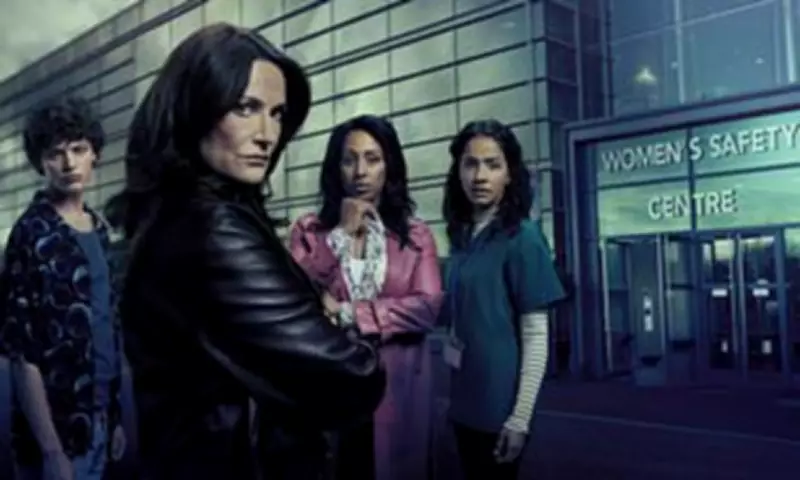
In a chilling new television drama, Channel 5 presents a Britain where the unthinkable has become law. All men are mandated to remain indoors from 7pm until 7am, with violations punishable by a two-year prison sentence. Women, in stark contrast, roam the streets freely under the cover of darkness. This is the unsettling premise of the six-part series The Curfew, adapted from novelist Jayne Cowie's dystopian thriller.
A World of Gender-Based Confinement
The series opens with a society that has fully embraced this radical curfew. Snatch squads aggressively enforce the rule, arresting any man daring to step outside for even a brief cigarette. The government justifies the policy with catchy, three-word slogans like "Keep Women Safe," "End Night Crime," and "Protect Our Streets." Yet, despite these draconian measures, violent assaults continue unabated, immediately casting doubt on the curfew's effectiveness.
A Brutal Murder Defies the Narrative
The drama's central mystery begins with a gruesome discovery. Right outside the tagging centre where every man must report to have an electronic ankle bracelet fitted, a woman's brutally murdered body is found, her head bashed in. Detective Pamela Green, portrayed with fierce intensity by Sarah Parish, is incensed. "That level of rage," she snarls, "Only a man could have done that!" Her conviction is absolute, dismissing any possibility of female aggression or capability for such violence.

This assumption is immediately challenged for viewers. We witness scenes of drunken women reveling in the deserted town centre at midnight, suggesting the potential for collective female violence. The narrative cleverly plants suspicion on key female characters, including Anita Dobson's Queen Bee of a women's hostel and Alexandra Burke, the former X Factor singer in her first major acting role. Mandip Gill's character, a single mother named Sarah, appears an unlikely suspect only because she has already confessed to the crime, adding another layer of intrigue.
Provocative Themes and Unanswered Questions
The Curfew boldly straddles the line between satire and a radical commentary on misogyny and sex crimes. It provocatively questions whether society would accept such extreme gender-based restrictions, especially given the recent history of widespread lockdowns that confined all citizens, regardless of gender, for months on end. The series suggests that with the right persuasive slogans, even the most absurd policies can gain public acceptance.
However, the drama notably avoids one of the most contentious modern issues. Its rules are rigidly based on biological sex: men are men, women are women. It completely sidesteps the complexities of transgender individuals. The fate of transwomen who have undergone sex-change operations or transmen, who are biologically female but identify as male and thus might be forced to stay indoors, is a glaring, unasked question. In its quest to be bold and provocative, the show stops short of tackling this contemporary societal debate.
Ultimately, The Curfew serves as a gripping, thought-provoking thriller that holds a dark mirror to our own world. It explores themes of control, gender politics, and the ease with which freedoms can be eroded in the name of safety. With strong performances and a compelling central mystery, the series promises to spark intense discussion about the limits of state power and the nature of justice in a divided society.