Miu Miu's Luxury Apron Collection Draws 'Out of Touch' Criticism
Luxury Italian fashion house Miu Miu has ignited a fierce backlash with its latest spring and summer 2026 collection, which features aprons priced as high as £3,700. Critics have derisively labelled the range as 'Soviet Dinner Lady chic', accusing the brand of being profoundly disconnected from everyday realities. The collection ambitiously seeks to merge domestic aesthetics with high fashion, but the exorbitant price tags have sparked widespread debate about appropriation and elitism in the industry.
Exorbitant Prices and 'Tradwife' Aesthetic Convergence
The controversial lineup includes a black leather apron retailing for £3,600 and a Macramé apron priced at a staggering £3,700. Brand descriptions praise the Macramé piece for its 'lively floral motif' and 'leather details', framing it as a retro reinterpretation of the traditional domestic apron designed to 'complete looks with a bold, original style'. Other items in the collection are a white Poplin apron at £1,470 and a Poplin pinafore dress costing £2,100.
This launch coincides with a notable surge in the 'tradwife-aesthetic', a trend encouraging women to embrace traditional domestic roles and values, often rejecting progressive feminist perspectives. The movement has gained traction across the United States, Australia, and the United Kingdom, promoting ideals centered on homemaking and childcare reminiscent of the 1950s and 1960s.

Celebrity Endorsements and Fashion Week Showcases
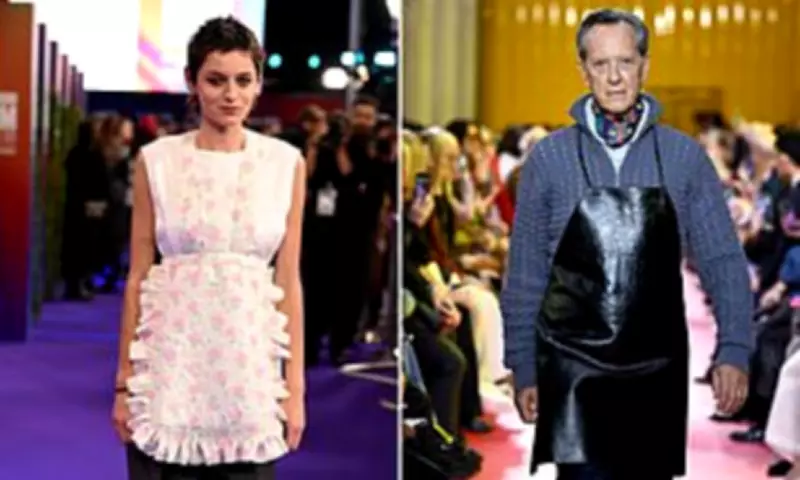
Actress Emma Corrin notably debuted a Miu Miu floral apron at the closing night of the 69th London Film Festival in October, bringing the trend into the celebrity spotlight. Meanwhile, during Paris Fashion Week, actor Richard Grant, aged 67, walked the runway modelling the spring apron collection, wearing a leather apron over a shirt and pullover. As the show progressed, the aprons became increasingly ornate, embellished with studs, crystals, and delicate lace.
The apron trend is not exclusive to Miu Miu. Designer Veronica Leoni opened her Spring 2026 show for Calvin Klein with a milk-white apron, citing 'working class heroes' as her muse. Additionally, American actress Myha'la wore Miu Miu's black leather apron dress at the season four premiere of Industry in January, while Norwegian actress Renate Reinsve opted for a Calvin Klein gown inspired by the milkmaid aesthetic at the European Film Awards.
Public Backlash and Accusations of Appropriation
Social media reactions have been scathing. One Instagram user and stylist quipped 'Soviet dinner lady chic,' while a Reddit commenter compared the collection to 'Marie Antoinette building a "farm" behind Versailles so that she could dress up and play peasant.' Another described the looks as 'upper class poverty cosplay', and many have labelled the entire endeavour as 'out of touch'.
Critics argue that Miu Miu's collection represents the 'appropriation of working class clothing and aesthetics', transforming humble, functional garments into unattainable luxury items. The brand's show notes attempted to frame the apron as a 'universal symbol of work' afforded 'nobility and respect', highlighting its shifting cultural meanings from domestic to clinical and industrial contexts. The collection drew initial inspiration from German photographer Helga Paris's book, Women At Work.
The Mainstreaming of the 'Tradwife' Look
Celebrity stylist Marian Kwei observes that the tradwife trend is inspiring innovative pieces across the fashion spectrum, including high-street brands. Shop windows are increasingly adorned with gingham, lace, waist-cinching frocks, and dainty bows, mirroring styles popularised by 'traditional wives'. Garments evoking the 1950s often bear coquettish names like Flossie, Mathilde, and Birdie.
Kwei explained to The Daily Mail that the aesthetic features 'tea dresses, puff sleeves, prim ladylike long skirts, a soft pretty colour palette, twinsets, cinched-in waists, and modest higher necklines.' She noted these styles are resurgent on high streets in stores like Zara and River Island, largely because younger Gen Z consumers are embracing a 'slower, more mindful and better balanced' lifestyle, albeit without the patriarchal connotations of the past.

A Trend Set to Endure
According to Vogue Arabia, the tradwife movement has 'emphasised virtues of modesty and subtlety', influencing mainstream fashion with 'higher necklines, longer hemlines and softer make-up'. Alena Pettitt, a self-described British tradwife, categorises the visual style into two camps: the '1940s and 1950s Retro/Vintage housewife' or the 'Pioneer/Farm girl'. After years of experimentation, Pettitt says she now prefers 'cotton and shirred milkmaid dresses' to achieve a feminine look.
Despite apprehensions regarding its implications for feminism and autonomy, the trend's popularity is undeniable. Kwei highlighted that the 'Trad Wife' topic has amassed over 300 million views on TikTok, with numbers growing daily, suggesting this aesthetic is firmly entrenched in contemporary culture. The Daily Mail has approached Miu Miu for comment on the controversy surrounding its apron collection.