Project Hail Mary Review: A Sci-Fi Dazzler That Doesn't Signal Great Things for Cinema's Future
This Ryan Gosling vehicle is immensely likeable and technically impressive, even if it carries the whiff of top-shelf nostalgia. Project Hail Mary is some top-shelf nostalgia, and it doesn't signal especially happy days ahead for film culture that some of the greatest skill and effort is being funnelled into giving a modern film like this the illusion it was released in 1979.
Nostalgia and Modern Filmmaking
Does that covertly reinforce the idea that analogue filmmaking is an artefact of the past? As opposed to something that can be integrated into a more modern style? That's something to worry about another time. Here's a film that's about as effervescently likeable as it can get. In it, Ryan Gosling becomes best buds with an alien, as they put aside all cultural and linguistic barriers to save their respective planets from a sun-gobbling threat.
It's an alchemically perfected blend of past sci-fi greats, with a good dose of Spielberg and Kubrick – familiar without feeling exhausted. There's a yellow raincoat costume that designers David Crossman and Glyn Dillon made for Gosling's character that's as distinctive and easily replicated as Marty McFly's orange puffer vest.

Science and Storytelling
The science is pitched at a level that's digestible but makes you feel smart for having digested it, like the way Sam Neill demonstrated how wormholes work in Event Horizon (1997) by stabbing a pencil through a folded-up piece of paper. Spider-Verse's Phil Lord and Christopher Miller direct here from a script by Drew Goddard, who previously adapted The Martian (2015) from the novel by Andy Weir.
Project Hail Mary is another of Weir's, published in 2021, and bound by the same comforting, idealistic outlook: that scientific collaboration, across nations and galaxies, can and will save us in the end. It's escapist entertainment, into a world where hope exists.
Characters and Performances
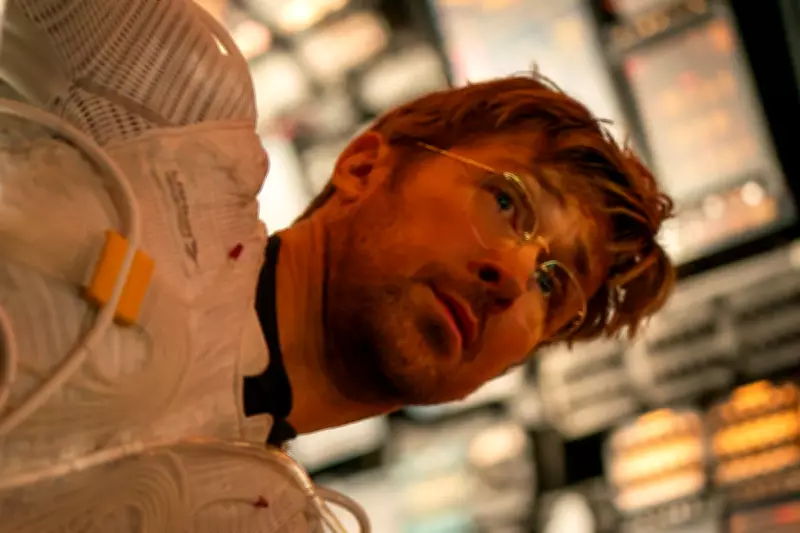
Most of the global effort plays out in the background, with a wonderfully phlegmatic Sandra Hüller (recent star of Anatomy of a Fall and The Zone of Interest) as a representative of the intellectual establishment back on Earth. We're primarily stuck with Gosling's Ryland Grace, a seemingly ordinary guy who wakes up on a spaceship, light-years from home, with no memory of who he is or why he's there.
What's important to know is that Project Hail Mary is, in large part, a buddy comedy, pairing Gosling with an extraterrestrial who is clearly the Gosling of their own society. While his Ken in Barbie (2023) will certainly be the more defining role of his career, Grace reflects the same ethos – that it takes an actor as cool as him to successfully play a goofball like this on screen.
Visuals and Technical Mastery
It's also an immaculate film to look at, in whichever of the 12 advertised formats audiences choose to watch it in (70mm, Imax, and 70mm Imax included), with its conscientious mix between practical sets and VFX technology. Its cinematographer, Greig Fraser, known for Dune (2021) and The Batman (2022), is one of the finest in the dying art of beautiful, dynamic lighting on a blockbuster scale.
Project Hail Mary was clearly made to catapult a certain segment of the audience back to their childhoods – it carries the same fetishisation of late Sixties and Seventies sound and production design as recent fare in the Alien franchise. Grace's spacesuit happens to be the same red as Dave Bowman's in 2001: A Space Odyssey (1968) and, at one point, he hums the same tune used by the aliens in Close Encounters of the Third Kind (1977) to communicate.
Cinema's Precarious Position
That said, cinema is in a precarious position right now. And, just maybe, Project Hail Mary will remind people why they ever fell in love with it in the first place. Sometimes, to move forward, it helps to look back. Directed by Phil Lord and Christopher Miller, and starring Ryan Gosling, Sandra Hüller, Lionel Boyce, Ken Leung, and Milana Vayntrub, this film is rated 12A and runs for 156 minutes, in cinemas from 19 March.