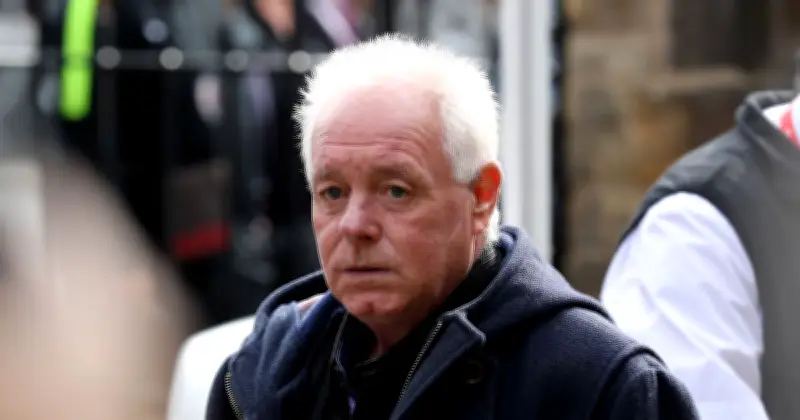
Former Coronation Street star Bruce Jones has recounted the harrowing moment he stumbled upon a body believed to be that of a Yorkshire Ripper victim. The actor, who became a household name playing Les Battersby in the long-running soap, previously appeared in a series about the Yorkshire Ripper titled The Secret Murders on ITV. The programme connects more than 20 unsolved murders and attempted murders to Peter Sutcliffe for the first time.
The Chilling Discovery
Bruce recalled the chilling moment in October 1977 when, as a young man, he uncovered the brutally murdered body of Jean Jordan — believed to be Sutcliffe's first victim — on a Manchester allotment where he was working alongside a friend.
He told the programme: "There was two of us, me and this older bloke who managed to get an allotment, which we did. We managed to acquire this big shed but it needed a brick base." The actor went on to explain that he found a building plot nearby which he had been to a few times to collect bricks.
"It was on the way there, five times I'd gone, filled the barrow, come back. And the sixth time, there was this body," he said. "My mate came over, he couldn't look at it, he was being ill."
Bruce added: "I ran across the main road. I nearly got killed running across that road, too. I rang 999. I thought, 'What do I do, do I go, do I stay?' The next minute, I've never seen so many police cars."
The Victim: Jean Jordan
Jean, a young mother in her early twenties, had travelled down from Scotland to settle in Manchester, where she was working as a sex worker. She was picked up, savagely attacked, and murdered between September 30 and October 11, 1977. The circumstances surrounding her death — blunt force trauma to the head, stab wounds, her clothing removed, and her body posed by her killer — led Manchester detectives to conclude that the Yorkshire Ripper, who was already being pursued by West Yorkshire Police, was responsible.
Police Questioning
Bruce also recalled how he was questioned by officers in connection with Jean Jordan's murder. He said: "They asked me if I'd been to Yorkshire. I couldn't remember if I'd been to Yorkshire or not. 'Where was I in Manchester on such and such a date?' I didn't know. [Police asked me] Why I had a hammer and big chisel and lump hammer in my wheelbarrow? That was to break the bricks up I needed for the base of the shed. Just question after question.
"Your mind does play tricks on you. It's like 'Where was I? Had I been to Yorkshire? No, I've never been to Yorkshire.' Right from the minute you find that body your mind is going faster than you can think. And no, no, no I wasn't there. I wasn't there... you know never been there. Never been there. And in the end, they come in and tell you, 'Get dressed,' and we'll run you home and that was it."
The £5 Note Clue
Jean had been handed a brand new £5 note shortly before her death, which officers recovered from her handbag. The five-pound note was traced to one of three banks in the Bradford, Shipley, and Bingley area, and police used the serial number to establish its origin, leading them to the haulage firm where Sutcliffe worked as a driver. Despite questioning Sutcliffe about the banknote on three separate occasions, police ruled him out as a suspect.
The Yorkshire Ripper's Reign of Terror
Sutcliffe, once amongst the most feared criminals in Britain, passed away aged 74 in November 2020 after reportedly declining treatment for coronavirus. His murderous rampage across Yorkshire and Manchester between 1975 and 1980 struck terror into Northern England, triggering a massive manhunt and a deeply flawed police investigation. Sutcliffe was serving a whole life sentence for the killings of 13 women, a number of whom were sex workers, as well as the attempted murder of a further seven victims.