The Renoir Girls: A Hidden History of Art, War and Betrayal
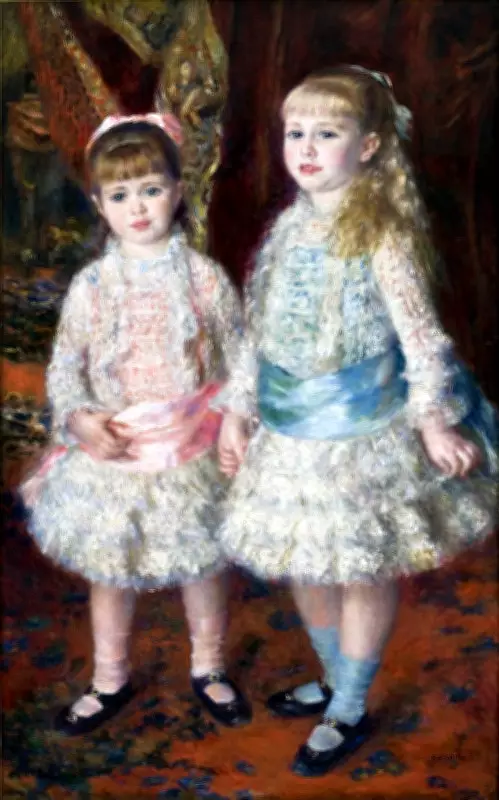
In her compelling new work, Catherine Ostler masterfully uses one of Pierre-Auguste Renoir's most celebrated paintings as a gateway to explore a narrative that oscillates between intimate family drama and the sweeping currents of history as France succumbs to fascism. The book, The Renoir Girls: A Hidden History of Art, War & Betrayal, begins with an image that initially appears to belong to a vanished era of privilege and tranquillity.
A Painting of Illusory Serenity
Housed in the São Paulo Museum of Art, Renoir's portrait depicts two young girls standing side by side, their white dresses glowing against an opulent interior, distinguished by pink and blue sashes. Their soft, composed faces suggest a childhood suspended in time, untouched by future turmoil. Ostler's narrative, however, systematically dismantles this illusion of permanence, revealing the fragile world behind the canvas.
The subjects are members of the Cahen d'Anvers family, a prominent Jewish banking dynasty deeply embedded in Parisian high society during the late-19th century. Their father, Louis, wielded significant financial influence, while their mother, Louise, hosted salons that attracted artists, writers, and aristocrats. This was a realm where art and money, culture and power, reinforced one another. Renoir, still establishing his reputation, navigated this world uneasily, reliant on patronage yet more at home in Montmartre's bohemian circles.

The Sisters' Divergent Paths
The story unfolds through the lives of three sisters: Irène, the eldest; Elisabeth, the "blue" girl; and Alice, the youngest, marked by pink. Each sister's trajectory diverges dramatically, forming the emotional core of Ostler's account.
Irène married into the Camondo family, another esteemed Jewish banking dynasty, continuing to inhabit a world of wealth and cultural refinement. Yet, this apparent stability proved deceptive. Her daughter Béatrice and Béatrice's children were deported and murdered during the Holocaust, demonstrating that wealth and integration offered no shield against political extremism.
Elisabeth led a quieter life, eventually converting to Catholicism and withdrawing from Parisian society. By the Second World War, she lived in obscurity in rural France. In January 1944, officials arrested her in a stark, snow-covered village scene. Despite her age, frailty, and conversion, she was deported, highlighting the absolute categories imposed by a genocidal state.
Alice, through marriage to an English aristocrat, became Alice Townshend and largely escaped the horrors that engulfed her sisters. Her relocation and changed social identity spared her from the immediate reach of the war's atrocities.
Historical Context and Enduring Divisions
Ostler situates these personal stories within broader historical shifts. The Dreyfus affair of the 1890s exposed deep antisemitic fractures in French society, revealing the precarious position of Jewish families like the Cahen d'Anvers. "I don't think France ever fully recovered," Ostler remarks, noting enduring divisions over monarchy versus republic, left versus right, and attitudes toward Jews and immigration.
The First World War briefly fostered national unity, but old tensions resurfaced afterward. France's collapse in 1940 led to the Vichy regime's active participation in persecuting Jews, a theme Ostler finds particularly unsettling. The betrayal was not solely external; local authorities facilitated arrests, as seen in Elisabeth's case.
Research and Resonance
Ostler's narrative skillfully blends intimate details from letters, family papers, and descendant interviews with wider historical events. Her research involved painstaking efforts, including a remarkable discovery of a trunk filled with letters and diaries from a 94-year-old granddaughter in Kensington. This impressionistic approach, akin to the painting itself, allows moments and details to coalesce into a powerful whole.

The book's resonance lies in the tension between appearance and reality. Renoir's portrait, often dismissed as "chocolate-boxy," transforms under Ostler's scrutiny into a poignant record of a fleeting moment before catastrophe. "When you see it in the flesh, it's very different," Ostler observes, noting its beauty and construction, which contrasts sharply with the tragic fates of its subjects.
Relevance to Contemporary Issues
Ostler emphasizes the shocking relevance of these historical themes today. "I was horrified that the themes are still so relevant," she says, pointing to enduring anti-Jewish tropes like Rothschild conspiracies and blood libel. She laments widespread ignorance of these tropes, highlighting a dangerous lack of historical knowledge.
Ultimately, The Renoir Girls transcends art criticism to explore identity, assimilation, and the catastrophic turns of history. It reminds readers that serene images can harbour seeds of destruction, and the distance between beauty and tragedy may be perilously short. The painting, once a symbol of stability, now stands as a testament to transience and the harsh realities faced by those beyond its frame.
The Renoir Girls: A Hidden History of Art, War and Betrayal by Catherine Ostler is published by Simon & Schuster, with events scheduled at the V&A and Hatchards Bookshop in London.