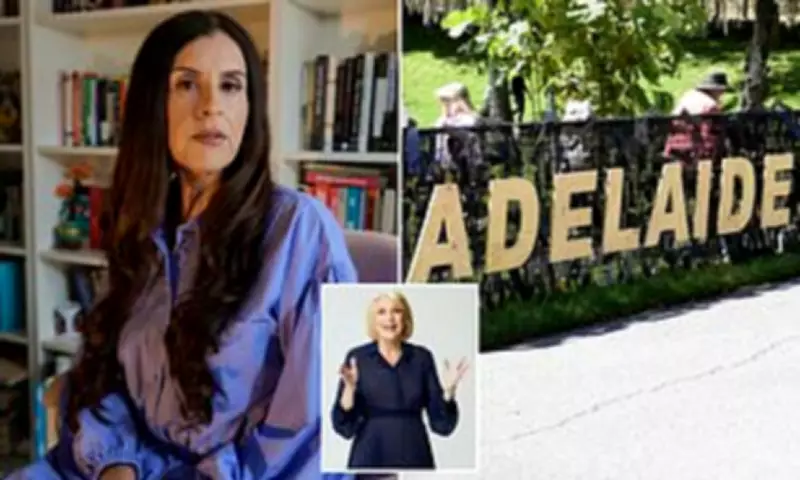
Australian-Palestinian Author Secures New Platform After Writers' Festival Controversy
Dr Randa Abdel-Fattah, the award-winning Australian-Palestinian author and academic whose controversial disinvitation from Adelaide Writers' Week sparked widespread backlash, has announced she will now be speaking at an alternative literary event in the South Australian capital. The development comes after months of intense debate about cultural sensitivity, free speech, and institutional responses to political expression within Australia's literary community.
The Original Controversy and Festival Collapse
In January, Adelaide Festival organisers made the contentious decision to withdraw Dr Abdel-Fattah's invitation to participate in the prestigious Adelaide Writers' Week programme for 2026. The move followed concerns about "cultural sensitivity" in the aftermath of the Bondi Beach terror attack, though critics argued it represented censorship of legitimate political viewpoints.
The author had faced criticism for previous anti-Zionist statements, including her declaration that "If you are a Zionist you have no claim or right to cultural safety." This position, while controversial to some, represents a perspective shared by many within academic and activist circles concerned with Palestinian rights.

The festival's decision triggered what can only be described as a mass exodus of participating talent. More than 180 writers, commentators, and literary figures withdrew from the event in solidarity with Dr Abdel-Fattah, including former New Zealand Prime Minister Jacinda Ardern and respected ABC journalist Sarah Ferguson. This unprecedented withdrawal left organisers with little choice but to cancel the entire 2026 Adelaide Writers' Week programme, admitting it was "no longer viable for it to proceed."
A New Festival Emerges from the Ashes
On Wednesday, organisers revealed that Dr Abdel-Fattah will now feature prominently at Constellations: Not Writers' Week, a one-off alternative festival scheduled to run in Adelaide from February 28 to March 5. The event positions itself as a direct response to what organisers describe as the previous Adelaide Festival board's problematic decision-making.
According to a press release, the new festival aims to "show support for the writers and readers who withdrew from Adelaide Writers' Week 2026 in protest at the previous Adelaide Festival board's decision to cancel the appearance of Dr Randa Abdel-Fattah." This represents a significant victory for those who argued that the original decision constituted unacceptable censorship.
Dr Abdel-Fattah will participate in an "in conversation" event with Louise Adler, the former Director of Adelaide Writers' Week who resigned from her position in January when approximately half the festival board stepped down following the programme's cancellation. Ms Adler had worked extensively to curate the 2026 programme before its dramatic collapse.
The Free Speech Debate Intensifies
In a column for The Guardian, Ms Adler - who serves on the advisory committee of the Jewish Council of Australia - explained that her decision to resign was made with a "heavy heart" but that she could not participate in silencing writers. Her commentary highlighted broader concerns about free expression in Australia's cultural institutions.
"The increasingly extreme and repressive efforts of pro-Israel lobbyists to stifle even the mildest criticism have had a chilling effect on free speech and democratic institutions," Ms Adler wrote. She further criticised what she described as the weaponisation of the phrase "Bondi changed everything" by certain lobby groups and media outlets.
Following intense criticism and media scrutiny, the Adelaide Festival board reversed its decision to exclude Dr Abdel-Fattah and issued a formal apology. Their statement read: "We apologise to Dr Abdel-Fattah unreservedly for the harm the Adelaide Festival Corporation has caused her. Intellectual and artistic freedom is a powerful human right. Our goal is to uphold it, and in this instance Adelaide Festival Corporation fell well short."

Reactions and Reckonings
Dr Abdel-Fattah accepted the apology while highlighting what she sees as systemic issues within Australian public institutions. In a social media response, she noted that the episode reveals a "profound lack of racial literacy" and emphasised the urgent need for comprehensive anti-racism education across cultural organisations.
"I accept this apology as acknowledgement of our right to speak publicly and truthfully about the atrocities that have been committed against the Palestinian people," the author stated. "I accept this apology as a vindication of our collective solidarity and mobilisation against anti-Palestinian racism, bullying and censorship."
She further acknowledged that while the apology represents progress, it "is not a quick fix to repair the damage and injury inflicted" on marginalised communities. The new Adelaide Festival Board chair, Judy Potter, also apologised to Ms Adler, acknowledging her "principled stand" and describing her as "a revered figure of Australian literature who we hold in the highest regard."
Political Dimensions and Broader Implications
South Australian Premier Peter Malinauskas has denied accusations that he pressured the festival board to cancel Dr Abdel-Fattah's original appearance. Meanwhile, the author herself has connected the controversy to broader patterns of what she describes as "settler colonial and white supremacist violence" against marginalised peoples.
"Whilst this was all triggered by a blatant act of anti-Palestinian racism against me as an individual person," Dr Abdel-Fattah argued, "it is clear that settler colonial and white supremacist violence against one marginalised person represents violence against all marginalised people."
The entire episode has sparked crucial conversations about:
- The boundaries between cultural sensitivity and censorship
- The role of literary festivals in hosting difficult conversations
- Institutional responses to political expression in post-colonial contexts
- The power dynamics between cultural institutions and marginalised voices
As Dr Abdel-Fattah prepares for her appearance at the Constellations festival in March, the Australian literary community continues to grapple with these complex questions about expression, representation, and institutional responsibility in an increasingly polarised cultural landscape.