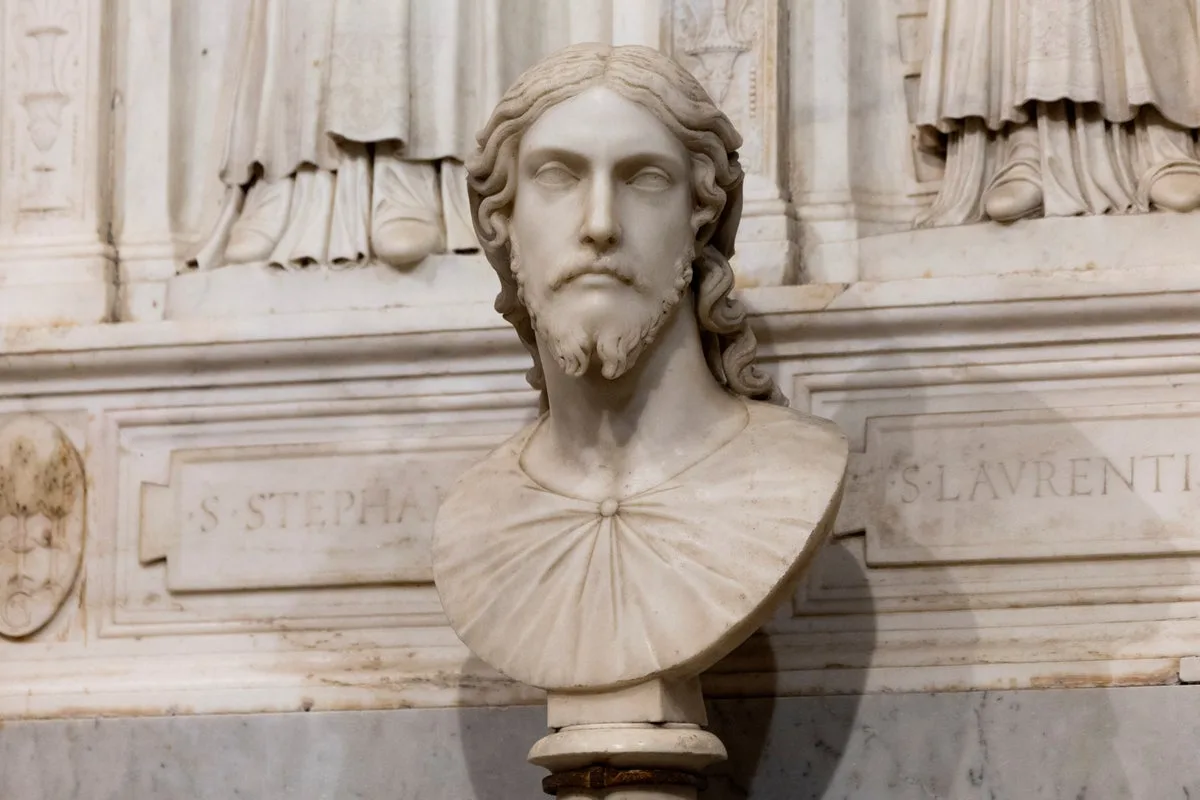
Michelangelo's 'Lost' Masterpiece Rediscovered After 200 Years in Roman Basilica
A magnificent marble bust depicting Christ the Saviour, which has stood for centuries within a Roman basilica, has been officially re-attributed to the Renaissance master Michelangelo Buonarroti. This remarkable discovery follows nearly two hundred years of obscurity regarding the sculpture's true origins, fundamentally altering our understanding of the Old Master's later years and legacy.
The Sculpture's Hidden History
The sculpture is housed within the Basilica of Sant’Agnese fuori le mura, located on Rome's ancient Via Nomentana. Historically associated with Michelangelo until the early nineteenth century, the bust's provenance became lost to time, leaving it as an anonymous work within the church's liturgical space. It has been integrated into the basilica's functional setting for generations, preserved through centuries of architectural renovations and additions.
The Decade-Long Investigation
Italian independent researcher Valentina Salerno, a member of the Vatican committee celebrating the 500th anniversary of Michelangelo's birth, is credited with this groundbreaking re-attribution. Her extensive, ten-year investigation did not rely primarily on stylistic analysis but instead on meticulous archival work.
"I am not an art historian — in fact, I don’t even have a university degree — but the strength of my research lies in its reliance on public archival documents," Salerno stated, describing her method as that of an investigator.
Her research drew upon a wealth of historical sources, including notarial records, posthumous inventories, and indirect correspondence linked to Michelangelo's final years in Rome. This documentary evidence has provided a new narrative about how the artist's works were handled after his death at the age of 88.
Challenging Established Narratives
The discovered documents directly challenge the long-held belief that Michelangelo systematically destroyed works late in his life. Instead, the sources suggest a carefully orchestrated plan. Drawings, studies, and select marble sculptures were discreetly transferred within a trusted circle of pupils and associates following the artist's passing.
"At Michelangelo’s death, every powerful ruler would have wanted to claim something of the master," Salerno explained. "But the artist carefully devised the transfer of the material in his possession so that his art could be passed on to his pupils and thus to future generations."
One particularly revealing document references a locked room, accessible only with multiple keys, which was created specifically to safeguard valuable artistic materials. Although this room was later emptied, its contents can be traced through subsequent transfers to religious institutions and secondary storage sites.
A Network of Preservation
The research outlines a discreet network through which unattributed works were moved, ensuring they remained embedded in functional, often religious, settings rather than entering the commercial art market. The Sant’Agnese bust appears to be a prime example of this preservation process.
Franco Bergamin, from the Order of Lateran Canons Regular, expressed astonishment at the discovery: "We have lived here since 1412, and the monumental complex of Sant’Agnese always holds surprises — this is one of them."
Future Implications and Current Status
The data uncovered by Salerno will form the foundation for a broader attribution process, aiming to progressively return other forgotten works to Michelangelo's oeuvre. These findings are set to be presented to the international scholarly community, potentially rewriting chapters of art history.
The gleaming white marble bust now stands proudly on an altar within a side chapel of the basilica, protected by a modern alarm system. This rediscovery not only returns a masterpiece to its rightful creator but also illuminates the sophisticated methods by which Renaissance artists sought to protect their legacies for posterity.