National Theatre's Man and Boy Revival: A Sobering Satire on Wealth and Corruption
Anthony Lau's new production of Terence Rattigan's seldom-revived 1963 play Man and Boy at the National Theatre's Dorfman Theatre offers an admirably serious but relentlessly sober exploration of moral corruption among the super-rich. This revival strips away the scandalous edge that once shocked audiences, presenting instead a metatheatrical exercise in financial downfall and human disconnection.
Rattigan's Late-Career Warning
Terence Rattigan, the great 20th century playwright who began his career with perky wartime comedies like French Without Tears, created Man and Boy during Britain's post-war economic boom. The play serves as a stark warning against abandoning staid financial principles for American-style capitalist excess. Set in Depression-era Manhattan, the story unfolds in the bohemian poverty of Greenwich Village, where struggling pianist Basil (Laurie Kynaston) and his actor girlfriend Carol (Phoebe Campbell) live modestly until their world is disrupted by an unexpected visitor.
A Father's Disturbing Proposition
When the play premiered in 1963, critics were scandalised by the central premise: a father offering his son as a toyboy to a wealthy business associate. Anthony Lau's 21st century production tests modern audiences differently, presenting the story without the satirical flourishes or plot twists that contemporary audiences might expect from tales of evil rich men. Instead, Rattigan's narrative unfolds with sober determination, offering little remorse for either characters or viewers.

Design and Performance
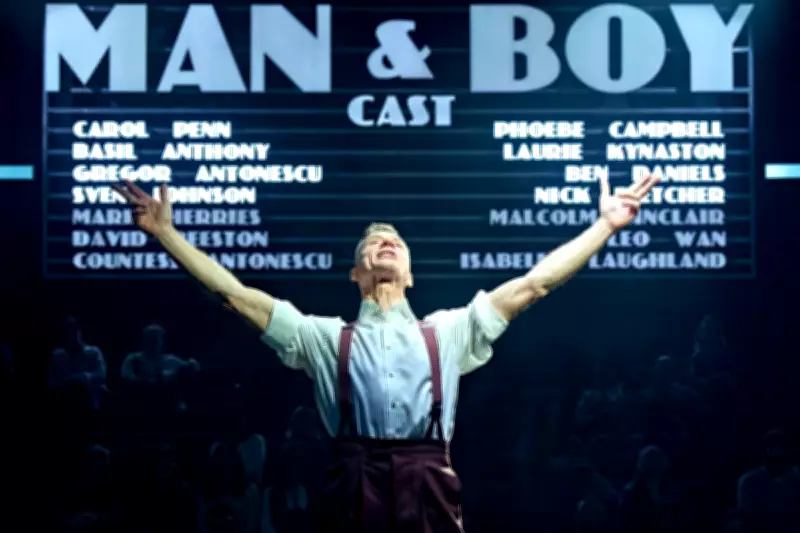
Designer Georgia Lowe creates a visually striking 1930s showbiz aesthetic, complete with a giant metatheatrical marquee that illuminates character names upon entry. Unfortunately, the Dorfman Theatre's layout means half the audience cannot see this clever device. The production initially feels like a slow-moving backstage drama until disgraced financier Gregor Antonescu crashes into the scene, revealing that Basil is actually his estranged son Vasiliy, hiding from the wealthy world that raised him.
Ben Daniels delivers a compelling performance as Antonescu, bringing lean, troubled, otherworldly energy to the role of a man being strangled by his own intricate web of financial dirty dealings. As he expounds on stock market liquidity, his flexing biceps and prominent veins become visual metaphors for the money pulsing through global systems like blood through arteries.
Underwritten Characters and Moral Vacuum
Rattigan portrays the super-rich as fundamentally unmoored individuals, hopelessly incapable of genuine human connection. Antonescu's desires have a strange purity—he doesn't seek to buy love or beautiful things, but rather to make his mark on world affairs. This creates a dramatic vacuum where no character possesses sufficient intellectual heft or bravery to challenge him effectively.
Georgia Laughland provides welcome comic relief as Countess Antonescu, sashaying onto stage in extravagant mink that she discards like crisp packet wrappers before delivering camp ripostes in rakish white satin pyjamas. She's clearly the only character who enjoys having money, but like Carol's role, hers feels cruelly underwritten within Rattigan's serious framework.
Production Choices and Final Assessment
Lau attempts to inject energy through unconventional staging: actors clamber incongruously over tables, a lighting grid descends worryingly close to the stage, and characters sway in dim light as if in slow-motion fight scenes. These witty touches provide refreshing moments but sometimes feel mismatched with Rattigan's grave portrait of moral corruption.
The play's final scenes arrive with refreshing swiftness after a narrative largely starved of action and tension, clattering onto the stage like dropped coins. Ultimately, Man and Boy offers more to respect than to enjoy—a sobering examination of financial and moral decay that retains its power to unsettle even as its scandalous edge has faded with time. The production continues at the National Theatre's Dorfman Theatre until 14 March.