David Hockney's Serpentine Exhibition: A Hopeful Spring Gift for a Troubled World
With the first signs of spring emerging across the landscape, the timing could not be more perfect for the opening of a new exhibition by Britain's most beloved artist, David Hockney. Set within the picturesque surroundings of one of London's most beautiful parks, the Serpentine Gallery is hosting a showcase of entirely new works, some so freshly completed that the paint appears barely dry. In an extraordinary gesture, admission to this David Hockney exhibition is completely free, making it a true gift to the public as the season turns.
A Year in Normandie: A Digital Masterpiece
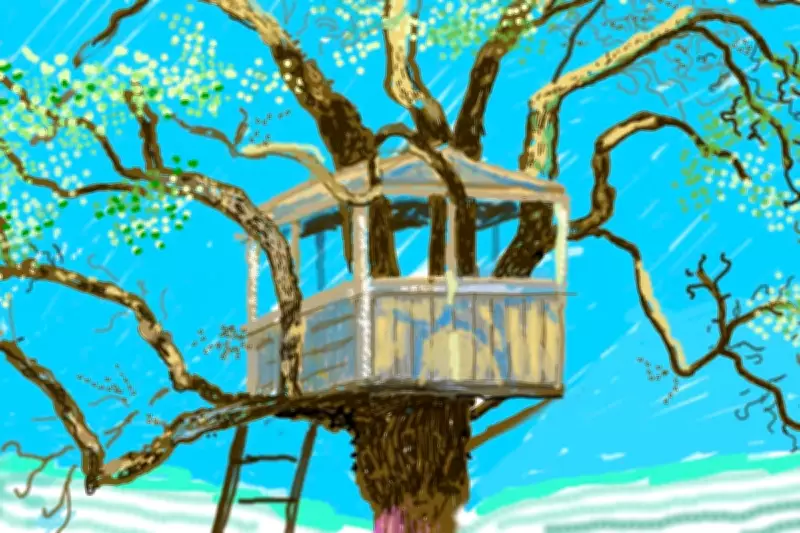
Hung along the corridor encircling the Serpentine's North gallery, A Year in Normandie stands as Hockney's largest work to date. This 90-metre frieze meticulously chronicles the shifting light and colours around his studio in northern France, capturing the cycle from winter to winter during the Covid-19 pandemic year of 2020-21. Initially, there might be disappointment upon learning that the approximately 200 panels are iPad paintings rather than traditional canvases. However, the expert lighting transforms them, making it hard to believe they are simply print-outs pinned to the wall. The work glows like an endless lightbox winding through the building, with images seamlessly transitioning in a way unachievable with conventional painting techniques.
There is an exhilarating sense of a continuous view around Hockney's garden, as if viewers are walking through both time and space. Hockney drew initial inspiration from the endlessly unfolding Bayeux Tapestry, a childhood favourite. His finished piece, though, incorporates a diverse array of visual styles and perspectives, interwoven with his instinctive artistic flair. It is a pure coincidence that the Bayeux Tapestry will be displayed at the British Museum for much of this exhibition's run, a move Hockney has publicly opposed due to conservation concerns.

Artistic Techniques and Global Influences
In the early stages of the frieze, as snow gives way to spring buds, Hockney abandons Western fixed-point perspective in favour of Chinese "aerial" perspective, reminiscent of the ancient scroll paintings he greatly admires. This creates the sensation of viewing the rolling landscape around his Normandy farmhouse from multiple viewpoints simultaneously. The blossoms against a turquoise sky carry a distinctly Japanese aesthetic, with a subtle nod to Vincent van Gogh, highlighting Hockney's global artistic influences.
Around the midpoint, just past an emergency exit, a sudden burst of rain is depicted with simple downward lines—another Japanese touch—before the landscape adopts a more measured, traditionally European character. Imagine Constable's countryside dotted with psychedelic magenta trees. As colours soften and yellow, Hockney guides viewers into high summer, eventually arriving at a terrace with a chilly stream, where blossoming trees now bear fruit and snow is visible along the glowing wall.
Digital Impressionism and Historical Parallels
This work premiered at Paris's Orangerie, which also houses Claude Monet's panoramic water-lily paintings—another great exploration of nature, space, and time, parallels of which Hockney was keenly aware. His methods for evoking natural textures, using tools from the iPad's Brushes app, are endlessly inventive. Through criss-crossing and overlaying streams of dots and leaves created with a single stylus sweep, along with hand-drawn lines and striking colour contrasts, Hockney captures shifts in light and temperature. This approach often feels like a form of digital Impressionism, blending traditional artistry with modern technology.
Some Other Thoughts about Painting: Oil Works
The gallery's two central rooms feature oil paintings completed at the end of last year, collectively titled Some Other Thoughts about Painting. Each of the ten canvases centres on a table with a chequered tablecloth seen in reverse perspective, narrowing as it extends towards the viewer. Hockney believes this unconventional approach is truer to how we actually perceive the world.

In five of these new works, paintings stand on the table, including pieces by Rothko and Gerhard Richter, set against wallpaper that could be mistaken for abstract art. This revisits Hockney's long-standing theme of "painting within a painting." In the other five works, individuals close to Hockney are depicted sitting before paintings, such as Joe Hage in front of Bruegel's Tower of Babel or Thomas Mupfupi and Jack Ransome before Hockney's Yorkshire landscapes, blurring the lines between art and reality.
A Message of Hope and Renewal
While these oil works are entertaining, the ever-changing, encircling view through the seasons in A Year in Normandie remains the exhibition's heart. Despite Hockney's reportedly frail health and speculation that each new work could be his last, this show exudes vitality. Its immersive evocation of the renewal of nature, art, and life itself arrives at an ideal moment, offering a powerful message of hope to a world in desperate need of inspiration. A Year in Normandie and Some Other Thoughts about Painting will be on display at the Serpentine Gallery from 12 March until 23 August.