David Hockney's Digital Frieze: A 90-Metre Vision That Falls Short in Person
David Hockney, the artist who reassured postwar Britain that it was acceptable to embrace beauty and freedom, has long been celebrated for revitalising modern painting. Emerging in the late 1950s, his work countered the dull academicism and tiresome machismo of the time with an unabashed celebration of conventional forms of beauty. His coolly sentimental double portraits and domestic scenes highlighted the liberated lifestyles enabled by economic and social reforms, free from the angst or irony of his peers. For those who were working-class and gay, his art offered a refreshing perspective.
The Gift of Sentimentalism
To label Hockney a gifted sentimentalist is no backhanded compliment. In this regard, he resembles Andy Warhol, who was distinguished by his pure love for capitalist America's fruits and his genius in sharing that love. Hockney's work from about 1963 onwards disproved the misconception that great art must be difficult, despise the everyday, and remain inaccessible to the public. His ability to communicate directly with audiences made his art treasured for decades.
A Shift in Artistic Direction
However, critical sniping eventually caught up with Hockney. Whether due to anxiety about being taken seriously or a loss of creative steam, the era-defining painter retreated into ill-advised historical dialogues with Picasso and Van Gogh. He began experimenting with various media, from set design to fax machines, with mixed results. Over the past 50 years, Hockney has oscillated between his pop art roots and a more experimental "jazz phase," occasionally returning to his gift for direct communication, as seen in portraits like that of performer Divine or his Yorkshire landscape paintings.

The Centrepiece: A Year in Normandie
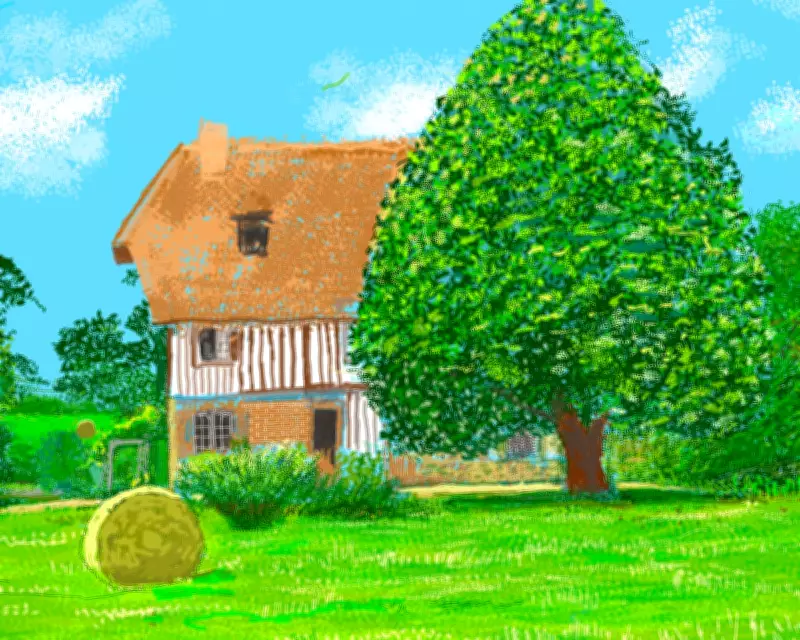
At the heart of his current exhibition at Serpentine North in London is the 90-metre long frieze titled A Year in Normandie. This monumental print, dramatically installed around the gallery's perimeter, depicts the changing landscape around Hockney's French home through the seasons. Constructed from about 100 separate digital images created on an iPad, these pictures have been collaged together, enlarged, and printed on a single strip of paper. Theatrically lit against a dark-blue wall, it glows like a screen in a dark room, designed to reproduce well on phone screens—an intelligent decision, as in reality, it proves underwhelming.
Technical Flaws and Artistic Theory
A Year in Normandie expresses Hockney's pet theory that single-point perspective in realist painting does not reflect human vision. He argues that humans see through multiple viewpoints, with the brain stitching images together for narrative continuity. While interesting in the abstract, the execution falters. The joins between panels are unaccountably messy, and the clangorous colours resist harmonisation. Occasional nice touches, such as shimmering reflections or lilac rain, cannot escape the medium's limitations. The work resembles Normandy run through a digital filter, echoing paintings from 1880 to 1940, from Monet to Dufy, but lacks authenticity.
Highlights and Shortcomings
The most successful works in the exhibition are two portraits that showcase Hockney's close attention to detail, facilitated by personal relationships. A portrait of his partner, Jean-Pierre Gonçalves de Lima, captures an ironical and indulgent expression, reminiscent of his celebrated 1977 portrait of his parents. A second portrait of his nephew offers glimpses of his ability to conjure character through affection. However, even these are marred by distractingly steep reverse perspectives in table placements, which feel like violent nods to Van Gogh and Cézanne rather than subtle tributes.

A Betrayal of Connection
This treatment of artworks as arguments or guessing games seems a betrayal of Hockney's connection with broader audiences. His real appeal has always been to those who find beauty in their surroundings, not just to cultural elites. Upon leaving the Serpentine gallery, the blooming Kensington Gardens and a magnolia tree on Exhibition Road serve as a reminder: even in dispiriting times, we must be allowed to take pleasure in the world. Hockney's best work teaches this lesson, but A Year in Normandie risks undermining it with its digital artifice.
David Hockney: A Year in Normandie and Some Other Thoughts About Painting is on display at Serpentine North, London, from 12 March to 23 August, inviting visitors to reflect on the intersection of technology and traditional artistry.