The Unforgettable Legacy of Harold 'the Kangaroo' Thornton
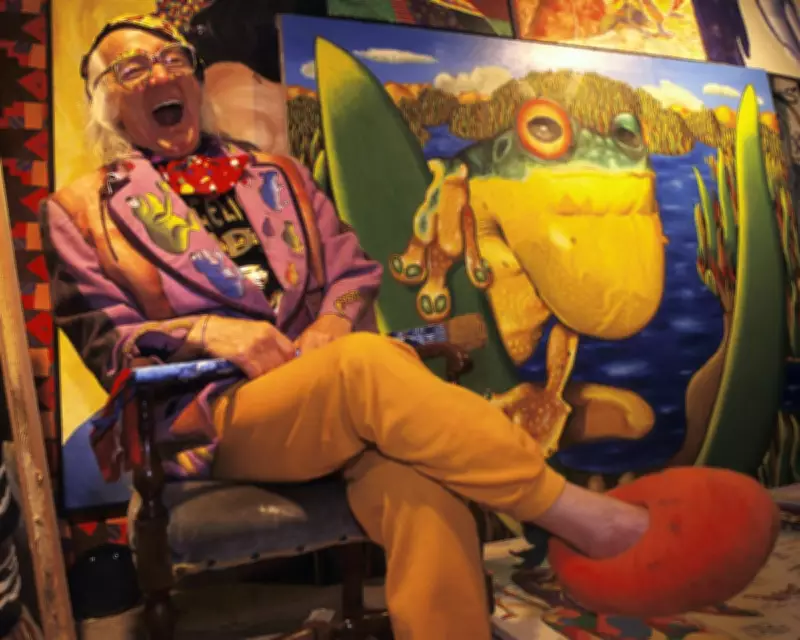
In 1983, visitors to the Archibald prize exhibition were greeted by a striking sight: a seven-foot psychedelic portrait of Greens leader Bob Brown, titled Dr Brown and Green Old Time Waltz, and its creator, Harold "the Kangaroo" Thornton, standing proudly beside it. Clad in hand-painted attire, with painted false teeth and a decorative walking stick, Thornton declared himself the "greatest genius that ever lived." This moment encapsulated the life of an artist who, despite relentless self-promotion and a prolific output, remained largely unrecognised during his lifetime and continues to be overlooked today.
A Life of Art and Embellishment
Harold Thornton was born in Enfield, Sydney, in 1915, and his childhood was marked by hardship. Bullied for his dyslexia and portly build, he found solace in painting, often working for days without rest. His works, characterised by rich colours, hidden details, and a mischievous sense of humour, drew admiration from notable artists like Martin Sharp and Ken Done. Done once even paid to ship a crate of Thornton's paintings globally. Yet, financial success eluded him; he described himself as "living like a rat" and resisted selling his art, fearing it would lose accessibility.
Thornton's life was a tapestry of tall tales and remarkable truths. He claimed that Paul McCartney and Jimi Hendrix had stolen his music, and he often spoke of dying on an operating table and travelling the world as a ghost. Beyond the embellishments, his achievements were extraordinary: a three-time Archibald prize finalist, a professional wrestler, a restaurant owner in Papua New Guinea, and a star in an early Peter Weir short film. In one macabre episode, he painted his father's portrait posthumously, locking himself in with the corpse to complete the work.

The Amsterdam Years and Political Awakening
Thornton spent many years in Amsterdam, where he painted on the streets with a sign reading, "If you like Harold's art, Harold likes beer." A mural on The Bulldog cafe remains a local attraction, and a monograph by his friend Pienke WH Kal helped preserve his memory there. His political consciousness was ignited during a trip to Tasmania in the 1980s, where he joined the Franklin Dam blockade. To give his nephew Philip a break, family members funded the journey, which led to friendships with environmental activists Christine Milne and Bob Brown.
It was during this time that Thornton painted his iconic portrait of Brown. Initially embarrassed by the halo-like imagery, Brown later came to appreciate the work, comparing it to Hieronymus Bosch and noting its historical significance. The painting now resides in the National Portrait Gallery in Canberra, serving as Thornton's most enduring legacy.
Stubbornness and Kindness in Equal Measure
Beneath Thornton's exuberant exterior lay a deep kindness. Friends recall his desire for connection, with artist Dale Trueman describing him as "star-struck" upon meeting him. However, his stubbornness often clashed with authority. When commissioned to paint the mayor of Wagga Wagga, he exaggerated the man's red nose, sparking a physical altercation. After failing to make the Archibald cut on another occasion, he protested on the gallery steps with a giant papier-mache head in a shopping trolley.
Thornton's insecurity about his intellect, stemming from childhood bullying, manifested in his comic strips, which were riddled with spelling errors—some intentional, like describing himself as a "very humbel man." He believed his art was for the people, and he worried that commercial success would compromise its accessibility.
A Legacy That Endures
Harold Thornton passed away in 2004, but his memory lives on through those who knew him. His great-nephew Chris Osborne is working on a film to capture his essence, particularly his laugh, while Ken Done continues to support the preservation of his work. Thornton's paintings, when viewed together, are described as "spellbinding," yet his dream of a dedicated gallery remains unfulfilled.

In true Thornton fashion, he once wrote, "I am told everybody dies. But not me." His spirit persists in the vibrant, surreal artworks that challenge and delight, ensuring that the "greatest genius who ever lived" is not entirely forgotten. As Done aptly summarised, "He was Harold, and he didn't give a fuck."