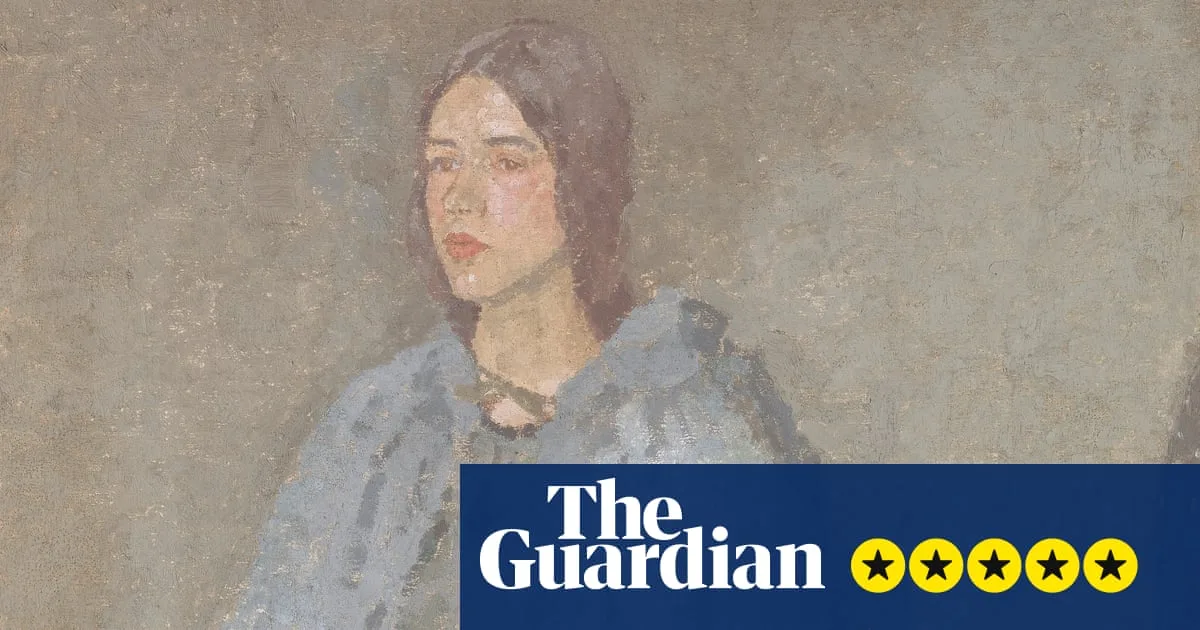
Gwen John: Strange Beauties Review – A Quietly Intense Retrospective in Cardiff
Opening precisely 150 years after her birth, a glorious new exhibition at the National Museum Cardiff honours the diligent and rigorous artist Gwen John, who famously found beauty in what others might dismiss as 'drabness'. Titled Strange Beauties, this comprehensive retrospective brings together more than 200 of her quietly intense works, offering a profound exploration of her methods, rhythms, and recurring themes.
The Art of Observing Ordinary Life
Gwen John was approximately 22 years old when she painted Mrs Atkinson around 1898, an unassuming portrait that exemplifies her unique charm. The faded floral wallpaper appears as a hazy wash of chestnut, while the drawing tacked to the wall has papery edges crumpled and curled like ageing flower petals. Mrs Atkinson, clad in black, forms a looming, almost triangular presence that could morph into a shadowy mountain if one squints. Her pale, glassy eyes, with heavy lids and pink rims, suggest a depth of emotion, perhaps recent tears, underscored by the crisp white handkerchief pressed beneath her hands.
When this piece was exhibited in 1926, a critic praised John's ability to uncover beauty in the mundane. The exhibition's title derives from John's own 1922 description of herself as 'a seer of strange beauties'. This showcase presents her mostly muted oil paintings, drawings, watercolours, and notebooks, revealing an artist who returned repeatedly to contemplative women, sparsely furnished interiors, still lifes, and devoted churchgoers, viewing them each time with fresh, attentive eyes.
A Diligent and Rigorous Artistic Journey
John's unwavering gaze is captured in a strident 1902 self-portrait, where she presents herself with tidily drawn-back auburn hair and a buttoned crimson blouse. Having moved from the Welsh seaside town of Tenby to London's progressive Slade School of Art, she famously scribbled 'Learn! Learn! Learn!' upon arrival, embodying a relentless pursuit of artistic mastery. Her diligence is evident in works like a playful group portrait of her siblings Augustus and Winifred among friends from around 1897, where she paid equal attention to a discarded shoe forgotten behind a curtain as to her sitters' youthful faces.
Rather than recounting her life story—already covered by four biographies—the exhibition focuses intently on her artistic processes. While there are glimpses of her bohemian younger brother Augustus and the sculptor Auguste Rodin, with whom she had a decade-long affair after beginning modelling for him in 1904, these remain secondary to the core examination of her work.
Subtle Variations and Devotional Themes
A room dedicated to her seven years in Paris highlights reunited pairs of canvases, showcasing subtle variations. In one version of A Corner of the Artist's Room in Paris from around 1907, a gauzy curtain veils the window and a parasol leans tipsily against a wicker chair; in another, the parasol is absent and the window stands open wide. More immediate alterations are visible between two portraits of the model Fenella Lovell, Girl with Bare Shoulders and Nude Girl, both from around 1910.
The largest room in the exhibition is devoted to religion, reflecting John's move to the leafy Parisian suburb of Meudon in 1911, where she began attending church and converted to Catholicism in 1913. Along one wall, experimental sketches and watercolours unfold like a long, skinny pew, depicting congregations observed from behind or in profile as they pray and listen to sermons. Nearby, a captivating series of portraits features the local convent's 17th-century foundress, Mère Marie Poussepin, including one with a surprisingly mischievous smile.
Deep Devotion to Singular Subjects
John's profound dedication is most apparent in the 60 paintings she created of a single, unnamed neighbour in Meudon, who now enjoys a room of her own in Cardiff. In one portrait, the neighbour holds a book; in another, a rose. With prolonged observation, subtle tweaks to her dress, props, and hair become noticeable. Gradually, the images simplify until, much like Mrs Atkinson when squinted at, the neighbour transforms from an individual into a still life. The result is art that is sensitive yet unsentimental, studious, and undeniably, strangely beautiful.
Gwen John: Strange Beauties continues at the National Museum Cardiff until 28 June 2026, before touring to the National Galleries of Scotland, the Yale Center for British Art, and the National Museum of Women in the Arts in Washington DC.