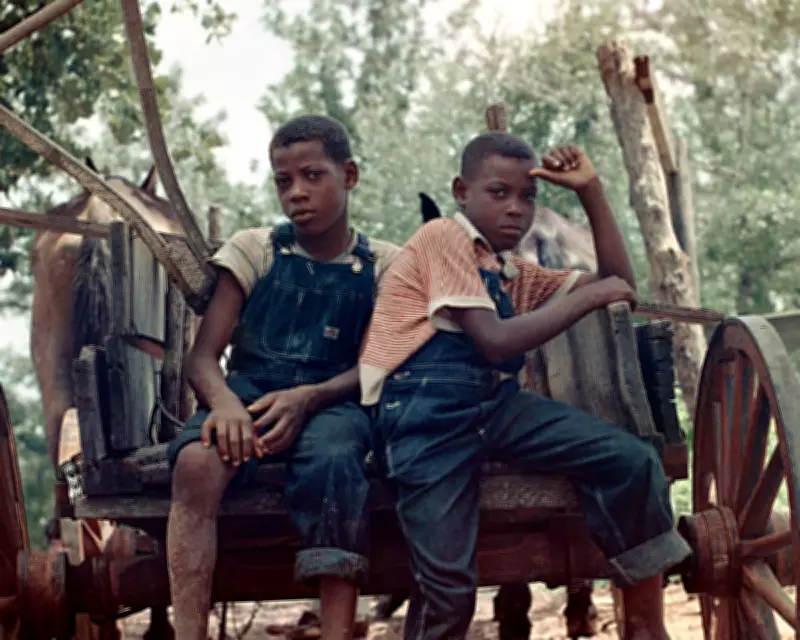
Gordon Parks' Segregation Stories: A Lens on Dignity in Postwar Alabama
The great photographer Gordon Parks, whose career spanned over five decades, meticulously documented black family life in postwar Alabama, capturing the profound dignity and resilience displayed under the oppressive Jim Crow laws. His work, now featured in an exhibition titled Gordon Parks: The South in Colour at Jackson Fine Art in Atlanta, Georgia, until 13 June, offers a powerful visual narrative of the African American experience during a tumultuous era.
Exhibition Highlights and Historical Context
This timely exhibition commemorates two significant milestones: the 70th anniversary of Parks' landmark images of the segregated US south published in Life magazine, and the 20th anniversary of The Gordon Parks Foundation. Featuring more than 30 photographs from his Segregation Story series, alongside a brand-new portfolio, the show juxtaposes previously unshown works with his most recognised pieces to deepen their emotional and historical resonance.
Parks employed a handheld, twin-lens Rolleiflex camera to photograph the daily lives of the Thornton family and their extended relatives, including the Causey and Tanner families. His deliberate choice to shoot in colour resulted in carefully composed, lush, square-format images that vividly portray the realities of segregation. As curator Dawoud Bey notes, Parks' selections of tool, material and sensibility lend the Black southern presence, often under siege, a sense of lives fully and expressively lived.

Social Justice and Personal Resilience
Beginning in the 1940s, Parks focused his lens on social justice, race relations, the civil rights movement, and the broader African American experience. One poignant image, Untitled, At Segregated Drinking Fountain, Mobile, Alabama, 1956, illustrates the prevalence of prejudice under Jim Crow laws, which enforced racial segregation in schools, public transport, restaurants, and even drinking fountains. Yet, the scene also captures a moment of compassion, as a gentleman helps a young girl reach the fountain for a drink.
Born into poverty and segregation in Fort Scott, Kansas, Parks was drawn to photography as a young man. Despite lacking formal training, he won a Julius Rosenwald Fellowship in 1942, leading to roles with the Farm Security Administration and the Office of War Information. By the mid-1940s, he worked as a freelance photographer for publications like Vogue and Glamour, before joining Life magazine in 1948, where he produced some of his most notable work over two decades.
Legacy and Multifaceted Career
Parks' influence extended beyond photography; in 1969, he wrote and directed the feature film The Learning Tree, based on his semi-autobiographical novel, followed by 1971's Shaft, which helped define the Blaxploitation genre. He continued to photograph, publish, and compose until his death in 2006, leaving a lasting impact on 20th-century art and culture.
Personal anecdotes underscore his resilience: at age 11, white boys threw him into the Marmaton River, assuming he couldn't swim, but he ducked underwater to escape unnoticed. After his mother's death when he was 14, he slept beside her coffin, confronting his fear of death. Educated in a segregated elementary school, he faced discouragement from teachers about pursuing higher education, yet he persevered to become a groundbreaking artist.
This exhibition not only celebrates Parks' artistic achievements but also serves as a poignant reminder of the struggles and strengths of black communities in the segregated south, making it a must-see for those interested in photography, history, and social justice.