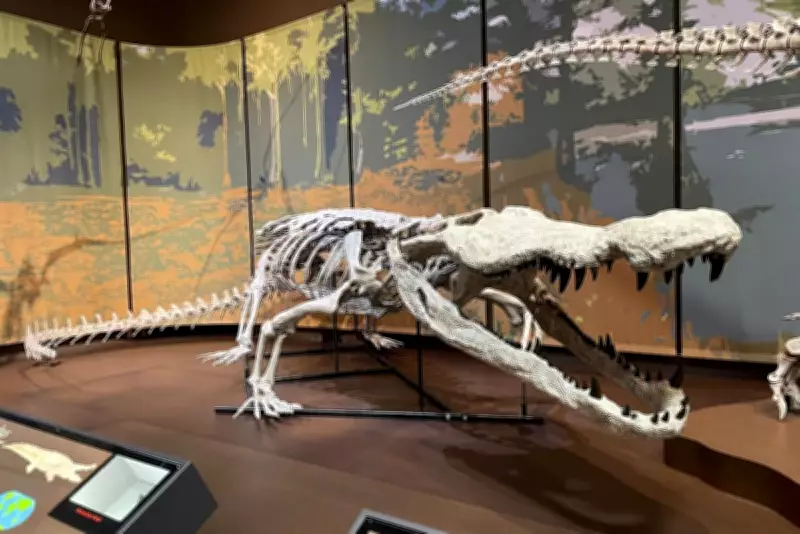
Museum Unveils First 3D Replica of Ancient 'Dinosaur Killer' Crocodile
In a groundbreaking scientific achievement, researchers have reconstructed the most complete skeletal model to date of Deinosuchus schwimmeri, a monstrous 10-metre-long prehistoric crocodile that terrorised ancient waters. Known colloquially as a 'dinosaur killer', this formidable relative of modern alligators roamed what is now the eastern United States approximately 76 million years ago, preying on dinosaurs and other large creatures of its time.
Unprecedented Detail in Reconstruction
The life-sized replica, commissioned by the Tellus Science Museum in Cartersville, Georgia, stands as the only one of its kind currently on public display globally. Scientists utilised high-resolution 3D scans of fossil material to craft this model, which represents the most current and accurate scientific understanding of Deinosuchus anatomy. This innovative approach has allowed for an unprecedented level of detail, providing a clearer visualisation of one of North America's largest ancient predators.
Insights into Prehistoric Ecosystems
The reconstruction offers valuable insights into prehistoric ecosystems and the survival strategies employed by such apex predators. By studying the model, researchers can better comprehend how Deinosuchus schwimmeri interacted with its environment, including its hunting behaviours and ecological role. This advancement aids in piecing together the complex web of life that existed millions of years ago, shedding light on the dynamics of ancient food chains and predator-prey relationships.

The unveiling of this model marks a significant milestone in paleontological research, enhancing public education and scientific discourse. It underscores the importance of technological advancements, such as 3D scanning, in bringing extinct species to life for modern audiences, while contributing to ongoing studies in evolutionary biology and earth sciences.