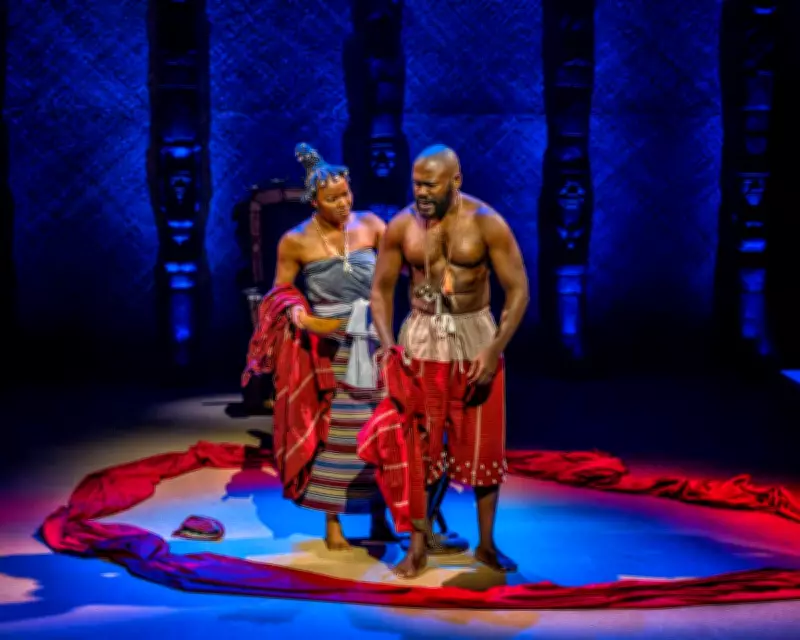
Crown of Blood Review: A Yoruba Reimagining of Macbeth's Deadly Ambition
In a bold theatrical reimagining at Sheffield's Crucible theatre, Oladipo Agboluaje's Crown of Blood transports Shakespeare's timeless tragedy of ambition and power to the mythic landscapes of 19th-century West Africa. This compelling production, presented by Utopia and Sheffield Theatres, replaces the Scottish highlands with Yoruba mythology while retaining the core themes of Shakespeare's original work.
Supernatural Elements and Mythic Foundations
Where Shakespeare's three witches often serve as mere plot devices to trigger Macbeth's ambition, Agboluaje's adaptation makes the supernatural all-encompassing and integral to the narrative fabric. The production opens with court historian Arokin, portrayed by Toyin Oshinaike, reporting increasingly fantastical phenomena - from flying elephants to gorillas with tortoise shells and women with vipers for hair.
These supernatural occurrences intensify following warrior Aderemi's return from battle, where he learns of his wife Oyebisi's prophetic dream about a crown placed upon his head. This vision, delivered with conviction by Kehinde Bankole as Oyebisi, sets the couple on their fateful journey from respected members of society to power-hungry despots.

Compelling Performances and Character Dynamics
Deyemi Okanlawon and Kehinde Bankole create a remarkably credible partnership as Aderemi and Oyebisi, bringing depth to their complex relationship. Okanlawon portrays Aderemi as a modest, initially likable soldier whose transformation into a tyrant feels both sudden and inevitable. Bankole's Oyebisi emerges as equally devoted and determined, with the production notably allowing her character to maintain agency throughout without descending into Shakespearean madness.
The supernatural elements gain tangible presence through Patrice Naiambana's portrayal of Esu, a deity who appears as real in his pointy cap and red rags as the amulets and shells that influence the characters' fates. This grounding in Yoruba spirituality, under Mojisola Kareem's direction, creates a mythic landscape where human characters appear as temporary players in an eternal struggle for power.
Social Commentary and Political Resonance
While remaining faithful to Shakespeare's structural framework, Agboluaje makes significant thematic shifts that broaden the play's social and political commentary. The adaptation moves beyond individual psychology to explore the wider social impact of Aderemi's actions, with particular focus on the politics of succession and royal house negotiations.
Kevin Jenkins's striking set design features a throne suspended by streams of blood, visually reinforcing the production's central themes of power and governance. As the narrative unfolds, the play becomes less about Aderemi's internal reflections - which are notably reduced compared to Shakespeare's original - and more about the systemic consequences of unchecked ambition.
Contemporary Relevance and Theatrical Innovation
The production's contemporary resonance becomes particularly evident in its closing moments, when a survivor of the carnage declares "It must never happen again" - a warning that feels pointedly relevant to modern political landscapes and contemporary demagogues. This adaptation successfully demonstrates how classic texts can be reinvigorated through cultural translation while maintaining their essential truths about human nature and power dynamics.
Crown of Blood continues at the Crucible in Sheffield until 7th February before embarking on a national tour, offering audiences across the country an opportunity to experience this innovative fusion of Shakespearean drama and Yoruba mythology that speaks powerfully to both historical and contemporary concerns about leadership, ambition, and the corrupting nature of power.