Charmaine Watkiss: Weaving Art from Colonial Shadows
British artist Charmaine Watkiss is transforming museum spaces with work that confronts the silenced histories of colonialism and the transatlantic slave trade. Her latest exhibition, For the Ones Who Came Before, at the Royal Albert Memorial Museum in Exeter, represents a significant new chapter in her practice, directly engaging with institutional collections to surface buried knowledge.
From Herbalist Memories to Artistic Mission
Watkiss's artistic journey is deeply personal, rooted in childhood memories of visiting G Baldwin's herbalist in London's Elephant and Castle with her mother, a Windrush generation migrant from the Caribbean. "It's a place Black women used as a resource," she recalls, describing how these early experiences with medicinal plants sparked her research into botanical knowledge that travelled with enslaved Africans.
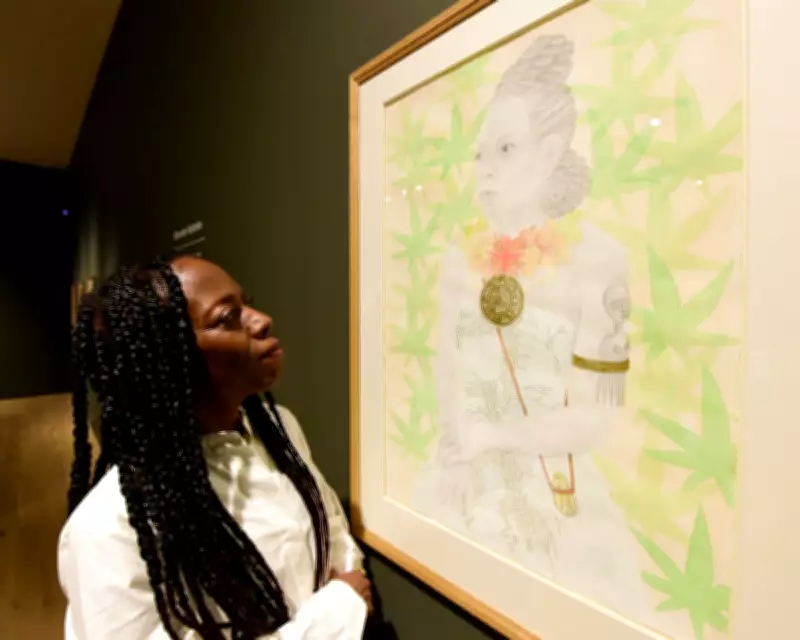
Her 2021 exhibition, The Seed Keepers, explored these connections through large-scale illustrated portraits of women of African descent alongside medicinal flora. "All this knowledge must have travelled with the enslaved," Watkiss explains, noting how her work evokes historical botanical illustration to trace survival strategies.

Confronting Absence in Museum Collections
When invited to create new work for RAMM, Watkiss immediately identified a critical gap. "I needed to respond to the West Africa display as the story of the diaspora was missing," she states. This realisation prompted a shift from her primary medium of drawing on paper to sculpture, inspired by the museum's collection of African masks, particularly mukenga helmet masks from the Democratic Republic of the Congo.
Her new mask sculpture will sit alongside other African masks in the museum's cabinets, including some on loan from the British Museum, creating what she describes as "a dialogue" between objects. The commission also includes a watercolour incorporating museum holdings like an nkisi figure, traditionally used for healing and protection.
A Non-Linear Path to Artistic Practice
Watkiss's route to becoming an artist was far from straightforward. After facing discrimination as a footwear designer in the late 1980s, she studied film, where a tutor's claim that "Black people made no contribution to western civilisation" motivated her dissertation to prove otherwise. In 2015, she devised a five-year plan to become an artist, studying at City Lit and completing an MA in illustration at Wimbledon School of Art.
She credits her decision to pursue art full-time in January 2020 partly to her practice of reiki. "It's a process of hurling yourself into the unknown and trusting you're not going to die when you jump," she reflects on this leap of faith.
Engaging with Complex Museum Legacies
Watkiss has previously engaged with historic collections through research fellowships at the Sloane Lab, partnered with the Natural History Museum and British Museum. She investigated what Hans Sloane and his contemporaries knew about healing plants, many specimens of which were collected by enslaved Africans.
A work commissioned last year is currently displayed at London's National Portrait Gallery alongside a portrait of Sloane, who owned enslaved people in Jamaica and profited from sugar plantations. Watkiss reimagines a woman Sloane wrote about as a "queen in her own country" who helped cure him, placing this healer on a throne adorned with symbols like the sankofa bird, representing looking back to move forward.
Addressing Generational Trauma Through Art
When asked about the challenges of working with legacies of race and enslavement in Western museums, Watkiss acknowledges the complexity. "It's a hard, complicated history," she says. "That trauma is generational – it's in our DNA. Growing up in western culture, being viewed a certain way – it's another layer."

Her work seeks to centre marginalised figures, transforming museum narratives through a blend of botanical illustration, traditional craft, and contemporary art practices. By weaving together personal history, rigorous research, and intuitive creation, Charmaine Watkiss continues to turn UK museum spaces upside down, offering new perspectives on our shared past.