Catherine Opie's 'To Be Seen' Exhibition Opens at National Portrait Gallery
An exhibition of work by the acclaimed American photographer Catherine Opie has opened at the National Portrait Gallery in London, running from 5 March to 31 May. Titled To Be Seen, the show presents a comprehensive collection of Opie's portraits that celebrate the LGBTQ+ community through a lens of radical visibility and artistic bravery.
Blending Historical Techniques with Contemporary Themes
Since graduating in the late 1980s during the height of the AIDS crisis, Catherine Opie has dedicated her career to capturing her community, friends, and family with unflinching realism. Her work deliberately adopts techniques from 16th-century portrait painters, including saturated colours and dramatic tonal contrasts, to declare that her subjects deserve to be seen with the same dignity as historical figures.
The exhibition features many of Opie's most famous portraits, which use these traditional devices to elevate contemporary queer identities. Her approach creates a powerful statement about representation and belonging in artistic spaces traditionally dominated by historical narratives.

Exploring Identity Through Performance and Presentation
Opie has always been fascinated by how identity can be constructed and transformed through costume, posture, and role-play. This interest is evident throughout the exhibition, particularly in her 1991 series Being and Having, which remains one of her best-known works.
In this series, Opie photographed 13 lesbian friends dressed as their masculine alter egos, complete with fake moustaches against vibrant yellow backgrounds. The images capture both the playful performance of masculinity and the poignant context of the AIDS crisis that was devastating the queer community at the time.
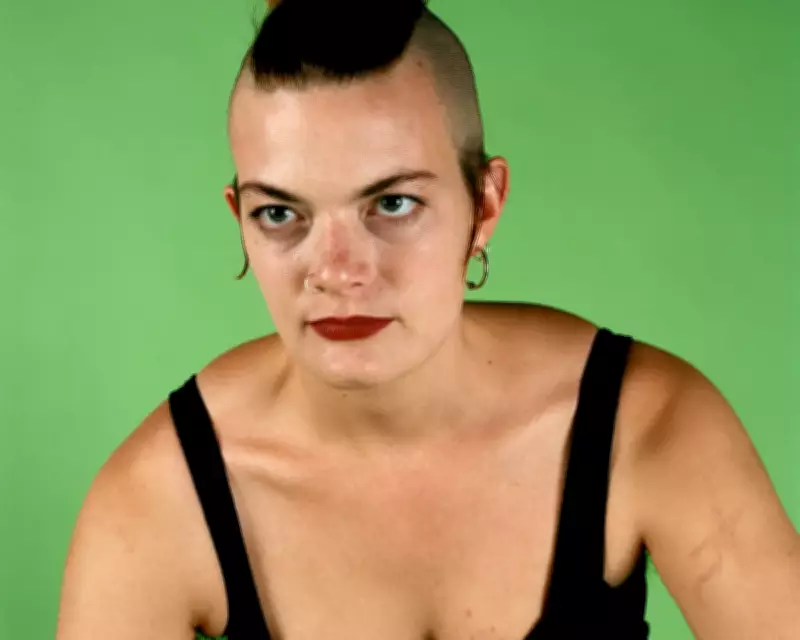
The exhibition also showcases Opie's exploration of body modifications, tattoos, and piercings, reflecting her Los Angeles roots while examining how physical presentation shapes identity.
Contrasting Portraits of Strength and Vulnerability
The exhibition presents a compelling tension between different aspects of Opie's work. In one room, large-scale baroque-inflected portraits feature subjects like fellow artists Mary Kelly and John Baldessari posed in solemn, classical stances against carmine walls and black velvet drapes. These works give gravitas to contemporary figures, suggesting they belong alongside the historical paintings that typically fill the gallery.
Elsewhere, more intimate portraits reveal vulnerability and domesticity. One photograph shows a friend, Pam, shaving in a bathtub with soft natural light streaming through a bathroom window. Another captures Opie's son Oliver as a toddler wearing a tutu in their family kitchen in Los Angeles during the Bush era—an image of playful possibility and safety.
Powerful Self-Portraits and Political Context
Two self-portraits hung facing each other in the exhibition space perfectly embody the opposing forces in Opie's work. Self-Portrait/Cutting (1993) shows Opie's back with a childlike image of a couple and house scratched into her skin, while Self Portrait/Nursing (2004) depicts Opie breastfeeding her son Oliver with all her tattooed and scarred skin exposed.
These works demonstrate how Opie's desire to rebel and tear at conventions coexists with her embrace of quiet domesticity, care, and comfort. The exhibition also includes Opie's documentation of political moments, including a semi-abstract landscape of the cliffs of Dover made during the Brexit referendum and photographs of protest posters from USC campus following reports of sexual assault at a fraternity.
Beyond the Exhibition Walls
In a significant curatorial decision, some of Opie's photographic portraits have been installed among the National Portrait Gallery's permanent collection of 19th and 20th-century oil paintings of "inspiring people." Her elegant portraits of figures like Isaac Julien, Gillian Wearing, Lynette Yiadom-Boakye, and tattoo artist Alistair Fate blend so seamlessly with the historical works that viewers might almost miss them—a subtle but powerful statement about inclusion and representation.

The exhibition moves through intimate spaces that allow close encounters with Opie's diverse practice, from portraits of lesbian couples and families taken during an American road trip to images of surfers emerging from the water with renewed vitality. Throughout, To Be Seen emphasizes what Opie considers necessary rather than merely visible: family, love, care, and the protection of private worlds from external violence.