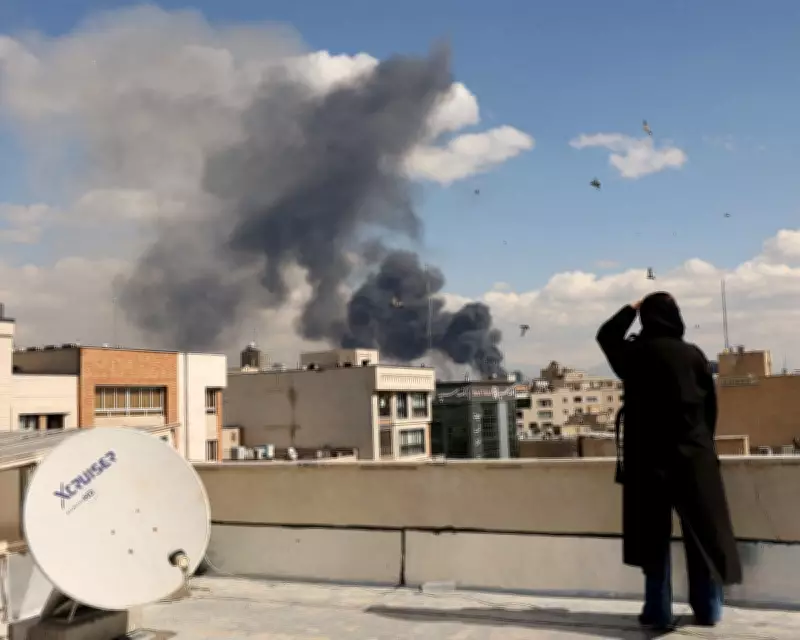
Middle East Conflict Intensifies as Iran Retaliates Against US-Israel Assault
The regional war that many nations had long feared has now erupted, with Iran launching retaliatory strikes across the Gulf following an unprecedented joint aerial assault by the United States and Israel. This escalation has plunged the Middle East into a dangerous new phase of conflict, drawing in neighbouring countries and threatening to destabilise the entire region.
Assassination and Immediate Retaliation
On Saturday, global attention turned to Iran after a massive US-Israeli bombing campaign targeted the country. The intense bombardment was swiftly followed by the assassination of Iran's supreme leader, Ayatollah Ali Khamenei, alongside numerous military and political figures. Before the world could absorb this shock, Iran retaliated, striking not only Israeli and American targets but also launching attacks against its Gulf neighbours.
Reports indicate assaults on American military bases across the Gulf region and the US embassy in Riyadh, with additional damage to civilian infrastructure including hotels. Tens of thousands of British citizens in the area now find themselves trapped in an increasingly perilous situation as the conflict rapidly escalates.

Gulf States Drawn Into the Conflict
Hours after the initial US-Israeli attack, Iranian missiles and drones were launched at Israeli and American bases across multiple Gulf nations, including Qatar, Kuwait, Jordan, the United Arab Emirates, and Bahrain. In a joint statement, Gulf states alongside the United States strongly condemned what they described as Iran's "indiscriminate and reckless missile and drone attacks," warning that these actions threatened wider regional stability.
Julian Borger, the Guardian's senior international correspondent, described the assassination of Ayatollah Ali Khamenei as "an historic rupture." Khamenei had dominated Iranian politics for thirty-six years, and his death creates significant uncertainty about his successor, the capacity of any opposition to assume control of the state, and the ultimate objectives of both the United States and Israel.
Economic and Human Consequences
The economic ramifications of the conflict are already spreading far beyond the battlefield. Insurance markets and shipping companies have become extremely risk-averse, with even the perception of danger causing immediate price increases. Iranian strikes have been reported in Saudi Arabia, where officials confirmed a fire at an oil refinery that is now "under control," and at a major gas processing plant in Qatar. Both facilities have halted production, potentially disrupting global energy supplies.
Gas prices surged dramatically, at one point rising by as much as forty-two percent in Europe, as traders priced in the risk of a prolonged conflict in one of the world's most critical energy corridors. The human toll continues to mount, with the Iranian Red Crescent Society reporting at least five hundred and fifty-five fatalities in US-Israeli attacks across one hundred and thirty-one cities since Saturday. Israel has reported ten deaths from Iranian attacks, with three additional fatalities in the Gulf region.
Regional Stability Under Threat
Iran's targeting of Gulf states represents a calculated strategy to build international pressure on the United States. According to Julian Borger, "Iran is trying to impose costs on the United States indirectly. The hope is that Gulf governments will pressure Washington to stop." Simultaneously, Iran has sought to reassure neighbouring states that they are not the intended enemy, conveying the message that "This isn't about you, it's about America and Israel."
However, this approach carries significant risks, as it may ultimately turn Gulf states against Iran entirely. Instead of blaming the United States or Israel, these nations might begin to perceive Iran itself as the primary threat. While damage to infrastructure has thus far been limited, the attacks jeopardise the image of stability and prosperity that Gulf nations have spent decades and billions of dollars constructing.

International Response and Future Uncertainty
The conflict has extended beyond the immediate region, with Iranian drones launched at the RAF Akrotiri base in Cyprus. Shortly thereafter, the United Kingdom, France, and Germany announced they had taken defensive action to protect their interests in the region and support their Gulf allies. The UK Foreign Office is currently developing contingency plans to evacuate tens of thousands of British citizens should the conflict escalate further.
For the United States, Iranian attacks have inflicted limited direct damage thus far, with six American soldiers killed and three US aircraft reportedly shot down by friendly fire. However, Washington appears to have little appetite for a prolonged conflict, with the Trump administration likely seeking a swift resolution that can be presented as a victory. As events continue to unfold, the situation may quickly move beyond the control of any single actor, creating unpredictable challenges for regional and global stability.