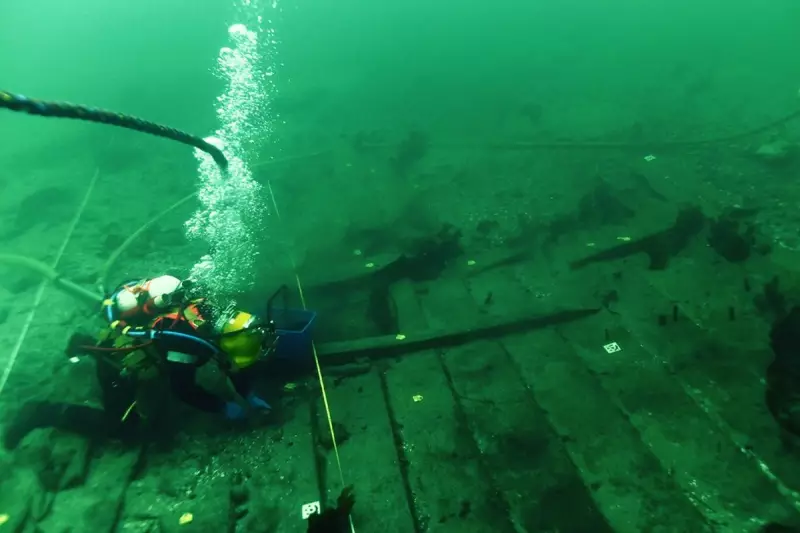
Maritime archaeologists have made a landmark discovery, unearthing the largest Viking cargo ship ever found—a colossal "super ship" that forces a dramatic rethink of the scale and sophistication of medieval commerce across northern Europe.
A Colossal Medieval Cargo Carrier
The vessel, christened Svaelget 2 after the channel near Copenhagen where it lay, is a monumental structure. Measuring 28 metres long, 9 metres wide, and 6 metres high, its length is comparable to two standard school buses placed end-to-end. Constructed around 1410 AD, this cog—a type of robust single-masted trading ship—had an estimated carrying capacity of a staggering 300 tonnes.
"The find is a milestone for maritime archaeology," stated excavation leader Otto Uldum, a maritime archaeologist at the Viking Ship Museum. "It’s the largest cog we know of, and it gives us a unique opportunity to understand both the construction and life on board the biggest trading ships of the Middle Ages."

Experts confirm the ship was designed for efficiency, built to transport vast quantities of bulky, everyday trade goods. "Shipbuilders went as big as possible to transport bulky cargo – salt, timber, bricks or basic food items," Mr Uldum explained. "The cog revolutionised trade in northern Europe. It made it possible to transport goods on a scale never seen before."
International Origins and Exceptional Preservation
Intriguingly, analysis of the ship's timber has revealed a story of international supply chains in the 15th century. Tree-ring dating showed the planks were crafted from Pomeranian oak, from modern-day Poland, while the ship's frames originated in the Netherlands.
"It tells us that timber exports went from Pomerania to the Netherlands, and that the ship was built in the Netherlands where the expertise to construct these very large cogs was found," Mr Uldum elaborated.
The wreck was found in an exceptionally well-preserved state at a depth of roughly 13 metres, sheltered from destructive coastal forces. This remarkable condition allowed for the unprecedented survival of rigging elements and, most notably, the ship's intact "high castles." These were large, timber-built raised platforms that served as elevated fighting positions and crew shelters on medieval merchant vessels.
"We have plenty of drawings of castles, but they have never been found because usually only the bottom of the ship survives. This time we have the archaeological proof," Mr Uldum said, highlighting the significance. The extensive remains will allow detailed study of how these structures were built and used.
A Snapshot of Medieval Life at Sea
Beyond the ship's structure, the discovery offers a rare, intimate glimpse into the daily lives of its crew. Archaeologists recovered a trove of personal items, including:
- Painted wooden dishes and ceramic bowls
- Bronze cooking pots
- Leather shoes
- Combs
- Rosary beads
"The sailor brought his comb to keep his hair neat and his rosary to say his prayers. We have the remains of the pots his food was cooked in and the bowls he ate from," Mr Uldum noted. "These personal objects show us that the crew brought everyday items with them. They transferred their life on land to life at sea."
While no specific cargo was found, researchers are certain it was a merchant vessel, with no evidence of conflict on board. The find underscores the advanced societal organisation of the era. "It required a society that could finance, build and equip these enormous ships that served the Middle Ages’ need for export and import over great distances," Mr Uldum concluded. "Svaelget 2 gives us a tangible piece of the puzzle and makes it possible to understand how technology and society evolved side by side."