
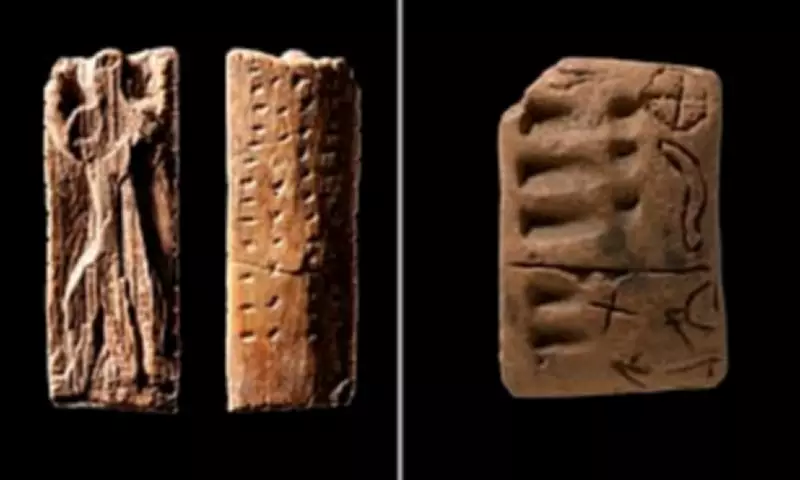
Ancient Bone Carvings Reveal 40,000-Year-Old Symbolic System
Archaeologists have uncovered evidence of one of humanity's earliest known symbolic systems, carved into animal bones and ivory figurines approximately 40,000 years ago. This groundbreaking discovery predates the first Sumerian cuneiform writing from Mesopotamia by tens of thousands of years, fundamentally challenging established timelines of human cognitive and cultural evolution.
Prehistoric Artifacts with Deliberate Markings
Researchers analyzed more than 3,000 individual etchings on 260 prehistoric relics, including flutes, animal carvings, and human-animal hybrid figurines. These artifacts, many discovered in caves within Germany's Swabian Jura region, display 22 recurring symbols ranging from V-shaped notches to lines, crosses, and dots. The systematic repetition of these markings suggests intentional communication rather than random decoration.
'The artifacts date back tens of thousands of years before the first writing systems,' explained study co-author Ewa Dutkiewicz, an archaeologist at Berlin's Museum of Prehistory and Early History. 'There are plenty of theories, but until now there has been very little empirical work on the basic, measurable characteristics of the signs.'
Information Density and Symbolic Hierarchy
The research team discovered that certain objects carried higher 'information density,' with more symbols deliberately engraved per surface area. Figurines particularly exhibited this characteristic, while tools, flutes, and ornaments bore symbols to a lesser extent. This suggests a hierarchy in how symbols were applied depending on each object's purpose and significance within prehistoric communities.
Notable examples include the small mammoth figurine from Vogelherd Cave in southwestern Germany's Lone Valley, which bears multiple sequences of crosses and dots on its surface. Other significant artifacts include the 'Adorant' from Geißenklösterle Cave and the Lion Man from Hohlenstein-Stadel Cave, both featuring evenly spaced notches and hybrid creature depictions.
Statistical Analysis Reveals Structured System
Professor Christian Bentz of Saarland University emphasized the empirical approach: 'The signs on the archaeological objects are frequently repeated—cross, cross, cross, line, line, line. This type of repetition is not a feature found in spoken language.' Researchers applied statistical models and classification algorithms to quantify the carvings' structure, consistency, and information content.
Remarkably, when compared with early proto-cuneiform tablets from ancient Mesopotamia, the prehistoric carvings showed similar statistical properties in structure, repetition, and information density. 'Our findings show that Palaeolithic hunter-gatherers developed a system of symbols that has an information density statistically comparable to the earliest proto-cuneiform tablets from ancient Mesopotamia, which came 40,000 years later,' Bentz revealed.
Implications for Understanding Human Evolution
The findings indicate that humans arriving in Europe during the Upper Paleolithic period were already capable of complex symbolic thought. The systematic use of signs suggests these early hunter-gatherers had developed methods to store and transmit information beyond spoken language, essentially creating an early form of external memory.
While researchers emphasize they are not attempting to decipher the signs' concrete meanings, they suggest several possible functions:
- Recording seasonal patterns or animal migration cycles
- Representing religious or cultural significance through hybrid figures
- Functioning as counting systems or record-keeping tools
- Indicating early social conventions through consistent symbol placement
The discovery pushes complex symbolic communication back at least 35,000 years from previously accepted timelines. 'Little changed between the Old Stone Age and the first proto-cuneiform scripts,' Bentz noted. 'Then, about 5,000 years ago, a new system emerged to represent spoken language, with completely different statistical characteristics.'
Future Research Directions
As researchers continue to analyze and catalog these prehistoric objects, they hope to uncover additional patterns that could further illuminate the symbolic lives of early human communities. 'There are many sign sequences to be found on artifacts. We've only just scratched the surface,' Dutkiewicz acknowledged.
While these carvings do not constitute writing in the modern sense, they provide invaluable insight into the cognitive and cultural sophistication of early Homo sapiens. The study establishes a framework for studying prehistoric symbols more broadly through empirical analysis, opening new avenues for understanding how human communication systems evolved over tens of thousands of years.




