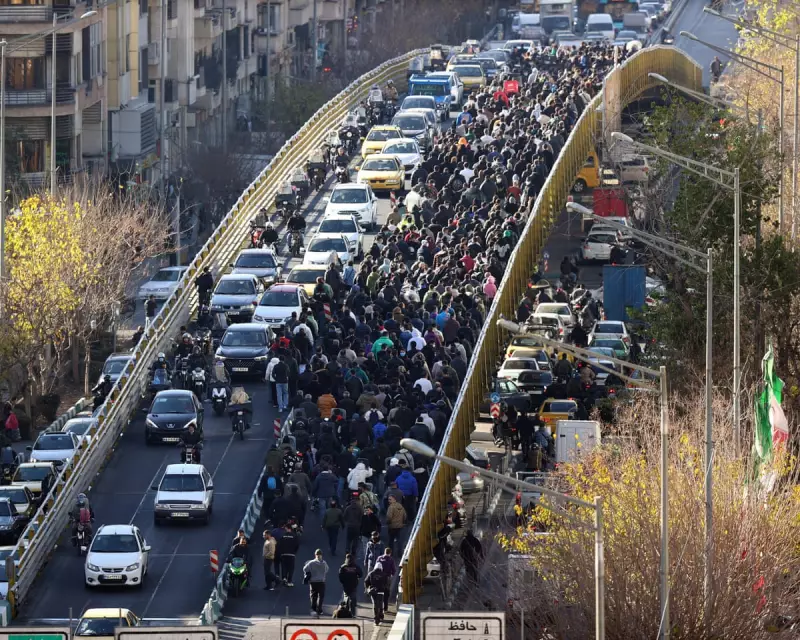
Iran has been rocked by its largest wave of public unrest since 2022, as a dramatic collapse in the value of the national currency has pushed tens of thousands of citizens onto the streets in protest against a deepening economic crisis and the country's governance.
Currency Collapse Fuels Public Fury
The immediate catalyst for the explosive demonstrations was the Iranian rial's plunge to a historic low of 1.42 million to the US dollar on Sunday. This represents a staggering devaluation of more than 56% in just six months, shattering the purchasing power of ordinary Iranians. For individuals like Alborz, a textile merchant from Isfahan and a father of four, this was the final breaking point.
"What will my children eat? Do we have to bring suitcases of cash to simply buy bread?" Alborz told the Guardian, using a pseudonym for his safety. The currency's freefall has sent inflation soaring, with food prices now 72% higher on average than this time last year. This economic pain is compounded by some of the world's most intense international sanctions, which have crippled Iran's access to foreign exchange and frozen funds.

From Economic Grievance to Political Revolt
What began as demonstrations against the catastrophic deterioration in living standards has rapidly widened into a broader condemnation of the ruling establishment. For a fourth consecutive day, students have paralysed university campuses, traders have shuttered their stores, and demonstrators have blocked streets, defying police and security forces.
Social media channels have been flooded with videos showing protesters chanting "Death to the dictator" and "Woman, life, freedom"—slogans that carry severe prison sentences. These chants directly echo the protest movement triggered by the death in custody of Mahsa Amini in 2022, which was violently suppressed. A protester in Tehran shared an image of a metal pellet allegedly fired by security forces, though this claim could not be independently verified.
"For years now, we have slowly but surely made significant changes to our lifestyles because of this corrupt government. This was the last nail in the coffin," said Alborz, adding, "We want the mullahs gone."
Government Offers Dialogue Amid Internal and External Pressure
The government, still reeling from a bruising 12-day conflict with Israel in June, has called for dialogue with protest leaders. President Masoud Pezeshkian instructed officials to listen to the "legitimate demands" of the people. However, protesters remain deeply sceptical, viewing the offer as a tactic to co-opt their movement and drain its momentum.
"If the administration wanted to talk, they wouldn't fire teargas, shoot at protesters... There is no willingness from any of us to talk to them, we want the mullahs gone and we want democracy," stated Farhad, a 19-year-old student activist. Students report that security services have confiscated IDs and made arrests on campuses.
Internationally, the regime faces renewed threats. US President Donald Trump hinted at potential military action, warning he would "knock them down" if Iran renewed nuclear activity—a claim Tehran denies, insisting its nuclear programme is peaceful. Domestically, the powerful Revolutionary Guards Corps vowed to confront any "sedition" or security threats, blaming foreign enemies for psychological warfare.
Despite the intimidation, protesters vow to continue. Alborz reported that people blocked roads and chanted they would not let security forces pass. "We are not going to open shops until the regime weakens further," he declared, expecting trade unions to soon join the expanding strike action.