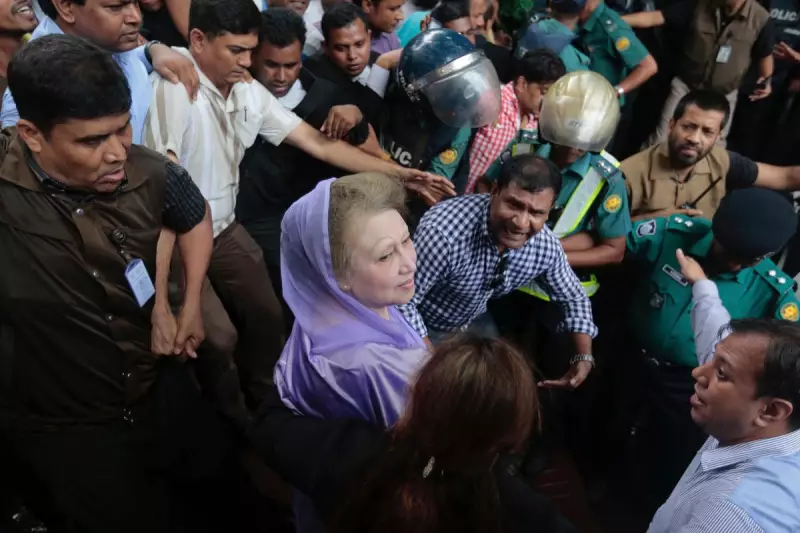
Vast crowds have converged in the heart of Dhaka to pay their final respects to former Bangladeshi Prime Minister Khaleda Zia, who passed away on Tuesday at the age of 80 following a prolonged illness. The funeral prayers, held on Wednesday, drew an immense gathering of supporters, marking a sombre end to a defining chapter in the nation's political history.
A Nation Bids Farewell
Since the early hours of Wednesday morning, waves of people from the capital and beyond streamed towards Manik Mia Avenue, the area outside the national parliament building designated for the ceremony. Authorities had anticipated hundreds of thousands of attendees, with dignitaries from neighbouring nations like India and Pakistan also expected. The coffin of Bangladesh's first female prime minister, draped in the national flag, was transported from the hospital to her residence and then to the venue in a van escorted by security personnel and party loyalists.
To maintain order, the interim government deployed approximately 10,000 security officials, including soldiers, around the site. The government, led by Nobel Peace Prize laureate Muhammad Yunus, declared a three-day national mourning period and a public holiday for Wednesday. Flags flew at half-mast across the country in honour of Zia, who served two full terms and one brief term in office.

A Formidable Political Legacy
Khaleda Zia's journey into politics began after the assassination of her husband, former President Ziaur Rahman, in a 1981 military coup. She rose to prominence as a leading opposition figure during a nine-year movement against a former military dictator, who was ultimately ousted in 1990. Her political ascent culminated in a landslide victory in the 1991 democratic election, a pivotal moment as Bangladesh embraced parliamentary democracy.
Until her death, Zia remained the chairperson of the Bangladesh Nationalist Party (BNP). Known for her calm demeanour, she was locked in a decades-long, fierce political rivalry with her archrival, former Prime Minister Sheikh Hasina of the Awami League. Hasina, who had ruled for 15 consecutive years, was herself ousted in a mass uprising in 2024 and has been living in exile in India. In a stark postscript, Hasina was sentenced to death in November on charges of crimes against humanity related to last year's unrest.
Succession and the Road Ahead
Khaleda Zia was laid to rest on Wednesday beside her husband's grave in a park adjacent to the parliament building. Her political legacy now passes to her eldest son, Tarique Rahman, who is the acting head of the BNP. The party is considered the front-runner as the country looks towards its next general elections, scheduled for February.
The monumental turnout for her funeral underscores her enduring influence and the deep political divisions that have characterised Bangladesh for generations. Her passing closes a significant volume in the nation's story, even as the contest for its future continues.